Why Allowing the Blockading of a Bridge Will Work Against Free Speech
By Vinay Kolhatkar
August 9, 2025
SUBSCRIBE TO SAVVY STREET (It's Free)
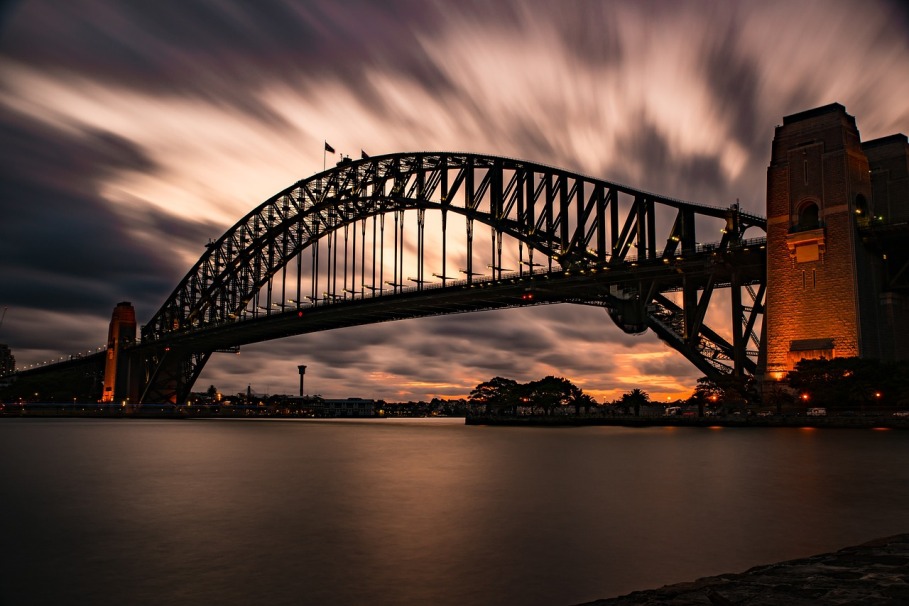
On Sunday, August 3, 2025, on a wet and stormy winter day, an estimated 90,000–300,000 people marched across the iconic Sydney Harbour Bridge to protest against suffering in Gaza. It made worldwide news.
Is such a “protest action” accordant with free speech principles?
Is such a “protest action” accordant with free speech principles? This question is content neutral. It matters not whether such blockading is for or against Net Zero, for or against Israel, for or against Donald Trump.
The First Amendment to the US Constitution enshrines free speech, including the “the right of the people peaceably to assemble, and to petition the Government for a redress of grievances.”
“Peaceable” as defined by Merriam-Webster, means “disposed to peace, not contentious or quarrelsome, quietly behaved, free from strife or disorder”—it’s arguably of a higher order than being merely peaceful.
The NSW Supreme Court decision will work against free speech, elevating roadblocking-style publicity stunts into a form of protected speech.
Perhaps Belinda Rigg, NSW Supreme Court judge, has never grasped the essence of free speech, which is that assembly must be “peaceable”—not interfering with the rights of multitudes of people going about their business. Rigg allowed the misguided Palestine Action Group to block traffic and disrupt thousands of car and bus commuters, unnecessarily costing the state millions in security, alongside the elevated dangers of crowd crush and the inability of ambulances to get to crushed people. Thankfully, no crowd crush came to pass. But Rigg’s decision will work against free speech, elevating roadblocking-style publicity stunts into a form of protected speech.
In Australia, we permit peaceful assembly only as a consequence of being a signatory to international human rights treaties, rather than having such rights enshrined in our constitution. Australia is a party to seven core international human rights treaties. The right to freedom of assembly and association is contained in articles 21 and 22 of the International Covenant on Civil and Political Rights (ICCPR).
But even here, the ICCPR recognizes that:
Under article 21 freedom of assembly may be subject to restrictions imposed in conformity with the law and which are necessary in a democratic society in the interests of national security or public safety, public order, the protection of public health or morals or the protection of the rights and freedoms of others [Emphasis mine].
Your freedom to travel across the Sydney Harbour Bridge, a state-owned piece of infrastructure, is being trampled upon, not to mention the feelings and morals of those stringently opposed to the falsely-framed narrative of IDF-led genocide and manufactured starvation.
In any event, blocking other people from going about their business is not an act of speech.
The Fairness Doctrine and Our Real Free Speech Battle
Elected representatives in Australia are accessible by email, and sometimes via meetings. Even electoral candidates are inundated with email. As a candidate for the federal lower house myself in the May 2025 federal election, I was flooded with emails threatening lack of support if I were not to fall for the leftist narrative on Palestine, much more so than I was as a candidate in the April 2024 federal by-election.
But emails can be ignored, even by those elected. Individuals wanting to exercise free speech can also get together in groups at locations where private owner-managers do not object due to content, group size, or any other issue. No, you should not have a right to protest political issues on university campuses, which are meant for education, unless a privately-owned university allows such disruption—good luck with that.
However, as we stand here today, taxpayers have funded a range of public property, including the Sydney Harbour Bridge, that is unlikely to be privatized any time soon. The managers of these properties, including parklands, bridges, and media mastheads like the ABC and SBS, are arms of governments or delegated entities that morally owe a general duty to all citizens, or arguably, at least to all taxpayers.
In the early to mid-1900s, when radio was the main form of mass communication, and limited bandwidth could be potentially captured by a few owners, the Mayflower doctrine was a mandate implemented by the U.S. Government Federal Communications Commission (FCC) that required American radio broadcasters to “provide full and equal opportunity for the presentation to the public all sides of public issues”. The Mayflower doctrine was replaced by the fairness doctrine in 1949, and it stood the test of time until 1987.
It might seem odd that a Libertarian Party-endorsed, two-time federal election candidate would invoke, of all things, the fairness doctrine.
The fairness doctrine had two basic elements: It required broadcasters to devote some of their airtime to discussing controversial matters of public interest, and to air contrasting views regarding those matters. Stations were given wide latitude as to how to provide contrasting views: It could be done through news segments, public affairs shows, or editorials.
It might seem odd that a Libertarian Party-endorsed, two-time federal election candidate would invoke, of all things, the fairness doctrine, which in its time, the New Left, wary of dominant conservative ownership of the media, loved. But Ayn Rand even invoked the fairness doctrine against government-funded education—and that was an absolute masterstroke.
From a natural-rights standpoint, the fairness doctrine was partially right. It was wrong for government to control media via licensing, which practice should be abolished. Nor should there be any public ownership of TV and radio stations. Then we won’t need a fairness doctrine.
While TV and radio stations are publicly (as in government) owned, a fairness doctrine is applicable.
But, while TV and radio stations are publicly (as in government) owned, a fairness doctrine is applicable, and the public deserves to hear all sides of a major conflict, including what may at first seem the most heretic. For example, the ABC must present, to the public, the scientists and scholars that dissent vigorously from climate alarmism. Even those accused of murder or pedophilia get their day in court, but never those who dissent from popular leftist narratives.
It is eminently sensible to impose a fairness doctrine but only on all publicly-owned media properties. A version of the Zapple doctrine should also be imposed on public media, It needs to be amended such that there would be no restriction on any political party buying any amount of ad time on any public or private media (the original Zapple doctrine required this), but which would require the ABC and such publicly-owned broadcast stations to devote a certain amount of time to minor electoral parties and their policy positions.
The Right to Protest—but Where?
What about physical properties? Where may the people “peaceably assemble”?
People can peacefully assemble on any privately-owned land with the permission of the owner, provided they also do not cause nuisance to neighbors.
Arms of government own numerous physical locations, some of which, such as the iconic Sydney Harbour Bridge, are used by millions every day. Today, people have the opportunity to have their say on social media at no cost besides time they decide to spend on it. The physical town square of the Athens of Ancient Greece, the birthplace of democracy, has been replaced by the digital town square. The when and where of physical assembly can also be organized on the digital town square.
The government could choose from its set of properties, those that would be least disruptive to commuters, and other taxpayers and citizens, when used by a minority segment of the populace to proclaim their grievances.
The state government could choose from its set of properties, those that would be least disruptive to commuters, and other taxpayers and citizens, when used by a minority segment of the populace to proclaim their grievances. Such a facility can be a section of parkland that’s always designated as a soapbox area, such as the Speaker’s Corner in Sydney, NSW, and which should ideally be exclusively reserved by time at a modest cost per hour to avoid conflict. Whether such events attract publicity will be entirely up to the media, where it’s privately-owned. Their owners get to decide what to air.
But, in line with the fairness doctrine, publicly-owned media must mention all public soapbox bookings on their websites. And they must carry some reportage when the event exceeds a pre-determined hurdle (with no discretion allowable to the public-media editors). Publicly-owned media also must cover dissenting views in a neutral, trying-to-understand stance, neither critical nor laudatory.
This is our true free-speech battle—ultimately removing all media (and education) from the biased hands of government actors, but until that happens, forcing government-owned media to play fair.
People armed with reason and evidence do not need such harmful antics, neo-Marxists bereft of logic and Islamists without peace in their hearts do.
Meanwhile, the police are correct to stop proposed blockading actions regardless of their content. Blockading is against free speech. The state should outlaw the publicity stunts undertaken on iconic publicly-owned structures. People armed with reason and evidence do not need such harmful antics, neo-Marxists bereft of logic and Islamists without peace in their hearts do.
Even the non-leftists and non-Islamists who walked the bridge that day, marched against free speech, many without realizing what they were doing.
Even the non-leftists and non-Islamists who walked the bridge that day, marched against free speech, many without realizing what they were doing. They who have their hearts in the right place, but a mind that’s not keeping up, may invoke a Voltaire-attributed sentiment to defend the rights of free speech of those who disrupt our lives with blockading actions that have no resemblance to speech. We should remind them of another quote, also perhaps wrongly attributed to Voltaire: “Anyone who can make you believe absurdities can make you commit atrocities.”
The author thanks Professor Aeon Skoble and Graham Gillard for their reactions to my recent Facebook meme on free speech (Skoble: “Stopping traffic isn’t speech,” Gillard on what “peaceably” means). Both those sentiments were incorporated in this essay.
The first version of this essay “Free Speech Has Nothing to Do with Pro-Palestinians Blocking Traffic,” was published on August 3, 2025, in Spectator Australia and has been expanded and reprinted with permission.

-

O Catalonia! O Gaza! Political Romanticism Rolls On
-

Book Review: Dictators and Disinformation by Jay Friedenberg
-

The New Humanoid Workforce: When Labor Becomes Capital
-

Muddling Through—Until We Don’t
-

Part II: Can We Exorcise the Ghost from the AI Machine?
-

Can We Exorcise the Ghost from the AI Machine?
-

The Intimacy Marketplace Part II: The New Johns
-

The Intimacy Marketplace Part I: From Playboy to OnlyFans
-

Why Freer Governments Also Fear Crypto
-

Blockchain vs. Authoritarianism: A Global Clash for Liberty