
Mamdani Proposes Freezing Landlord Income—Thereby, the Housing Supply
By Walter Donway
August 21, 2025
SUBSCRIBE TO SAVVY STREET (It's Free)
Feature image credit: Bingjiefu He
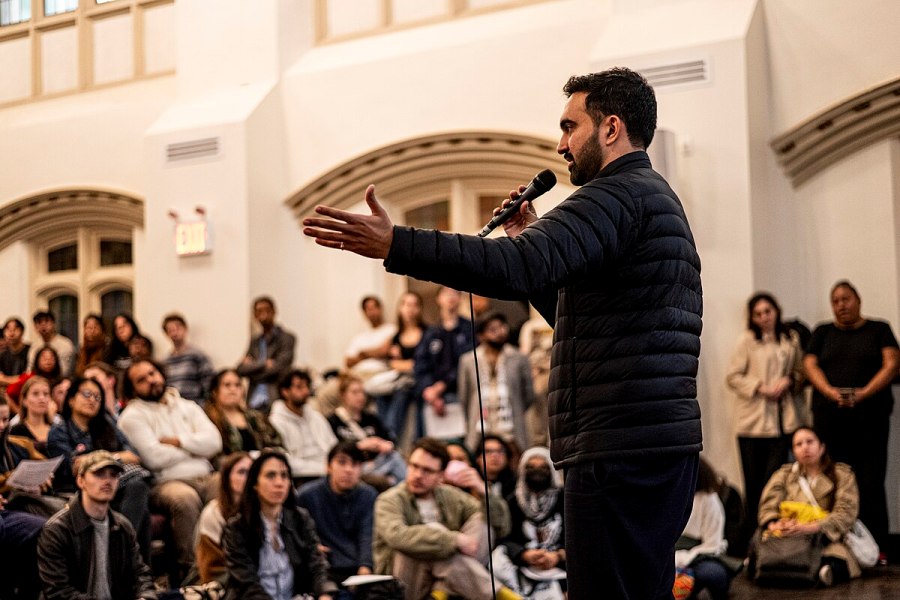
In his campaign for mayor of New York City, Democratic Socialist Zohran Mamdani has called for a citywide rent freeze. He also proposes that the government build 200,000 new rent-stabilized units over the next decade. To many New Yorkers struggling with inflation, including rising housing costs, that sounds like compassion in action. Younger voters especially, trying to settle in a city with skyscraping rents, fall in behind Mamdani.
The young in liberal-leftist New York City are caught up in a storm of righteousness about Israel’s policy and actions in Gaza.
Apart from economic issues, however, commentators point out that Mamdani is Muslim, and the young in liberal-leftist New York City are caught up in a storm of righteousness about Israel’s policy and actions in Gaza. And so, in the city with the largest Jewish population outside of Tel Aviv, a Muslim leads in the race to become mayor.
Their anger at the apartment shortage and rents is justified, but landlords are their fellow victims.
Their anger at the apartment shortage and rents is justified, but landlords are their fellow victims. The exploiter of both tenants and landlords is government—left‑wing, interventionist, special‑interest‑dominated government. (“Socialistic” is not a bad description.) But the younger generation missed the long, bitter lessons of earlier generations with variants of socialism—from national socialism to communism to the British post‑WWII experiment with extreme nationalizing of industries.
Rent control—in the form of freezes, rent caps, and “stabilization”—has a long, tragic record in our city. It has choked off the supply of new apartments, ruined owners of existing buildings, made maintenance uneconomical and unaffordable, and made life increasingly tough for the unlucky losers in the rent-control lottery.
Our “Temporary” Rent Controls (in 1943)
Nowhere in America has rent control clung on longer, and on a larger scale, than in New York City.
Nowhere in America has rent control clung on longer, and on a larger scale, than in New York City. Nowhere have its long‑term failures been more on display. Rent control came to New York as a WWII emergency measure. (It had been tried on the state level after WWI but allowed to expire.) In 1943, Washington D.C. imposed price controls—including on rents—across the U.S. under the Emergency Price Control Act. At the end of the war, the federal controls were lifted nationwide, but New York would not give them up. The City, in that era, had a vocal leftist elite not only in politics but among academics, reporters and editors, and other intellectuals. Sympathy for socialism (including Soviet communism) was outspoken and impassioned. Socialism was a ready solution advanced for almost any public problem. Federal housing price controls were rebranded as New York rent regulations and have continued now for almost 80 years. Now, few cities in America have housing problems as severe as New York’s.
In 1969, the state introduced “rent stabilization” to supplement rent control, governing buildings constructed between 1947 and 1974. Rent regulation has metastasized. As of 2023, more than one million apartments—about 45% of the city’s rental stock—are rent‑regulated, according to the NYU Furman Center’s 2023 report. (Wall Street Journal, Furman Center) The city’s overall rental vacancy rate is just 1.4%, and, for rent‑stabilized units, a paltry 0.98%—well below the national average (~4%) (New York Post).
A measure sold to Americans as a temporary wartime necessity became institutionalized in New York. As its reach expanded, so did its unintended consequences.
Price Controls Everywhere and Always Create Shortages
Rent control has been packaged as special compassion for retired New Yorkers, low-income New Yorkers, newly arrived New Yorkers, and minority New Yorkers, but it is just a government‑imposed price ceiling. When the law sets prices below what would be the market bid, demand rises and supply declines. Tenants snap up and hold onto bargain apartments. Builders redirect investment away from producing new units. Owners of regulated units lose all incentive to spend on maintenance above a bare minimum. The results: scarcity, stagnation of new supply, and deterioration of existing housing. Today, rent regulation is a maze of city and state legislation, regulations, qualifications, exemptions, and special categories—revised and re-revised—that makes the field lush grazing for lawyers, accountants, lobbyists, real-estate agents, and, of course, bureaucracy.
A 2019 study by Rebecca Diamond, Tim McQuade, and Franklin Qian found that rent control in San Francisco led to a 15% reduction in rental housing supply and a 7% increase in citywide rents because landlords converted rental properties to condos or otherwise removed them from the rental market (University of Colorado Boulder, American Economic Association). It is no surprise, of course, that the east and west coast outposts of American left-liberalism share an affair with rent-market price controls. (California and Oregon have some variant of state rent control.)
A city like Austin, Texas—without rent control—saw its housing inventory rise by 17% between 2020 and 2024, compared with only a 3% increase in New York City over the same period.
Meanwhile, a city like Austin, Texas—without rent control—saw its housing inventory rise by 17% between 2020 and 2024, compared with only a 3% increase in New York City over the same period (Wall Street Journal). In Minneapolis, the repeal of single-family zoning and rejection of rent control produced a measurable boom in new construction (Saint Paul Pioneer Press, 2023).
The economic logic of rent control dictated one of New York’s bleakest housing chapters: the abandonment crisis of the 1970s. As nationwide inflation surged, landlords of rent‑controlled buildings—unable to raise rents as expenses soared—walked away. Between 1976 and 1986, the city seized more than 100,000 apartments through tax foreclosure. In the South Bronx, neighborhoods became uninhabitable, buildings were burned for insurance, and catastrophic “de‑densification” followed. We acquired the term “bombed-out zone.”
Landlords As Scapegoats
The stereotype of the wealthy, exploitative landlord who can afford to forego his rental income to help poor struggling families is a Marxist fantasy. A 2019 Rent Stabilization Association report found that three-fourths of rent‑regulated buildings are owned by small landlords—working-class families, immigrants, and retirees. Whatever the size of the property owner or firm, the economics are brutal. In the wake of the 2019 Tenant Protection Act, the market values of rent-regulated multifamily buildings plunged almost 30%, and owner loan delinquencies rose to 16%, compared with under 1% for unregulated units.
According to the Community Housing Improvement Program, two-thirds of rent‑stabilized units operate at or below breakeven after expenses (taxes, fuel, insurance, repairs). Property taxes alone can consume 30–40% of gross rental income—making landlords involuntary tax intermediaries. How about “freezing” real estate taxes?
When landlords can’t cover costs, maintenance suffers.
When landlords can’t cover costs, maintenance suffers. NYU Furman Center reports rent‑stabilized buildings average twice as many housing code violations per unit as compared to market-rate buildings (Furman Center). The 2021 Housing and Vacancy Survey showed that a third of regulated units average three serious maintenance issues, compared with under 10% of market-rate units.
New York’s Privileged Class
Rent-controlled tenants pay 30–70% below market rents and rarely give up their apartments as their income rises. In 2019, the average rent‑stabilized tenant lived in his or her unit for 14.6 years. Distorted economic incentives mean that single retirees, for example, typically hold onto their 3-bedroom apartments while young families struggle.
Well‑off households benefit disproportionately. Chetty, Diamond, and Friedman used NYC tax data to show that many rent‑regulated tenants earn well above median income, especially in gentrifying areas. The Rent Guidelines Board (2019) reported median income of $47,000 for regulated households versus $67,000 for unregulated—though with wide variance (Furman Center). More than 40,000 rent-controlled apartments in the City are occupied by tenants making $150,000 a year or more (sometimes much more).
Sweden’s well-known economist Assar Lindbeck said: “The best way to destroy a city, other than bombing, is rent control.” And NYC Mayor Eric Adams recently remarked: “Gas doesn’t freeze, electricity doesn’t freeze, insurance doesn’t freeze. . . . When you’re not mayor, you can be idealistic. You’re not realistic.” (NYT April 2025).
William A. Moses, founder of CHIP, put it bluntly in 1983: “Rent control is the principal reason for neighborhood deterioration . . . 300,000 apartments . . . would have been built” without it.
The 200,000 new rent-controlled units that Mamdani proposes would increase public housing bound-by-law to abide by future rent-control decisions. (It is not surprising, given his devout “old-time socialism,” that Mamdani plans to pay the $100 billion cost by taxing the wealthiest 1% of New Yorkers.) While rent control shifts housing costs from tenants to owners, public housing, instead, shifts housing costs to taxpayers—arguably fairer. But the NYC Housing Authority, the largest in America, with 300,000 residents in 160,000 units, and subsidizing some of cheapest housing in the city, has become notorious for chronic disrepair (accumulating $80 billion-plus in unmet capital needs), management bogged down in bureaucracy and union rules, a plague of violent crime with gang activity and open-air drug markets in poorly designed and policed layouts, and segregation of the “poor” (or rent-privileged).
Now, just as Mamdani is proposing 200,000 new units, the city is implementing a program to convert units to private management. Mamdani pledges to fix all the problems that have plagued public housing for decades. His proposals reveal his economic illiteracy (or perhaps his cynical exploitation of the economic illiteracy of his constituency. Few policy proposals have been as decisively discredited by economists as rent controls—by experience and in theory. To use government power to limit what the producer can charge, even as the producer’s costs remain the same, discourages new production—that is, new supply, as of apartments. Those who obtain apartments at government-controlled rents enjoy their benefit at the expense of those who face the ensuing shortage of apartments. And, in time, they see their own buildings deteriorate as landlords faced with fixed income from their buildings slash spending.
The economic logic is well-known, which is why few cities have even considered rent-control policies. The fans of such policies are the lucky minority who obtain rent-controlled apartments and pass them on from generation to generation. Or demagogic politicians like Mamdani who promise that government will step between landlords and renters, law will replace the free market, and you will win if your mayoral candidate wins.
Try De-Controlling
If affordability is the goal, New York has better options than trampling property rights and discouraging maintenance. In the immediate term, zoning reform, for example, could allow accessory dwelling units, basement apartments, and multifamily buildings in outer boroughs. Streamlining approvals for new development projects to cut the present 2–3-year wait would lessen the death-grip of the housing bureaucracy. In genuinely desperate cases, subsidies or vouchers might be given to needy renters without distorting the price system of the entire housing market. And, of course, reducing state and city real-estate taxes would be revolutionary—if governments ever could control their spending.
The US Supreme Court declined (November 2024) to review a challenge to rent control brought by landlord groups, but potentially a strong case could be based on the Fifth Amendment’s “takings” clause.
The US Supreme Court declined (November 2024) to review a challenge to rent control brought by landlord groups, but potentially a strong case could be based on the Fifth Amendment’s “takings” clause. Rent control does not “take” a landlord’s property by eminent domain, but it takes much of the value of that property by legally capping its profit potential and hobbling management (e.g., evictions). Justice Clarence Thomas made comments about the urgent importance of reviewing issues raised by rent control. Rent control cases from jurisdictions such as Los Angeles are pending.
For some eight decades, rent control’s fatal contradictions have screwed up housing for generations of New Yorkers. The renowned dynamism of our city has been hobbled by a socialist-inspired “freeze” on a crucial sector of our economy. We need more housing, not more government controls. Mamdani’s proposal is the same-old-same-old. It counts on the economic illiteracy of his constituency. The solution to New York’s seemingly chronic housing shortage is the one that built America and New York itself: an economy free from government controls, regulations, bureaucracy, over-spending and over-taxing, and the imperatives of election-year politics. Affordability requires new supply, not new freezes.

-

O Catalonia! O Gaza! Political Romanticism Rolls On
-

Book Review: Dictators and Disinformation by Jay Friedenberg
-

The New Humanoid Workforce: When Labor Becomes Capital
-

Muddling Through—Until We Don’t
-

Part II: Can We Exorcise the Ghost from the AI Machine?
-

Can We Exorcise the Ghost from the AI Machine?
-

The Intimacy Marketplace Part II: The New Johns
-

The Intimacy Marketplace Part I: From Playboy to OnlyFans
-

Why Freer Governments Also Fear Crypto
-

Blockchain vs. Authoritarianism: A Global Clash for Liberty