
Transcript: Is Left-Libertarianism Really Libertarianism?

By The Savvy Street Show
August 23, 2025
SUBSCRIBE TO SAVVY STREET (It's Free)
Controversies in Libertarianism, Podcast 6
Date of recording: August 12, 2025, The Savvy Street Show
Host: Vinay Kolhatkar. Guests: Walter Block, Roger Bissell
For those who prefer to watch the video, it is here.
Editor’s Note: The Savvy Street Show’s AI-generated transcripts are edited for removal of repetitions and pause terms, and for grammar and clarity. Explanatory references are added in parentheses. Material edits are advised to the reader as edits [in square brackets].
Summary
In this episode of The Savvy Street Show, the host and guests engage in a deep discussion about Left-Libertarianism, exploring its definitions, implications, and distinctions from mainstream libertarianism. They delve into the concepts of thin and thick libertarianism, the role of bleeding-heart libertarians, and the challenges of equal opportunity in education. The conversation also touches on the muddied meanings of political terms and the potential for political alliances within the libertarian movement.
Takeaways
- Left-Libertarianism is often viewed as a controversial subset of libertarianism.
- There are two main wings of Left-Libertarianism: American and European.
- Thin libertarians focus solely on property rights and the Non-Aggression Principle.
- Thick libertarians, like bleeding heart libertarians, add moral considerations to libertarianism.
- Bossism, or hierarchical structures in workplaces, is debated among libertarians.
- Social justice is a contentious topic within libertarian circles.
- Equal opportunity in education raises questions about indoctrination versus education.
- The term “libertarian” has become muddied and may need reevaluation.
- Political alliances can be formed on specific issues, but libertarians should maintain their core principles.
- There is no single method to effectively convert others to libertarianism.
Vinay Kolhatkar
Good evening, and welcome back to The Savvy Street Show. Today is podcast six [in the series on libertarianism], and we have two eminent guests again. You may be familiar with them already. First up, we have Walter Block, eminent libertarian and economist and author of Defending the Undefendable, which I always thought should have been “indefensible,” but now both are English words. Walter changed the dictionary.
Vinay Kolhatkar
We also have Roger Bissell, who is a musician, editor, and philosopher. We won’t need his music today, but we’ll surely need his philosophy. Welcome to the show, Roger, and welcome, Walter, as well.
I always thought that Left-Libertarianism was like an ugly boil on the backside of libertarianism that won’t go away.
Today is podcast six in this series on libertarianism, and today’s topic is a little bit complex. I find myself, to be honest, far less well-read than these two folks here. Should Left-Libertarianism be considered libertarianism at all? I always thought that Left-Libertarianism was like an ugly boil on the backside of libertarianism that won’t go away. You tried everything, creams, antibiotics, bursting the pimple, but it doesn’t go away. But maybe I’ve been wrong and I should have always loved them like their siblings, so we’ll find out if my mind changes today.
Part of the definition of Left-Libertarianism is that the adherents do actually believe in free markets and self-ownership, but they want a redistribution of the products of self-ownership, which is very, very fuzzy, at least in the political sphere. I belong to a libertarian party here in Australia. There is the one in the US, the one in Argentina. I am aware of one in New Zealand. None of them are for higher taxes and redistribution. So, I am going to start with Roger. Does Left-Libertarianism, if I defined it right, does it hold water, and what distinguishes them from mainstream libertarianism? Roger?
Roger Bissell
First of all, if you’ve got any extra cream you could send me, that would be good. ’Cause I think I got one of those boils after listening to your question. [Laughter]
The American wing is represented by thinkers like Roderick Long and Gary Chartier.
Well, to my knowledge, Vinay, there are at least two wings of this Left-Libertarianism community. I’m going to oversimplify a little bit, but I just think of them as the European and the American versions—and I know there’s some of each in each, but we’ll pass over that. As far as I know, the American wing is represented by thinkers like Roderick Long and Gary Chartier, and they do not support redistribution or universal basic income, any more than they do government interference in personal issues or economic issues in general. I could be wrong about this, and Walter—or they later, if they see this—can correct the record. The main wing of the Left-Libertarians, though, do appear to support these kinds of policies. They reject Lockean property rights. Anything you claim to own is automatically up for grabs by the redistributionists, whether it’s local, state or national, whatever. In my opinion, anyone who rejects property rights is automatically non-libertarian, so [to speak of] Left-Libertarians of the European flavor is [actually] a misnomer. These people don’t give any proof that I’ve seen, but they argue that everyone has a collective share in natural resources. So, if you mix your individual labor with this collective property—the woods or the minerals in the ground or whatever—that doesn’t legitimately make it yours; and if you do that, and you try to assert that you own it, you’re actually stealing from the community the thing you’ve produced with your very own individual labor. Also, the community educated you, so they may have that claim on you, too. Like Barack Obama once said, “You didn’t build that,” and Hillary Clinton said, “It takes a village.” Now, where did this notion come from? [About 200 years ago], there was a French anarchist-socialist named Pierre Joseph Proudhon, and his famous saying was “Property is theft.” He meant that if you’re a landowner or a capitalist, you steal your profits from the people who work for you. Of course, there’s no explanation of how the workers own what they produce either, since you could argue that both the capitalists and the workers are stealing the product they make from everybody else. I don’t know how they [resolved that dilemma], but the European Left-Libertarians are definitely collectivists, and they do not agree with property rights. The American Left-Libertarians tend more to be individualists. That’s somewhat of an overgeneralization again, like I said, but that’s my quick answer.
But there is more to it. Even the Roderick Long/Gary Chartier wing, who I think do support Lockean property, are still anti-capitalist because they think capitalism is immoral. Now, why would it be immoral? They do like exchange of property and free markets and all that, [so] why is capitalism so bad? Well, not just because it steals from the community and the workers, but because it treats the workers badly. We know that if you run a business or if you’ve worked for one, a capitalist enterprise is structured like a bureaucracy, it’s hierarchically structured, and it has an authority structure. That means that if you’re a worker, the further down you are in the structure, you are further beneath the owners and therefore you are lower than them, inferior to them, and you’re oppressed by them because they boss you around, they subject you to authority. This idea goes back to Proudhon, also. He said that an employee is “subordinated, exploited: his permanent condition is one of obedience.” So, whether you’re a European or American flavor of Left-Libertarian, you think that a really libertarian economy is going to have production carried out without any authority structure, without any of this nasty stuff they call “bossism.” If there could be such a thing as capitalism-without-bossism, I don’t think they would want to use the government to impose it on the existing economy. Instead, they would like to dismantle the state to get rid of government and then let the voluntary interactions between people just naturally replace authority structures. So, in a way, it would be kind of like Marx: as the state withers away, this bossism stuff would wither away too.
Vinay Kolhatkar
Yes, it is a sort of Marxist syndicalism or whatever they call it. Walter, do you define Left-Libertarians in any other way? Do you regard them as a boil or a sibling?
Walter Block
There are those who are “thin” libertarians and those who are “thick” libertarians.
Well, the way I see the issue, there are those who are “thin” libertarians and those who are “thick” libertarians. What’s a thin libertarian? I’m a thin libertarian. I wish I weighed a little less, but that’s a different issue. We’re not talking about how much you weigh, we’re talking about your ideology, your philosophy. I think I’m one of the thinnest of thin libertarians because, for me, libertarianism is just two things, Lockean private property rights based on homesteading and the Non-Aggression Principle, and that’s it. Nothing else. I agree with Roger that there were two versions of Left-Libertarian. One is Proudhon and Murray Bookchin, who were just total commies. They don’t deserve the name “libertarian,” and I don’t even think they would want to be associated with us libertarians. Then there’s this other group. Mainly they’re focused around this group called Bleeding-Heart Libertarians. The Bleeding-Heart Libertarians have a blog. There are two or three dozen, maybe four dozen of them. Some of the people I would mention would be Roderick Long, that Roger mentioned. I would also mention Mike Huemer and Matt Zwolinski. These are people who are really libertarians, but they’re not thin libertarians. They adhere to the Non-Aggression Principle and private property rights, fine, but they add on other stuff, like you have to be nice. You don’t have to be nice from the thin-libertarian point of view, The thin-libertarian point of view is just a theory of crime. When are you a criminal? You’re a criminal if you grab somebody’s property or you intersect with his body against his will. You don’t have to be nice. I can go up to people and go “Haaaaaaaa!”, and I’m still compatible with libertarianism. Then they add on a whole bunch of other things, like somehow interracial marriage is good. No, interracial marriage is neutral. We have no view whatsoever on interracial marriage, except that it should be legal, of course. But these people are saying somehow it’s virtuous. Well, it might be virtuous according to Left-Libertarianism, but you don’t get any extra brownie points, as far as thin libertarianism is concerned. Another one is homosexuality. For these people, homosexuality is better than heterosexuality, [and] we have to be nice to or kind to [them]. No, we don’t have to. We can avoid them. We can boycott them. We can boycott anyone we damn well please, because boycotting is part of freedom, because we believe in free association. Roger was exactly right on Roderick Long. He believes that bossism is somehow bad. No, bossism isn’t bad. I used to play the violin, and I played in a big orchestra. I’m not that good. And every once in a while, the conductor would say, “Walt, shape up.” The conductor was my boss, and if I didn’t shape up, he would have kicked me out of the orchestra. Well, that’s bossism. It’s voluntary bossism. Nothing wrong with voluntary bossism. Now, coercive bossism is very different. That’s rape and murder and kidnapping and stuff like that.
There are also right-wing thick libertarians.
I wanted to add one more complication, and that is, there are also right-wing thick libertarians. The only one that I know for sure is Hans Hoppe. What’s Hans Hoppe’s view? That homosexuality is bad, that homosexuals should be excluded from society. No, this is an abomination, equally. So, from the thin libertarian point of view, we’re against the left-wing libertarians and we’re against the right-wing libertarians because they each add something to the Non-Aggression Principle and private property rights based on homesteading, and that’s the thin libertarian view. The view of libertarians on homosexuality is that it should be legal. If homosexuals want to have a contract which looks like marriage, God bless them, and if you prohibit that, then you’re violating their rights. On the other hand, to say that they have to be kicked out of society is an abomination. I mean, we’ve got some very, very important homosexual libertarians, Ralph Raico, Ron Hamowy, whole bunches of other people that are magnificent contributors to liberty and libertarianism, and to say that they should be excluded from society is an abomination.
Vinay Kolhatkar
Okay, let me come back to Roger on this whole issue of bleeding-heart libertarianism, and Roger was about to talk about the bosses, which I always think, well, ex ante, you sign a contract, and you agree to be an employee somewhere where somebody is going to be a boss. You can decide, I don’t want to sign a contract. I’ll start my own business. So, over to Roger, bleeding-heart libertarians and this issue of bosses.
Roger Bissell
Well, I’m really done talking about bossism, and I liked everything that Walter said, so let’s just go on and look at the cardiac issue here, the bleeding-heart issue.
Some of them call themselves “neoclassical liberals.” If you want to get a leg up on the others in your field, you put “neo” in front of your label and then, automatically, you’re really cool. Some of them have been promoting Milton Friedman’s ideas, like school vouchers and a negative income tax, some kind of a universal basic income. They’ve been trying to get a foot in the door so that the liberals and egalitarians will talk with them by showing that libertarians are not indifferent to the poor, and all we care about is property rights, blah, blah, blah. Well, as people, that’s one thing, but as libertarians, the whole idea, as Walter said, is: it’s a political [only] philosophy. Zwolinski, he’s the ringleader of that [group]. However, Roderick Long apparently was the one who invented the term “bleeding-heart libertarians.” He came up with this almost 30 years ago. It’s as old as one of my kids.
Now they also talk about “social justice.” That’s a big deal [to them].
Now they also talk about “social justice.” That’s a big deal [to them], and they aren’t just focusing on what the government does or on social programs. They want to dig into what libertarianism means, and they think it’s more than justice or, as Walter said, the Non-Aggression Principle and property rights and homesteading. Roderick, again, he’s the culprit here. He pops up a lot. I helped edit a book with Chris Sciabarra and Ed Younkins about six years ago called The Dialectics of Liberty, and Roderick contributed a piece to it called “Why Libertarians Should Be Social Justice Warriors.” Now, if that’s not a red flag to the bull, I don’t know what is! I’m going to try to be as fair to him as I can, and then I’ll just let it dangle in midair. He says there are actually two aspects of morality that both have to be considered in order for libertarianism to be fully moral. Well, as Walter says, for libertarianism to be fully moral, you just have to not commit a crime. But there are people who think we’re rather thick if we don’t get this idea: there’s benevolence and you have to have a certain minimum level of equality, so there has to be concern for the least advantaged—and there’s also justice, so you have to be committed to homesteading and self-ownership and to the individual. Now, the whole idea is, they try to balance these, and that seems to be the style in the last five or 10 years. A lot of libertarians [are concerned with] how to balance the concerns of individual rights and justice, whatever that might be, however you might define it. Roderick Long is not the only one who’s come up with this notion, but I don’t like it any better than I do this idea that being a bleeding heart, being a person who cares, is an essential part of libertarianism. I get what they’re trying to do. They’re trying to say libertarianism is more than just a political theory, and people should have moral concerns about relationships with other people. But what should those moral concerns be? Well, I’ll figure that out, thank you very much, and I don’t lose my John Hospers/David Nolan membership card if I don’t agree with you on what moral concerns I should have.
I see this whole thing about [bleeding-heart libertarianism and social-justice libertarianism] as kind of a Trojan Horse.
I don’t know if the two of you do or not [agree], but I see this whole thing about [bleeding-heart libertarianism and social-justice libertarianism] as kind of a Trojan Horse. We have a very troubled mixed economy we’re living in—so much discord. When people trot out this and throw it into the current discussion about what policies should be, I just see it more as aiding and abetting the people who are trying to push for more government. I don’t see it working to damp down the amount of government we have. [I also want to point out] that [there are] Right-Libertarians, Christian libertarians—I consider myself a centrist, just a libertarian—and we’re trying also to get clear on what the foundations for liberty are, and there’s not going to be any easy agreement about what there is beyond, as Walter said, the Non-Aggression Principle and Lockean rights and homesteading. Those [three] things ought to be set in stone and not balanced off against something else. If you call yourself a libertarian, and you’re fudging around the edges with those things, I think, like I said earlier, you’re skating on thin ice.
Vinay Kolhatkar
All right, before I move on to equalization of opportunity, I do want to ask you, Walter, whether you want to add to that?
Walter Block
I like Roger’s point about the Trojan Horse. I never thought of it that way. I just thought of [the Left-Libertarians] as suck-ups [to the liberals], but he’s more scholarly than I am. [Roger, protesting: No, no, no!]
I think part of the motivation of these people is that they notice we’re not winning, and they want to win. They want to be accepted. They want the New York Times to publish them or whatever the thing would be, and they’re trying to ingratiate themselves. They’re jettisoning libertarian theory in order to suck up to the mainstream. One of the examples I use is immigration. Now, I’m an open-borders person, and in order to keep bad guys out we privatize everything, and now if you want to come in here you have to get the permission of the owner, and every square inch is owned. But what they’ll do is, they’ll say we should allow the government to keep the bad guys out, but they’ve jettisoned libertarian theory. I see myself as a purist. I don’t like to give up libertarianism. I like to make libertarianism show that it can be pragmatic or utilitarian. I wrote a book on privatizing roads, and the idea here is, we don’t want the government to have roads and do it better. We don’t want to be efficiency experts for the state. That’s what Murray Rothbard called Milton Friedman, “an efficiency expert for the state.” This idea of the school vouchers thing, it’s an attempt to make public education more efficient, where we don’t want more efficient public education. We want private education.
There’s one group I wanted to mention, and that’s called the Triple L [Live and Let Live Foundation]. Marc Victor is in charge of that, and he’s a friend of mine. He sort of veers toward Left-Libertarianism, but not really. I’m not sure where he stands, but his idea is: pure libertarianism, but you have to be nice if you want to be on the inner circle. If you’re part of the Triple L, you don’t really have to be nice. I just thought I would mention that because we’re mentioning all these other groups, and he’s an important part of the libertarian movement, so I thought I’d mention him as well.
Vinay Kolhatkar
Thank you. Now, I am sympathetic to Roger’s Trojan Horse view. I do think that the word “liberal,” which was a pure word, was probably deliberately corrupted by Marxists and neo-Marxists on the Left, and this could be another way of doing it. But leaving that, we are moving into equal opportunity now. And at first glance, it sounds really nice, doesn’t it? We’ll have compulsory and free schooling, maybe even free universities, to equalize the opportunities so that the poor can go and learn just as well, and they start out almost the same. But these people never talk about what the government has a natural inclination to do, [which] is to not educate, but to indoctrinate. And moreover, there are a lot of things that you cannot do even with law. You can’t equal things. There are so many things about humans: talents, physical size, attributes such as natural athleticism, IQ, sexual attractiveness. How do we equalize? [For instance], it always happens on dating sites that a certain percentage of men get 90% of all swipes, and the remaining 95% all put together get 5 or 10% of the swipes. Lots of things cannot be redistributed. There are so many things, such as, one, you cannot equalize the opportunity such as on dating sites and IQ and athleticism. But in addition, where you try to equalize it through free and compulsory schooling, they’re missing an important issue there. Free and compulsory schooling changes quickly into free and compulsory indoctrination.
Roger, how do the Left-Libertarians address this issue?
Roger Bissell
Okay, I wanted to quickly mention that Walter was talking about Milton Friedman being the efficiency expert for the government. He did this for a long time. Back in World War II, he proposed the idea for withholding tax from everybody’s weekly paycheck, so as to help jump start the financing for the US government’s efforts in World War II. It was supposed to be a temporary expedient, right? And yet, it hasn’t gone away.
Anyway, back to your question. I guess it depends on what you mean by “public education.” Now, if the schools and universities are state run, and if the government is setting the curriculum, and there’s compulsory attendance, then that would be a huge opportunity for indoctrination, and it has proved to be. Left-Libertarians would probably oppose that as much as other libertarians would. But if the schools are decentralized and run on a community or local basis, and attendance were voluntary, then I think at least the Left-Libertarians who are really libertarians, like Roderick Long or Kevin Carson, would probably see that as no more of a danger for indoctrination than the fire department or the public roads. You keep the state out of education, and it’s provided entirely by markets or local communities. I think that’s what they’d like to see. They might like to see taxes or fees [that would be given] either directly to the schools or to the parents for vouchers or grants for the kids. But the more competitive and local [education] is, the less they would worry about indoctrination.
Now there’s something related to indoctrination, I think is a real problem on the university level.
Now there’s something related to indoctrination, I think is a real problem on the university level. And that’s, right now we’re seeing the federal government trying to get the universities to end some of the biased policies they have against certain viewpoints and certain ethnic groups. And I fear that’s only going to be partially successful and only temporary, because if the other party wins back Congress and the White House in three years, it’ll just swing back the other way. I have not heard Left-Libertarians speak out much about that except, they say, “Freedom of speech is being violated by denying tax funds or accreditation to the institutions that are hard on the Jewish kids,” or whatever. I just think that they’re not really consistent on who they see as being oppressed and abused. You see certain groups [that more often] ace out the SAT tests, [but what they’re told is], “I’m sorry. You have to go to the back of the line because you’re not an underprivileged group.” That seems to be a real problem. And again, I don’t hear them saying much about that.
Vinay Kolhatkar
Okay. Walter, does equalization of opportunity go down the wrong road, or do they [Left-Libertarians] have a solution?
Walter Block
I don’t have an equal opportunity to be in the NBA.
I agree with you, certainly. I don’t have an equal opportunity to be in the NBA. I’m 5’6”, and I can’t jump, and I’m very sluggish, and it’s not fair. We should have, what did they say, we want a professoriat that looks like America. Well, if we had that [in basketball], then the NBA, which is what, 90% black, something like that?—I think the blacks are only 15% or 14% of the population—if we had proportionality, we’d have to kick out a magnificent athlete who can jump 40 feet up in the air. I’m exaggerating, but only slightly. Somehow, we never want to apply this idea of equalization to the NBA or to the National Football League or anything like that. We just want to apply it to schooling, and Donald Trump, God bless him, is trying to stop this.
Can you find ten conservative or libertarian professors at Harvard? Now, Harvard has around 3,000 professors, but you can’t find ten.
Now, I think I differ a little bit from Roger here who said that when the next president gets in, they’ll push it back to where it is now. Well, at least we’ll have had some small time when we had some sort of representation of conservatives and libertarians. You know what the Sodom and Gomorrah test is? God was going to smite Sodom and Gomorrah because they were evil, and an angel went up to God and said, “If I can find ten righteous people, let them go,” and God said, “Okay.” Well, [for colleges] the Sodom and Gomorrah test is, can you find ten conservative or libertarian professors at Harvard? Now, Harvard has around 3,000 professors, but you can’t find ten. Donald Trump, bless him on this. I disagree with him on a lot of things, but here on Harvard, he is magnificent, and also on Columbia, my old school where I got my degree. What Donald is really saying, if I may put words in his mouth, is: look, you want to be a racist, and you don’t want the whites in there, and you want to have all socialism, fine, go, good, but don’t do it with the government dime or with tax money, and don’t think you’re going to get tax-exempt status either. So, no more funds for you, no more tax-exempt status, and now go, do it. What they say is, somehow he’s preventing them from doing their socialist thing. He’s not. He’s just saying, do it with your own money. Also, he’s going to tax some of their endowment. So, I’m a big fan of Donald on this one.
I think that on Milton Friedman, I wanted to add to what Roger said about this withholding tax supposedly temporary. Ronald Reagan said it well. He said, there’s nothing as permanent as a temporary government program.
Vinay Kolhatkar
Okay, I think all old men should have equal opportunity to walk the catwalk, too, to be [catwalk] models. Where does it stop? So, this brings me to a major concern of mine. I always thought the word “libertarian,” before I started reading about bleeding hearts and the other people, I thought it was free in one sense. It was correct and completely identified us versus liberal, which is a word we still use in the right sense in Australia and in Europe. Murray Rothbard took this word on, “libertarianism,” and I’ll start with Walter on this one. Was that right for Murray Rothbard to choose that word, or maybe it was right then and it’s no longer right? Are we looking for a new word to describe our philosophy, or should we be?
Walter Block
Well, you know, I think that this idea that we want to convert people to freedom and liberty and libertarianism, and should we jettison words so that we’ll be more acceptable? I don’t really see it. Murray used to say, “Anarchy is good enough for me.” I’ve been an anarchist all my life, all this adult life, all this conscious life. So, I don’t see why we should give up on words. The more words we have, the better. They’re always trying to take words away from us. “Capitalism is evil” [they say]. Well, should we say, “We don’t really favor capitalism, but we favor free enterprise?” Why lie? We favor capitalism. We favor free enterprise. The more synonyms we have, the better, and if we have to give up words because it will make ourselves more palatable, well . . .
Vinay Kolhatkar
Sorry, can I interrupt you? Not to make us palatable, but because the word has been muddied, and I think Rothbard’s argument was, the “liberal” word has already been muddied, so let’s use “libertarian.”
Walter Block
Well, we do call ourselves “classical liberals.” The way I see our movement, at the top are the anarcho-capitalists. The next group would be minarchists, limited government, Ayn Rand, Nozick, people like that. Then Ron Paul, a little lower, constitutionalist, because he adds post offices and post roads. Then classical liberals like Hayek and Friedman. Now, we’ve been bashing Friedman, and there’s nothing wrong with bashing Friedman, but you know, he’s not all that bad. He’s a lot better than Joe Biden or any number of other people I could see. So, I think classical liberals are part of our group, and the way I see it, 1% of us are anarcho-capitalists, and the other three are 33% each, roughly. So, I think we should keep the word “liberal,” as in “classical liberal,” which is what we’re sort of known as, whereas if we start giving up words in order to become more palatable . . . no, I think we have to be honest, and we don’t want to allow the worst examples to come up, but we want to stick to our guns or our principles. I think that would be the way to go.
Vinay Kolhatkar
Roger, just let me clarify. I think the word has been muddied, and not to make it palatable, but to make it distinct. I agree with Walter, that “classical liberal” is still very, very distinct everywhere that I see. No one has muddied the waters, yet. One other thing I came up with was “natural-rights humanism.” I published two essays on Savvy Street on calling ourselves “natural-rights humanists.” So, where are you on this whole “name game”? Would you rather “a rose is a rose,” or something else [“Shakespeare: A rose by any other name would smell as sweet”]?
Roger Bissell
Well, first I’d like to clear up this issue about Walter’s notion of trying to make the NBA look like America. The only good thing I could see about that is that it would finally help satisfy the Women’s NBA demand for equal pay because it would so crater the attendance and revenues for the NBA that [the men’s] salaries would plummet, and finally you’d have income equality.
Anyway, the whole issue of what to name our philosophy: if we’re just talking about the political philosophy, the thin view of libertarianism or classical liberalism, I will say there is a problem of muddying and you have too wide an umbrella. It’s like, you’re a dog, but what breed of a dog are you? Well, if you’ve got a whole bunch of incompatible ideologies, like humanism, are you a libertarian humanist? Are you a socialist humanist? You’ve got to call yourself something and make it stick just like “classical liberal” [as opposed to just “liberal”]. People look at classical liberals and [are confused, because they] thought a liberal was somebody who liked big government, and so they say, well, a classical liberal must like Beethoven and big government. [As for] humanism, religious libertarians are going to hear “humanism,” and they’re going to hear “secular humanism,” and they’re going to think, these are a bunch of godless atheists, just like those Russian communists were. So, you’ve got to pick a term and stand your ground and just define it. If you have to stand on your head every other time you talk to people, you do it.
Now, I have a little bit different approach to this, and Vinay and I have worked on this some. Instead of thick or thin, I think that what’s needed is a Goldilocks view, something that’s just right. So, I regard being nice and being just and all this stuff as personal morality. Then over here, you’ve got politics, not being a criminal, respecting people’s rights. In the middle [there would be some kind of social ethics where] people just look at each other as being an autonomous individual who has dignity and needs to be treated as an end in themself, and not something that you can use without their consent. Like Walter said, if you consent to being bossed, what’s the problem? You just do it. But if people go around trying to exploit others or let others exploit them because they have no real constructive purpose, but instead just view people as pawns, that wouldn’t be a healthy society, and it wouldn’t be very enjoyable or constructive to live in. Immanuel Kant and Ayn Rand talked about [this idea]. Vinay and I in our book on Aristotle, Modernizing Aristotle’s Ethics, came up with what we call “four orders of humaneness.” It’s all about not aggressing and respecting people’s autonomy and not just using them like they’re your property—unless you have a contract for it, of course, and then you can do it. So, I think if we could get enough people to agree to look at their fellow human beings that way, then they can do what they want in the privacy of their own home; and if they contract to do this or that or the other, that’s fine. That is the kind of Goldilocks idea that I think would really get us a long way toward a free society. Our Founding Fathers had something really good already set up. They had a society of really responsible people who treated each other with respect. They weren’t necessarily nice, but they recognized that each of them was an individual person that deserved to be respected and their rights to be respected. I think that’s why we have as good of a government as we have still today.
Vinay Kolhatkar
Okay, final question of the day, and I’m going to start with Walter. I guess, just on the name side, we could call ourselves “Right-Libertarians,” if we need to perfectly distinguish ourselves. We will have to, if the number of boils increase a lot, [because] there are BHLs and social justice warriors and all the rest, and we got to cover our ass all the time, as they say, which is a good thing. But then there was Barry Goldwater, who was as free market as one could [get] in politics. On the political side, I [believe] Vivek Ramaswamy as well as one of our [political] co-panelists, Ed Mazlish, use the term “conservatarian.” [Actually,] Ramaswamy didn’t use the term, but that’s where he was leaning, sort of a mixture of conservative and libertarian. Ron Paul got his bigger victories, if you will, standing under the Republican flag. So, if you were high up in the political side or had money like Elon Musk, would you try to merge the Libertarian Party with the Republicans and make for a new sort of a right-wing libertarianism? Walter.
Walter Block
I don’t see us as either right or left.
Well, I don’t see us as either right or left. The conservatives are not so bad on economics, but they’re horrible on personal liberties. You ingest the drug that they don’t like or engage in voluntary consensual sex for money, they’ll put you in jail. The Left is the opposite. They’re not so bad on personal liberties. Oregon was the only state in the union to legalize cocaine—not marijuana, cocaine—which would be a libertarian thing. There are a bunch of lefties in Oregon. They’re horrible on economics, and they’re not so bad on personal liberties, sex, drugs, whatever. So, I don’t see we should have any amalgamation with anyone except for areas where we agree temporarily. For example, Murray was always having amalgamations with the Left on the Vietnam War, because the Left was good on the Vietnam War, namely, they wanted it to end, whereas the Right was horrible. I remember I was once at a YAF [Young Americans for Freedom] conference, and some libertarians were burning draft cards, and the conservatives were bitterly opposed to that. So, I don’t think we should amalgamate, except for the [specific] issues. Like, if it comes up, should we get rid of the minimum wage law or get rid of unions? We can make an alliance with the conservatives. Should we legalize prostitution or pornography? Let’s have a liaison with the Left. Fine. But we have to stand fast for ourselves.
Now, I also wanted to mention one or two things that came up. I’m sure, Roger, it was just a typographical error when you said the Founding Fathers were so great. Minor point: slavery. I’m sure Roger would agree with me on that. Apart from slavery, everything he said, I think, is good. [Roger: Sure.] Yes, I didn’t doubt that for a moment.
What Harvard is saying is, “Donald Trump is ruining our academic freedom.” Well, he’s not.
I also wanted to mention just a little bit about academic freedom and return to Harvard and Donald Trump. What Harvard is saying is, “Donald Trump is ruining our academic freedom.” Well, he’s not. He’s saying you can have all the academic freedom you want on your own dime. But what’s so great about academic freedom? Look, I’m going to set up a Walter Block University. You guys want to be professors? You have to bow down to me. And everything you say has to be, “Walter Block is great,” every third sentence or something like that. Namely, I’ve ruined your academic freedom. Am I a criminal? No, it’s a little crazy. I’m not going to have this university, but I’m trying to say, look, suppose we had plumber’s freedom, and I asked the plumber to come in and fix my bathtub, and he starts fixing the pipe over here. I say, “I want you to fix the bathtub,” and he says, “No, I have plumber’s freedom.” There’s no such thing as academic freedom in that regard.
And then I wanted to mention the pragmatic problem with affirmative action. What you get at Harvard [is] some of the brightest kids [with] 1,600 on the SAT and some people from other ethnic groups [with] a 1200 or 1300, and they’re 300, 400 points below. Now, [the second group] would do very well at Boston University, but not at Harvard, and yet they’re at Harvard, and now the professors at Harvard have a bimodal distribution. You’ve got some very bright people here, and you’ve got some people who are bright, but not quite there. What do you do as a professor? The people who are let in when they shouldn’t be let in, instead of majoring in physics or math or chemistry, they major in black studies or feminist studies or queer studies or something like that. If they had gone to a state university or some other place, they could have majored in something and gone to law school or whatever, but instead they go into poetry or sociology or something, which is just Marxism. So, there are lots of reasons to think of affirmative action being [wrong], and here’s a pragmatic one.
In terms of converting people, I ask: who were the two most successful people in converting other people to libertarianism? My answer is Ayn Rand for my generation and Ron Paul for the next generation. Now you ask, what are these two people like? They were almost polar opposites. Ayn Rand was nasty. If you try to be nice to her, she’ll slap you in the face. I’m exaggerating, but she was not a nice person, whereas Ron Paul exudes niceness. From this, what I infer is that there’s no one right way to do it. If Ayn Rand and Ron Paul, almost polar opposites in personality, are our two most successful people, then there’s no one right way to convert people, and the way to convert people is whatever is comfortable for you. You shouldn’t try to emulate anyone else. Do whatever is comfortable for you, and I think that would be the best way to convert people to libertarianism.
Vinay Kolhatkar
I actually know of an instance where not only some lecturers resigned over this admission policy of equalizing—this was not deliberate ethnicity but something else—but the next semester, they were told to equalize the distributions, so we don’t have all of them all in the “pass” grade, while some of them deserved a “fail.” And a bunch of you standing here are given high distinctions and distinctions. Now you got a distribution [among the lesser class]. It’s getting ridiculous, to be honest.
Over to Roger: would you sort of merge in a sense where libertarians merge with Republicans, stand under the Republican umbrella, if you will, or would you just sit there and say, “Let’s call ourselves Right-Libertarians, and that’s good enough”?
Roger Bissell
No, I like what Walter said on that, what you call “ad hoc” projects where we are supporting a particular issue, as long as you, number one, don’t get yourself identified with them because you’re not clear enough on what you think, and secondly, that you take the opportunity if you feel like it to try to clarify their understanding of the principles involved, and that it’s not just a one-off thing [where no principle is involved].
But I’m still scratching my head, Walter, about how you seem to be saying that the libertarian movement is bipolar. I mean, it’s like you’re saying that it’s partly nasty and partly nice, and my generation and yours is the nasty one. We came from that direction. And then the younger ones, they’re nice. Okay. Maybe that’s the direction libertarianism should go: toward being nice.
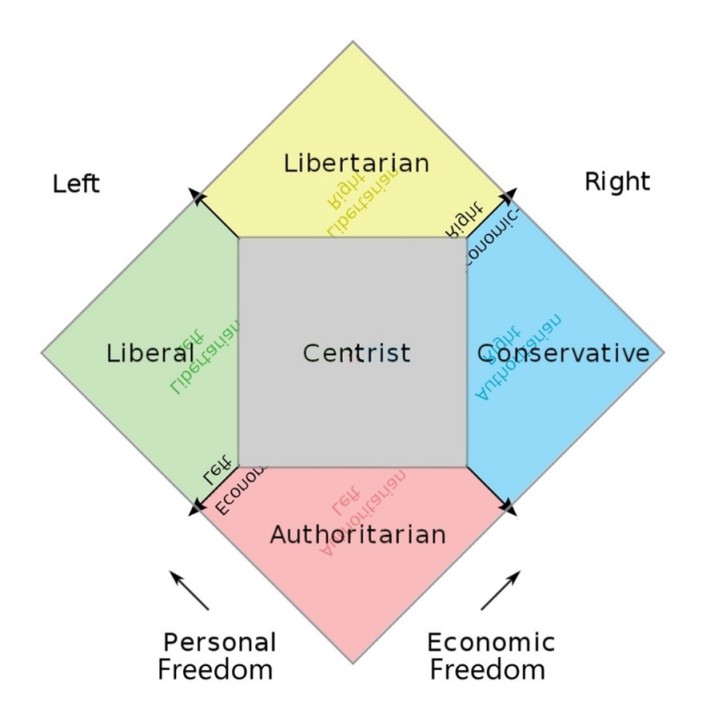
[But speaking of Ayn Rand] about 65 years ago, she started speaking on campuses about this whole thing, liberal and conservative and left and right, and she said, “A plague on both their houses. Neither one of those terms mean anything helpful to help promote liberty.” I think the problem is the conventional understanding of the political spectrum. Most people look at it just as simply as a one-dimensional thing. On the extreme left is communism. And then a little further in, you have the liberals and Democrats. Then on the [extreme] right, you have the fascists, and [a little further in] you have the conservatives and Republicans. In the middle, the problem is not only that you have the moderates and the wishy washy, but they [often] try to put the libertarians there, which is just plain silly. Or [what’s worse], they’ll put us out on the extreme—either commies or fascists, which is usually what they do. David Nolan [founder of the Libertarian Party in the US] had a better idea about 55 years ago, and here’s the diagram.
Now, if you look up toward the top, that’s high economic freedom and high civil liberty, and that’s libertarian. If you have low economic freedom and low civil liberty, that’s down on the bottom, that’s authoritarianism, or we could think of it as dictatorship or totalitarianism of both the communists and the fascist varieties. If you have high civil liberties and low economic freedom over on the left, that’s liberalism, and over on the right, you have high economic freedom and low civil liberty, and that’s conservatism. That’s a bit of an oversimplification, but it really does tell a good story because, going from left to right, from liberal to conservative, that is the spectrum that everybody understands. Also, instead of putting libertarians in the middle, and the authoritarians at either end, you’ve got the libertarians up on the top, where we belong. We are closest to the angels, and the authoritarians down on the bottom are closest to the devils. I think this diagram, if it could be spread around the country, like the Gideons put Bibles in motel rooms, might help more than just about anything to give people a clear picture of how things lay out in the political spectrum.
So, now if you’re asking, should we make common cause with the conservatives over here [on the upper right]? Well, there’s a middle ground on issue after issue. We could get together with them or [on the upper left] with the liberals, but with the authoritarians, no, not so much.
Vinay Kolhatkar
Thank you. This diagram is great. What I love about it is when you say neither left nor right, people assume you’re halfway on every issue, or you’re too centrist. But in fact, on the economics we are way towards the right. But we [libertarians] just face north [like] the compass faces north, so I really like it. I did notice that there was this little pimple on the yellow triangle at the top, which I think is the boil of the social justice people that we’re referring to—bleeding heart libertarians.
Thank you both. It’s been an extraordinarily illuminating and educative discussion. Is there a last line or two that either of you wish to add?
Walter Block
Whenever I take a survey as to where I am politically, left or right, I end up “moderate,” and I’m not really a moderate, because on all the economic issues, I’m on the right, and on all the personal liberties, I’m on the left. What they say on the spectrum is that the closer you are, the more similar you are, so you get Hitler and Stalin, they’re polar opposites [as commonly understood], but they’re buddies [on this Nolan chart]. Then you get Mother Teresa who’s a lefty and Stalin, who are close by. It’s just crazy. So, I think Roger did a splendid favor to us by his examination of the Nolan chart.
Vinay Kolhatkar
Thank you. Okay, it’s been great. And to viewers and listeners, if you want to stay savvy, keep tuning in, and we will see you soon in a couple of weeks’ time with another interesting topic of how we raise money in a classical liberal society voluntarily, and that will be podcast seven. Good night and good luck.

-

O Catalonia! O Gaza! Political Romanticism Rolls On
-

Book Review: Dictators and Disinformation by Jay Friedenberg
-

The New Humanoid Workforce: When Labor Becomes Capital
-

Muddling Through—Until We Don’t
-

Part II: Can We Exorcise the Ghost from the AI Machine?
-

Can We Exorcise the Ghost from the AI Machine?
-

The Intimacy Marketplace Part II: The New Johns
-

The Intimacy Marketplace Part I: From Playboy to OnlyFans
-

Why Freer Governments Also Fear Crypto
-

Blockchain vs. Authoritarianism: A Global Clash for Liberty