
Trump’s Climate Strategy: Benign Neglect – Part I
By Walter Donway
October 23, 2025
SUBSCRIBE TO SAVVY STREET (It's Free)
More than a few people who voted for Donald Trump—perhaps with more hope than conviction he would be less hospitable to the interventionist-welfare state and woke culture—are asking: What has he actually done? One thing that drew me toward Trump in 2016 was his attitude toward climate change because of my conviction that climate alarmism is less about weather than about attacking capitalism. After all, history has seen capitalism blamed for causing wars, impoverishing the “worker,” causing the “population bomb,” and rapidly depleting the earth’s resources (the “limits to growth”). Passage of time discredited them all. Now, we are urged to curtail capitalism and economic growth because the industrial revolution is the new cause of climate change—threatening to bring the earth to a boil. I perceived the “climate change” campaign as an “existential threat” not to the earth but to capitalism—as all previous “causes” were intended to be.
In fact, the subject seemed not to interest him.
That fixed my attention in 2016 on Trump’s peculiar position. For the most part, back then, he did not answer climate questions with arguments or denunciation. In fact, the subject seemed not to interest him. I recall one answer to a reporter who asked about catastrophic climate change. Trump said, “Well, you know the climate always has changed, sometimes drastically, so…” And he trailed off; that was his “answer.”
For those who ask what he has done, it is instructive to track what he has done about climate change since taking office in 2017. In addition, it is a lesson in how things get done in his administration, and how much most of us never see—thanks to the media accusations of perpetual wrongdoing and failure.
Trump’s First Term
By the time Trump took office, combating climate change had become a central tenet of U.S. and international policy. President Barack Obama treated global warming as a crisis and joined in brokering the 2015 Paris Agreement among some 200 nations to reduce greenhouse gas emissions. He hailed the deal as “the best possible shot to save the one planet we’ve got,” a historic turning point in the fight against dangerous warming. At home, his administration implemented policies like the Clean Power Plan to cut power plant emissions and tighter fuel economy standards for vehicles. The climate agenda would demand curbing fossil fuel use and other economic shifts to “save the Earth.” By 2016, the momentum of climate action seemed unstoppable. Science agencies, federal regulations, and global diplomatic efforts all aligned with the goal of drastically reducing carbon emissions in the coming decades.
Donald Trump came to office openly skeptical of climate “alarmism.” As a businessman and then a Republican candidate, he had dismissed climate change as grossly hyped or even a hoax. Back in 2012, he had tweeted, “The concept of global warming was created by and for the Chinese in order to make U.S. manufacturing noncompetitive.” Years later, when reminded of it, he passed it off as a joke—to him, “climate science” was a joke.
During the 2016 campaign, he had made his position clear: He opposed the Paris Agreement and Obama’s climate regulations and pledged to undo anything he saw as an economic straitjacket. He and many of his supporters deemed the global warming “crisis” a partisan ideological pretext for increased government control, higher energy costs, and restraints on capitalism. He tapped into a segment of the public that bristled at climate policies they felt would “hamstring” economic growth without tangible benefit.
When President Trump took office in January 2017, the White House perspective on climate change flipped overnight from fervent engagement to what can only be described as benign neglect. Trump did not wage an overt “war on faux science,” loudly disputing climate data line-by-line; rather, he largely ignored or downplayed the issue altogether. He rarely mentioned “science” or “climate” in public and more than a year into his term he still had not appointed a White House science adviser. Instead, his administration quietly set about pulling the United States out of the global climate framework and dismantling domestic climate initiatives, all while focusing on what Trump cared about more deeply: economic growth, “energy dominance,” and rolling back regulations. Again, this strategy amounted to a de facto climate policy of benign neglect; by simply not prioritizing climate change (and often actively reversing Obama-era measures), Trump effectively sidelined the entire climate agenda. His approach treated climate change as a nonissue or a nuisance, even as much of the world insisted it was an existential threat.
Dismantling the Climate Agenda: “America First” Over Paris
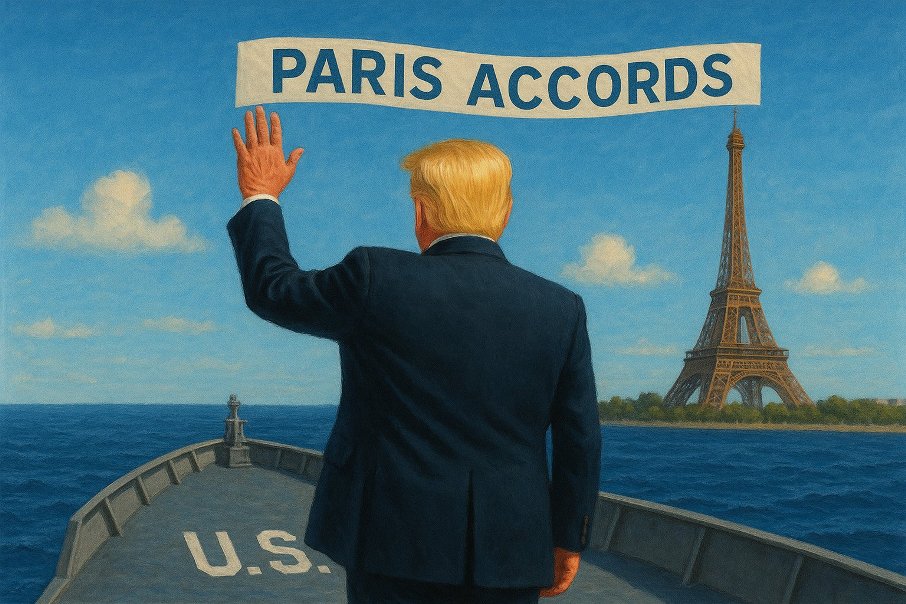
If Trump’s policy toward dealing with climate change was benign neglect, his treatment of climate change investments and commitments was anything but “neglect.” One of his earliest, defining moves was to withdraw the United States from the Paris Climate Accord. Announced in June 2017, the withdrawal sent a clear signal that the new president would not be bound by his predecessor’s climate commitments. In a Rose Garden speech, Trump cast the Paris Agreement not as a heroic pact to save the planet, but as a bad deal that would “undermine our economy” and “impose draconian financial and economic burdens” on the American people. He cited studies predicting the United States would lose millions of jobs under the accord and trillions of dollars in GDP, arguing that other countries like China and India were allowed to continue increasing emissions while U.S. industries suffered. In Trump’s view, “the agreement is [was] less about the climate and more about other countries gaining a financial advantage over the United States”—a “massive redistribution of U.S. wealth” that he would not countenance.
Ceasing U.S. participation cancelled Obama’s pledge to cut emissions by 26–28% by 2025 and stopped payments into the U.N. Green Climate Fund. American climate diplomacy had gone into hibernation. The retreat from leadership, of course, was met with dismay. Allies in Europe, Asia, and elsewhere reaffirmed their own commitments to the Paris accord, pointedly criticizing Washington’s reversal. China’s state media, for example, lambasted “Washington’s political selfishness” and noted that no matter how aggressively Beijing acted, it “won’t be able to take on all the responsibilities that Washington refuses to take.” The rest of the world, it seemed, would press on without America and vowed to hold the Trump administration accountable for shirking what they saw as a shared duty to future generations.
Domestically, Trump’s Paris pullout galvanized a reaction.
Domestically, Trump’s Paris pullout galvanized a reaction. The day of his announcement, a coalition of states, cities, and businesses formed the U.S. Climate Alliance to pledge that “We Are Still In” and will strive to meet America’s Paris goals without federal help. Democratic governors from California, New York, Washington, and a few other states led the charge, claiming to represent tens of millions of Americans and a significant slice of the U.S. economy. Other cities and companies (including some oil majors and Fortune 500 firms) jumped in by recommitting to reducing emissions. Even within Trump’s own cabinet there were differing views—notably, Secretary of State Rex Tillerson (a former ExxonMobil CEO) reportedly advised against withdrawal, and ExxonMobil publicly said the United States “should not back out” of Paris. Trump was unmoved by these appeals; by then he had begun what would be a years-long toughening up under the battering from his opponents (most of the Left media). To him, “America First” meant prioritizing coal miners and oil drillers over faux climatologists and international praise. The United States became the only nation in the world to reject the Paris Agreement at that time, a remarkable reversal of the “historic” turning point Obama had proclaimed just a year earlier.
U.S. withdrawal left a leadership vacuum on global climate action. No other major power left the accord, but U.S. absence meant loss of the world’s second-largest emitter from the collective effort, and a palpable weakening of diplomatic momentum. Trump officials even lobbied internationally against climate measures at times; the U.S. delegation to the U.N. climate conferences under Trump became notorious for hosting their own event promoting coal and fossil fuels as “solutions,” eliciting protests and ridicule from other participants. The U.S. federal government no longer acknowledged climate change as a serious issue, period.
Rolling Back Regulations and Gutting Climate Programs
As mentioned earliest, at home the administration wasted little time translating its benign neglect into concrete policy reversals. Federal agencies that had been mobilized to tackle climate change under Obama made a U-turn to the opposite direction. Most dramatic perhaps was the treatment of the Environmental Protection Agency (EPA), which Trump entrusted to Scott Pruitt, a former Oklahoma attorney general who had sued the EPA multiple times and openly denied the supposed “scientific consensus” that carbon dioxide drives dangerous global warming. Pruitt and his successor, Andrew Wheeler, methodically clawed back climate-related rules and erased climate initiatives:
Clean Power Plan Repeal: The signature Obama policy to limit carbon emissions from power plants was replaced by the EPA with a far more restricted rule (the Affordable Clean Energy rule) that gave states broad leeway and was projected to do little to cut emissions. The rollback of the Clean Power Plan reflecting Trump’s pledge to end the “war on coal.” The Interior Department also lifted a moratorium on new coal mining leases on federal lands to boost coal production.
Auto Emissions and Efficiency: Trump’s EPA and Department of Transportation began to roll back the aggressive fuel economy standards set for cars and trucks. They froze targets and revoked California’s long-standing waiver to set stricter tailpipe standards, sparking legal battles. This reversal of Clean Car Standards meant weaker requirements for vehicle efficiency and higher allowable emissions. (The Biden administration would later restore much of this, but the policy whiplash left automakers uncertain.)
Methane and Air Pollution Rules: The administration also took aim at regulations on the oil and gas industry, including methane emissions limits. Thus, the EPA eased Obama-era rules that required oil and gas companies to monitor and fix methane leaks in wells and pipelines. Similarly, rules on toxic emissions from power plants and limits on coal plant wastewater went on the chopping block. Trump’s team celebrated these moves as eliminating “red tape,” even as environmental advocates warned they would increase pollution.
Social Cost of Carbon & Guidance: Less visible were Trump’s executive orders to withdraw Obama-era directives that climate change be factored into federal decisions. The White House rescinded guidance that agencies consider climate impacts in environmental reviews. It dramatically slashed the “social cost of carbon”—an internal metric of climate damage used in cost-benefit analyses—from around $50/ton to near $1/ton, effectively nullifying the justification for many climate regulations. By redefining the math, the administration made it easier to justify rolling back rules on paper. In contrast with these changes, climate-focused research and advisory programs across the government were downsized or axed. A prominent example was dissolution of the Advisory Committee for the Sustained National Climate Assessment in August 2017. This 15-member panel of scientists, business leaders, and local officials had been created to translate the federal climate-science assessment into guidance for communities. Trump disbanded it, apparently over concerns it lacked enough “industry” representation. (The committee later reassembled independently of the government to continue its work.) Other high-level advisory bodies such as the White House Council of Advisors on Science and Technology (PCAST) went dormant for years under Trump. “Expert” input on climate during an era of proclaimed “scientific consensus” versus denunciation of disagreement as analogous to [Holocaust] “denial,” was viewed with suspicion.
Emblematic of the same suspicion was Trump’s handling of public information on climate change. In April 2017, barely three months into the term, the EPA’s climate change website was abruptly taken down, replaced with a notice that it was “being updated” to reflect the new administration’s views. The site had been a public portal for decades for data relating to greenhouse gas emissions, climate science more generally, and tools for communities. When it went dark, an EPA spokesman explained that the Agency’s website must “reflect the views of the leadership of the agency.” This purge took place literally on the eve of the People’s Climate March, when tens of thousands protested in Washington and other cities against Trump’s climate inaction. Marchers looking up the EPA climate site on their phones saw only a message that the page was “being updated.” Trump’s government was retreating not from climate policy, but from public dialogue about climate science.
Other agencies took action. The Department of the Interior opened federal lands and offshore areas for oil, gas, and coal extraction with no obedience to “climate impacts.” Even the sacred Arctic National Wildlife Refuge was slated for drilling leases. Energy, under former Texas governor Rick Perry, refocused on boosting fossil fuel production. (Perry became notorious for attempting (unsuccessfully) to subsidize coal and nuclear plants under the guise of grid resilience.) DOE renewable energy and efficiency programs at DOE faced proposed budget cuts, while research into fossil fuel technologies (like “clean coal”) was favored. State eliminated its climate change envoy and merged the climate diplomacy office into a broader bureau, signaling lowered priority. And the United States also stopped contributing to international climate funds from which developing nations had been led to expect aid for clean energy and adaptation.
NASA and NOAA, responsible for climate monitoring and research, felt the chill.
NASA and NOAA, responsible for climate monitoring and research, felt the chill. Trump repeatedly proposed slashing their earth science budgets. In budget blueprints, the White House sought billions in cuts to climate-related research at these agencies. Congress did not approve the most drastic cuts, but the intent was clear. The media reported that NASA’s climate scientists felt marginalized; one famous climate research unit (NASA’s Goddard Institute for Space Studies in New York) was abruptly notified it would be kicked out of its building as the administration questioned funding for its work. At NOAA, there were reports of political appointees reviewing scientists’ communications and a general pressure to avoid phrases like “climate change.” NOAA’s critical satellites continued to operate, but a contract for maintaining climate-observing satellites was said to be “slow-walked” by officials. The media characterized the cumulative effect as a deep demoralization among federal scientists. Research projects were dropped or delayed, climate reports were downplayed, and talented experts left government service. (In fact, ultimately hundreds of scientists across EPA, USDA, and other agencies either resigned, retired, or were reassigned during Trump’s term, some in protest and others due to budget constraints.)
The media characterized the cumulative effect as a deep demoralization among federal scientists.
Critics and opponents (and they were legion) charged that Trump’s policy of benign neglect amounted to “pretend the climate crisis doesn’t exist at all.” In practice, this meant erasing climate considerations from federal decision-making. Trump’s team represented these actions as logical cost-saving and pro-business measures. The White House Office of Management and Budget (OMB) asserted that climate research under previous administrations was a waste of billions on “fake science” and burdensome rules, and that “under President Trump, our science agencies are actually doing science again.” Cutting climate programs was thus framed as restoring focus to real science and core missions, free of “politically correct” agendas. In all, the reframing went ahead without apology, without compromise, essentially declaring that much of climate science and policy from the past decade was misguided or illegitimate.

-

Part II: Can We Exorcise the Ghost from the AI Machine?
-

Can We Exorcise the Ghost from the AI Machine?
-

The Intimacy Marketplace Part II: The New Johns
-

The Intimacy Marketplace Part I: From Playboy to OnlyFans
-

Why Freer Governments Also Fear Crypto
-

Blockchain vs. Authoritarianism: A Global Clash for Liberty
-

Human Horticulture—a Missing Link for Objectivism?
-

Healthcare: A System That Rewards Compliance Not Patient Care
-

Mr. President, Take a Leaf Out of the Desert Storm Playbook
-

The Swamp—Muddy Waters Run Deep