
Trump’s Climate Strategy Part II: Benign Neglect Will No Longer Suffice
By Walter Donway
November 7, 2025
SUBSCRIBE TO SAVVY STREET (It's Free)
This was the very opposite of the impression of “drift,” arbitrariness, and “hip shooting” the media consistently conveyed.
We have seen the cumulative, integrated, often bold actions, attitudes, and policies during President Donald Trump’s first term to implement just one plank of the Trump platform: Rollback climate alarmism. Much was reported piecemeal here and there but the media message that reached the public was that Trump had gone on an anti-science rampage of arbitrary destruction that would imperil the future of the planet. When was there a report on the consistency, remarkable extent, and depth of what the administration had accomplished—for better or worse? This was the very opposite of the impression of “drift,” arbitrariness, and “hip shooting” the media consistently conveyed.
Pushback, Protest, and “Plan B”
The inconsistency and ineffectiveness of the Trump climate rollback may have been the media’s theme, but the extent and urgency (panic) of the pushback—the surge of activism and counter-mobilization—during Trump’s first term did anything but minimize Trump’s impact. While the federal government consigned climate change to benign neglect, states, cities, civil society, and segments of business doubled down on it:
In April 2017, four months into Trump’s first term, the March for Science in Washington drew tens of thousands advocating for a return to climate urgency and rebuking “denial.” A week later, the People’s Climate March brought masses to the White House in blistering heat, chanting and waving banners for climate justice. Featuring figures like Al Gore, Leonardo DiCaprio, and Bernie Sanders, the rallies were intended to signal that a large share of Americans rejected Trump’s position. Benign neglect arguably had inflamed the issue—creating a locus of wider resistance, a rallying cry for opposition. His detractors had learned from the media and in their classrooms to paint Trump as the embodiment of anti-science governance and “climate denial.”
powerful states formed the U.S. Climate Alliance on the very day of the Paris pullout.
Powerful states formed the U.S. Climate Alliance on the very day of the Paris pullout.
Ultimately, more than two dozen states (representing half the U.S. population and economy) joined this bipartisan coalition, pledging to meet Paris Agreement targets through local policies on renewable energy, energy efficiency, and emissions standards. Predictably, California accelerated its push toward 100% clean electricity and stricter auto standards. States like New York, Washington, and Massachusetts invested in offshore wind and regional cap-and-trade programs. Even many localities, from New York City and Chicago to tiny towns, set emissions-reduction goals. They wanted above all to tell the world that the United States is “still in.”
To some, opposition from the private sector to Trump’s rollbacks was unexpected. But major corporations, including tech giants (Google, Apple), manufacturers, and even oil companies like BP and Exxon, for decades had become more outspoken on social issues, more politically correct, in their statements and advertising. Nor was it “just marketing”; new generations of CEOs brought the viewpoints and values inculcated by neo-Marxist, postmodernist universities. There was nothing about success and business at the top that required theoretical understanding and commitment to capitalism, the case for it, or the rich history of anti-capitalism.
Thus, when the administration tried to weaken auto-fuel standards, a split emerged: some automakers sided with California to maintain stronger standards, rather than face a patchwork of state regulations and cede leadership in efficiency to foreign competitors. Investors too began demanding climate risk disclosure and low-carbon strategies, a trend that gained steam even as Washington ignored climate change. In short, market forces and global trends kept the train of decarbonization chugging, albeit slower, even during Trump’s term. U.S. coal plants, for instance, continued to retire at a rapid clip—not due to EPA pressure, but because cheaper natural gas and renewables were out-competing coal. Despite Trump’s cheerleading for coal, America’s coal use fell further during his presidency.
Legal challenges from environmental organizations and some state attorneys-general took the Trump administration to court repeatedly.
Legal challenges from environmental organizations and some state attorneys-general took the Trump administration to court repeatedly, including lawsuits to block deregulation that they argued violated statutory duties to protect air, water, and climate. Courts became a battleground when the EPA tried to suspend the methane-leak rule (a federal court ruled the suspension was illegal, forcing enforcement to continue for a time). Likewise, the administration’s attempt to repeal the Clean Power Plan was mired in legal scrutiny; eventually the rule was rolled back and replaced, but the broader question of the EPA’s authority to regulate carbon reached the Supreme Court. (As one long-term impact, Trump’s appointment of conservative justices contributed to the 2022 West Virginia v. EPA decision, which limited the EPA’s options for sweeping climate regulations by interpreting its authority narrowly.) Even by 2020, relatively few major rollbacks had gone fully into effect, still tied up in litigation or procedural revisions. Their fate would depend on the outcome of the 2020 election.
Federal scientists, while constrained, hardly disappeared from the scene. In late 2018 the Fourth National Climate Assessment, a congressionally mandated report, was completed by scientists from 13 agencies. The findings raised the alarm; by later in the century, severe economic damage would result from unmitigated climate change. The Trump administration duly released the report on Black Friday (the day after Thanksgiving) and was accused of trying to bury the news. The report came into the headlines and carried a factual counterpoint to the administration’s claims. Outside government, scientists took steps to preserve data and continue research. Universities and philanthropies stepped up efforts to fund climate science that federal agencies were trimming. There was even a rogue effort by volunteer programmers and scientists to archive government climate data preemptively, in case websites or databases were wiped (an initiative launched right after the 2016 election).
So, while Trump catered to a climate-skeptical segment of the populace, he unsurprisingly stood at odds with overall public opinion on the issue. Editorials almost uniformly accused him of willful ignorance in the face of a mounting crisis. Polls during his term showed the majority of Americans did believe climate change is real and wanted the government to do something. This became a political vulnerability opponents sought to exploit. The 2018 midterm elections brought a wave of Democrats into Congress, some of whom (like Rep. Alexandria Ocasio-Cortez) advocated for a radical Green New Deal—a plan often portrayed by conservatives as the epitome of the “anti-capitalist” climate agenda Trump had warned against. By 2020, Trump had managed to make climate policy not an accepted consensus or orthodoxy, but a key dividing line in American politics. In 2020, he championed fossil-fuel industries and deregulation, while challenger Joe Biden promised an FDR-style investment in clean energy and a recommitment to Paris on “day one.”
Where Did Benign Neglect Leave Us?
Trump’s four years of federal climate-benign-neglect undeniably slowed momentum on climate policy in the United States. Years passed without government’s proactive climate efforts. By the end of Trump’s first term (January 2021), the U.S. had not implemented any comprehensive plan to cut emissions, and the country was formally out of the Paris Agreement. Trump’s critics point to their computer models that showed continued rises in global greenhouse gas emissions and saw climate-linked disasters everywhere from record wildfires in the American West, to devastating hurricanes and floods.
Trump and his allies counter that their approach averted economic self-sabotage and that the apocalyptic rhetoric was overblown. From their perspective, the true impacts of Trump’s climate rollbacks were largely positive or benign for the country. The U.S. economy expanded (at least until the pandemic) and energy prices remained relatively low, partly a function of unleashing domestic oil and gas production. Indeed, under Trump the U.S. became the world’s largest oil producer, hitting record output in 2018–2019. The administration touted this “energy abundance” as enhancing national security and prosperity. They also note that U.S. carbon emissions fell during Trump’s tenure (continuing a downward trend from the mid-2000s), thanks largely to market-driven shifts like the fracking boom making gas cheaper than coal. The market had delivered emissions cuts without heavy-handed regulation. And in a 2017 speech, Trump insisted that even without Paris, the U.S. would “continue to be the cleanest, most environmentally friendly country on Earth…. We’re going to have the cleanest air, the cleanest water, and we’re not going to lose our jobs.” His administration frequently pointed out that U.S. air pollution and CO₂ growth rate had been leveling off, whereas China’s emissions kept climbing—reinforcing Trump’s argument that international climate accords were letting big polluters off the hook while burdening America.
Trumpism cast the climate issue as a matter of economic freedom versus regulatory overreach.
With a somewhat rare reference to ideology, Trumpism cast the climate issue as a matter of economic freedom versus regulatory overreach. Prominent officials in his circle openly framed climate activism as a Trojan horse for socialism. In the later years, Trump’s Energy Secretary even declared, “Climate alarmism has had a terrible impact on human lives and freedom. It belongs in the ash heap of history,” arguing that abundant hydrocarbons are essential to human prosperity. A Trump OMB spokeswoman went so far as to dismiss the prior administration’s climate programs as “Green New Scam and culturally Marxist” endeavors. If Trump had realized in 2016 that climate change, as an agenda, was code for anti-capitalist policies—exactly the assault on free markets that Trump vowed to resist—he knew it now. “Benign neglect” begins to look like a purposeful defense of the American way of life. And despite dire warnings, the sky did not fall—the country did not descend into climate-fueled chaos during those four years.
But if anything, the climate movement grew louder. By 2019, youth-led climate strikes (inspired by Greta Thunberg) saw millions worldwide demanding action, and terms like “climate emergency” entered the mainstream. Even within the United States, despite federal inaction, emissions fell roughly 2% from 2016 to 2019 (excluding the 2020 pandemic drop), as coal plants retired and renewables surged—suggesting market and local forces filled part of the gap. In the end, though, many of Trump’s hard-won rollbacks were temporary. The 2020 election brought President Joe Biden to power on a platform that called climate change “the number one issue facing humanity.” True to his promise, Biden rejoined the Paris Agreement within hours of being sworn in, reinstated many climate regulations, and passed massive investments in clean energy (such as the 2022 Inflation Reduction Act) to accelerate the transition that Trump had downplayed.
Federal agencies quickly returned to publishing reports and enforcing environmental laws under new leadership. Internationally, the United States sought to regain trust by setting an even bolder 2030 emissions target and urging other countries to do likewise. Yet, the legacy of Trump’s first term is significant. He emboldened an ideological base that remains hostile toward climate policies viewed as left-wing or anti-business. The polarization around climate has only intensified, with the issue now entangled in America’s broader culture wars.
Trump’s Second Term
Returning to office in January 2025, Trump swiftly picked up the ball, moving to dismantle much of Biden’s climate policy. Within weeks, he reinitiated the U.S. withdrawal from the Paris Climate Agreement and directed federal agencies to freeze or reverse billions of dollars in climate-related programs. His administration launched a blitz of environmental rollbacks, more than 145 actions in the first 100 days alone, exceeding the total from his entire first term. Trump’s four years in “the wilderness” had given him, his associates, and conservative organizations such as the Heritage Foundation ample time to reflect, dream, and plan for a next term. Among targets were regulations on greenhouse gas emissions, clean air, and other climate measures. At the same time, he again has prioritized domestic fossil-fuel production: opening up federal lands (including parts of the Arctic) for new oil and gas drilling and radically speeding up permits for pipelines and mines. He even declared a national “energy emergency” to revive coal-fired power plants and has blocked many new solar and wind projects, which he was not above deriding as “ugly” installations. The President also installed vocal climate-skeptic officials across the government and again moved swiftly to shrink the role of climate science in policymaking. His EPA administrator, for example, announced plans to cut roughly 65% of the agency’s workforce and agencies were instructed to scrub terms like “climate resilience” and “net zero” from official documents. In a controversial push to reexamine the science, Trump’s Department of Energy convened a panel of contrarian researchers to produce a new federal climate report that downplays human-driven warming—a move mainstream experts unanimously declared “fails to adequately represent the current scientific understanding” of climate change.
The bottom line (if I may) is that Trump’s climate policy of benign neglect achieved in the short run all it intended:
- It freed the U.S. federal government from the grips of climate orthodoxy, for now, emphasizing unfettered economic activity over precautionary environmental measures.
- In liberating economic policy, it racked up achievements in energy production, economic growth, and, contrary to expectation, emissions reduction.
- Trump mounted a response—ideological, political, and practical—to what had been represented as a virtual American consensus, questioned only by the ignorant or malevolent. Refences to “all of us,” “humanity,” “mankind,” and “the world” moving ahead as one to save our planet from the industrial revolution now ring hollow.
Of course, no private person, organization, or institution is barred from as much climate research as voluntary philanthropy or business will buy. But the government had not been taking a position (i.e., benign neglect) on what is in fact new, still controversial, and high-stakes pretend science.
But now it has turned. Trump has taken a more confrontational attitude toward the climate narrative.
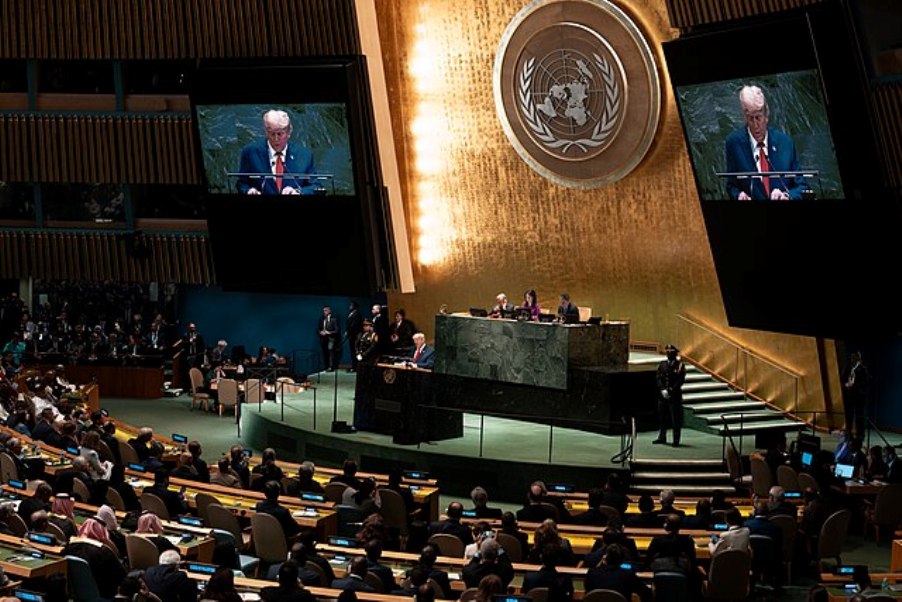
But now it has turned. Trump has taken a more confrontational attitude toward the climate narrative. Addressing the UN General Assembly on Sep 23, he called the climate narrative a “con job” and a “green scam.”
The period of benign neglect is over. Now, a genuine scientific debate on climate must begin, with the sides no longer labeled “scientists” and “deniers”—a debate that the cadres of the anti-Industrial Revolution and their legion dupes have so long and desperately sought to suppress.

-

O Catalonia! O Gaza! Political Romanticism Rolls On
-

Book Review: Dictators and Disinformation by Jay Friedenberg
-

The New Humanoid Workforce: When Labor Becomes Capital
-

Muddling Through—Until We Don’t
-

Part II: Can We Exorcise the Ghost from the AI Machine?
-

Can We Exorcise the Ghost from the AI Machine?
-

The Intimacy Marketplace Part II: The New Johns
-

The Intimacy Marketplace Part I: From Playboy to OnlyFans
-

Why Freer Governments Also Fear Crypto
-

Blockchain vs. Authoritarianism: A Global Clash for Liberty