Trump and Xi Jinping: Back to FDR and “Uncle Joe”?
By Walter Donway
November 14, 2025
SUBSCRIBE TO SAVVY STREET (It's Free)
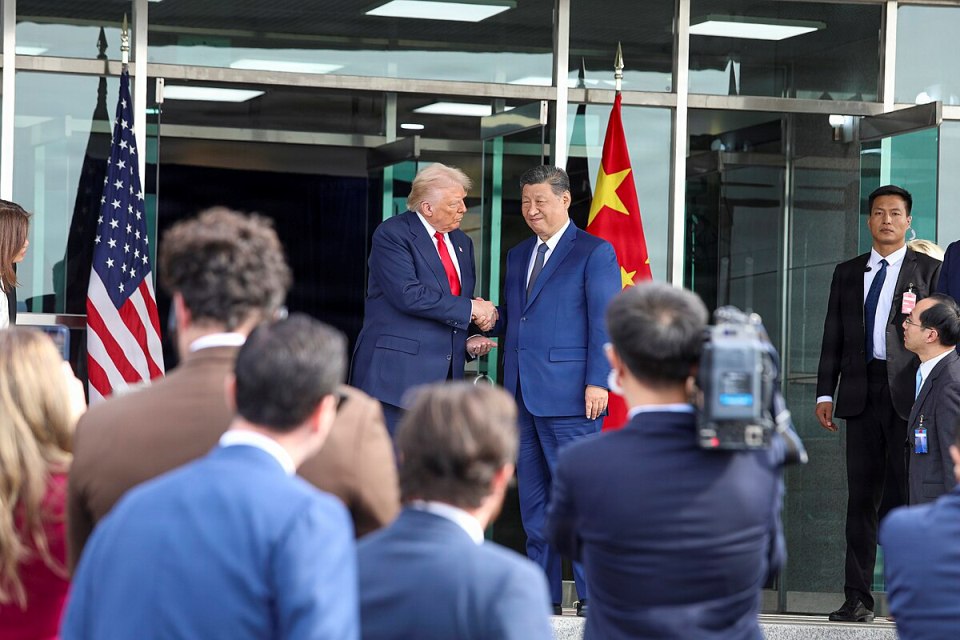
Feature image credit: Sgt. Daniela Lechuga (photograph in the public domain).
I voted for Donald Trump three times because I hoped he would stand firm against the illiberal trends dominating recent presidencies.
I voted for Donald Trump three times because I hoped he would stand firm against the illiberal trends dominating recent presidencies. He promised to address the fundamental concern of America’s founders: the limitation of government power in favor of freedom. He suggested he would put America first in international affairs and push back on what I saw as left-wing betrayal even of “liberalism”—from dogmatic gender ideology to climate alarmism, to racial quota policies. I feel deeply betrayed. During the October 30, 2025, meeting in Busan, China, President Trump heaped appalling praise on China’s President Xi Jinping, calling the communist dictator a “great leader” and even a “great friend.” It was a nauseatingly obsequious display of flattery—in plain terms, sucking up—to the dictator of the People’s “Republic” of China. This spectacle raises painful questions about Trump’s principles. Was his gush of admiration simply cynical deal-making at the expense of America’s values? Has Trump revealed that he lacks the moral compass I once hoped he had? The episode invites an outraged comparison to Franklin D. Roosevelt cozying up to “Uncle Joe” Stalin—another American president whitewashing a brutal tyrant for perceived gain.
Xi’s One-Party Dictatorship
Let’s be clear about who Xi Jinping is and what regime he commands. Since 1949, mainland China has been ruled by a one-party communist dictatorship called the People’s Republic of China. There are no free elections—the Chinese Communist Party monopolizes all power over the state, the courts, the media, and society. Dissent is crushed, and citizens enjoy none of the fundamental political freedoms Americans take for granted. The annual Freedom House survey consistently ranks China among the least free nations in the world, categorized as “not free” every year for decades. This was the Freedom House summary of China in 2024 under the “great leader”:
Xi Jinping has consolidated personal power to a degree not seen in China for decades.
China’s authoritarian regime has become increasingly repressive in recent years. The ruling Chinese Communist Party (CCP) maintains tight control over all aspects of life and governance, including the state bureaucracy, the media, online speech, religious practice, universities, businesses, and civil society. CCP general secretary Xi Jinping has consolidated personal power to a degree not seen in China for decades. Following a multiyear crackdown on political dissent, independent nongovernmental organizations (NGOs), and human rights defenders, China’s civil society has been largely decimated [emphasis added].
Free press? Not in China. The regime maintains total censorship and propaganda control.
Free press? Not in China. The regime maintains total censorship and propaganda control. Independent journalism or open criticism of the government is forbidden. Free speech or internet freedom? Again, nonexistent. The state operates a pervasive surveillance and censorship apparatus (the “Great Firewall”) to silence dissent).
Free assembly or opposition? Absolutely not.
Free assembly or opposition? Absolutely not. The Communist Party brooks no challenges to its rule. We need only recall Tiananmen Square in 1989, when hundreds of thousands of Chinese citizens rallied for greater freedom—only to be met with tanks and bullets. Those mass protests, the first serious challenge to the regime’s authority, were brutally suppressed by the military, with thousands killed or imprisoned. The motivation for the slaughter was the haunting fear that a little freedom might precipitate China into a Soviet-style collapse. Since then, any organized dissent in China has been snuffed out by police force, imprisonment, and other forms of repression. The fate of Tiananmen’s pro-democracy protesters is a stark reminder of the Chinese Communist Party’s ruthlessness toward its own people.
The Rule of Xi Jinping
Xi Jinping’s rule in particular has ushered in even more draconian controls. Xi has consolidated personal power to a degree not seen in China for decades—essentially setting himself up as dictator for life by abolishing term limits. Under Xi, the regime has intensified suppression of ethnic and religious minorities. For example, Uyghur Muslims in Xinjiang have been herded into mass internment camps, a campaign many observers describe as cultural genocide. Tibetans and other minority groups are likewise severely repressed. From Hong Kong’s crushed freedoms to the persecution of Falun Gong practitioners and Christian house churches, Xi’s government shows zero tolerance for liberty.
This is the tyrannical police state that Xi Jinping commands—the state that spies on, controls, and brutalizes its citizens to maintain Communist Party dominance. No free press, no free speech, no free elections, and no rule of law, period. It represents everything opposed to the principles of individual liberty, democracy, and human rights that America stands for.
“The Great Leader of a Great Country”?
Yet, face-to-face with Xi Jinping, Trump, the leader of the so-called “free world,” fawned over him with glowing language. It was beyond diplomatic courtesy—it was outright flattery that ignored the stark moral reality of Xi’s regime. Consider some of Trump’s own words about Xi in recent years:
President Xi is a great leader of a great country, and I think we’re going to have a fantastic relationship for a long period of time . . . it’s an honor to have you with us,” (Trump gushed while meeting Xi, even referring to the dictator as a “great friend.”).
He’s now president for life. . . . And he’s great,” (Trump said admiringly after China removed Xi’s term limits, adding “I think it’s great. Maybe we’ll have to give that a shot someday.”).
I want to thank President Xi, a very, very good friend of mine . . . we’ve developed an incredible relationship,” (Trump declared in early 2020 during the signing of a trade deal with China).
Trump has repeatedly downplayed Xi’s despotism and lauded his stature. He’s called Xi “a great gentleman” and “the most powerful Chinese president in a hundred years,” speaking almost in awe. He often emphasizes how “tremendously well” Xi treated him during state visits—as if a lavish banquet and parade in Beijing mean more than Xi’s tyranny over 1.4 billion people.
Trump has repeatedly downplayed Xi’s despotism and lauded his stature.
Watching President Trump smile and heap compliments on Xi—“great leader, great friend”—was profoundly disheartening. I had expected an American leader I voted for to confront China’s regime with moral clarity. Instead, Trump’s words amounted to sanitizing a totalitarian dictatorship. It felt like a moral betrayal of the Chinese people who suffer under Xi, and of all who believe in freedom. By validating Xi’s leadership in such glowing terms, Trump undercut America’s voice for human rights.
How can America speak again of “the last best hope of earth”?
The Art of the Moral Surrender
Trump’s defenders (I am one) might argue that his praise of Xi was merely strategic—an effort to secure better trade terms or cooperation on North Korea. Indeed, Trump initiated a major trade war with China in 2018 and later sought a deal to ease economic pressure on American farmers and manufacturers. But kowtowing has a dismal record as a “strategy.” Besides, China is known as one of the toughest negotiators in the world; how charmed do you think Mr. Chairman Xi was when Trump leaving a meeting leaned close and whispered in his ear?
American values—especially the commitment to liberty and democratic principles—should never be bartered away for short-term economic gains. By repeatedly referring to Xi as a “great friend” and declining to challenge the regime on human rights, Trump lent legitimacy to one of the world’s most repressive governments. It is not the “Art of the Deal” to praise tyranny; it’s moral surrender. (Characteristically, Trump came away from the meeting declaring on Airforce One that “on a scale from zero to 10 … the meeting was a 12.”
Echoes of FDR and “Uncle Joe”
This is not the first time an American president has flattered a dictator. Franklin D. Roosevelt famously referred to Josef Stalin as “Uncle Joe” during World War II, believing that warmth and goodwill might secure Soviet cooperation. FDR told an adviser, “I think that if I give him everything I possibly can and ask for nothing from him in return, ‘noblesse oblige’, he won’t try to annex anything and will work with me for a world of democracy and peace.” History proved otherwise. Stalin seized Eastern Europe, reneged on promises of democratic elections, and sparked the Cold War.
Trump’s praise for Xi smacks of the same naïveté—or worse, indifference to human suffering. Xi, like Stalin, is unlikely to reform because an American leader offers a kind word. On the contrary, such praise likely emboldens autocrats and demoralizes their victims.
Choose Clarity Over Kowtowing
America can and must engage with rival powers like China. Trade, diplomacy, and competition are inevitable. But that engagement must be grounded in moral clarity. The President of the United States should never whitewash tyranny to flatter a dictator’s ego. Words matter. When Trump praised Xi as a “great leader,” he betrayed not just Chinese dissidents but the ideals he claimed to defend.
If the Republican Party and the American public still believe in liberty, they must reject this brand of transactional morality.
If the Republican Party and the American public still believe in liberty, they must reject this brand of transactional morality. Standing up to the Chinese Communist Party doesn’t require insults or bluster—dictatorship fears most moral clarity and consistent honesty. Trump’s concept of a “deal” with China is dangerous, unprincipled, and unworthy of an American president.

-

O Catalonia! O Gaza! Political Romanticism Rolls On
-

Book Review: Dictators and Disinformation by Jay Friedenberg
-

The New Humanoid Workforce: When Labor Becomes Capital
-

Muddling Through—Until We Don’t
-

Part II: Can We Exorcise the Ghost from the AI Machine?
-

Can We Exorcise the Ghost from the AI Machine?
-

The Intimacy Marketplace Part II: The New Johns
-

The Intimacy Marketplace Part I: From Playboy to OnlyFans
-

Why Freer Governments Also Fear Crypto
-

Blockchain vs. Authoritarianism: A Global Clash for Liberty