
Is AI-produced Art, Art? That Is the Question
By Walter Donway
July 11, 2025
SUBSCRIBE TO SAVVY STREET (It's Free)
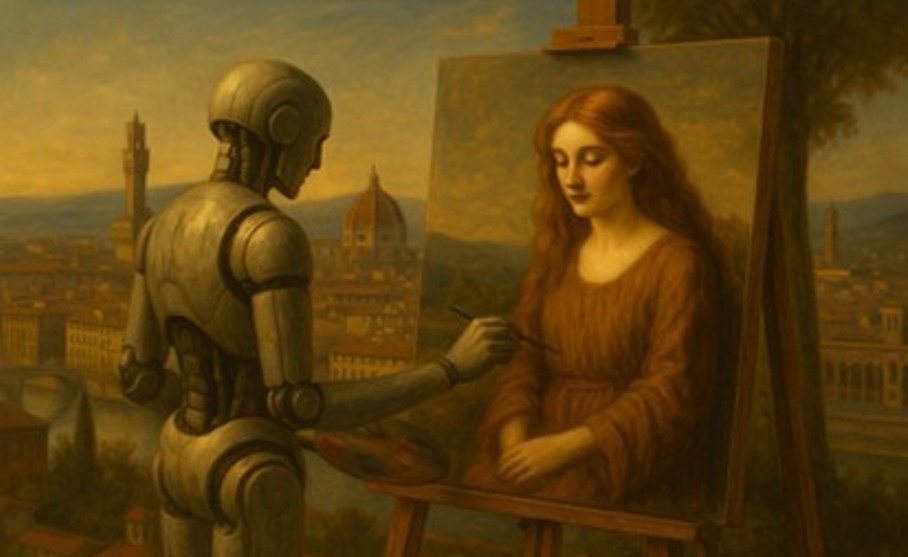
AI as creator portends (threatens?) profound change in our concepts of authorship, originality, and aesthetic value.
Over the past decade or so, artificial intelligence (AI) has gone from a backstage assistant in data processing for the creative artist to a performer stepping out before the audience. The algorithms now write poems, compose symphonies, paint in the visual style of your choice, and write full-length novels.1 The AI as creator portends (threatens?) profound change in our concepts of authorship, originality, and aesthetic value. Albeit, the “profound” change is often heralded mostly by complaints, grumbling, and warnings. Literary agents who interrogate prospective authors about any use of AI in their work, even their pitches, exemplify, I think, an ill-defined anxiety that is rooted in divergent philosophical assumptions about the nature of art, how we judge it, and how we value it. The reason given, however, is that use of AI-generated content, which authors do not wholly own, may violate the standard publishing contract. And, of course, it gets more personal: “Literary agents are freaking out about AI because it will inevitably will be used to replace them as the first-line bounce wall for the slush pile.”
At the end of last year, a new, 176-page biannual periodical, The AI Art Magazine, began publication in Germany and is dedicated entirely to art created by artificial intelligence (AI). Its publisher referred to ours as a “transformative moment in history” when there is a “fusion of human creativity and intelligent machines.”
In other words, he put the best possible spin on a growing controversy with opinion ranging from “a transformative moment in history” to dismissal of the entire notion of “art” generated by computer algorithms as a contradiction in terms—at worst, a threat to the continued existence of human culture.
Better Tools Equal Better Products—And Greater Productivity?
OpenAI’s GPT-4, a large language model (LLM), can turn out essays, short stories, and novel chapters in literally seconds. In 2021, the French publishing house Editions du Seuil brought out Le Robot qui m’aimait (“The Robot Who Loved Me”), a romance novel coauthored by AI. Some literary magazines, like Clarkesworld, temporarily slammed the door shut on all submissions, their editors flooded by AI-generated tales.
AI Virtual Artist and OpenAI’s MuseNet compose original classical and jazz pieces that have been performed by professional orchestras and marketed.
AI Virtual Artist and OpenAI’s MuseNet compose original classical and jazz pieces that have been performed by professional orchestras and marketed. In 2023, an AI-generated song mimicking the voices and style of ‘Drake’ and ‘The Weeknd’ went viral on TikTok and Spotify, propelling the protagonists into legal and ethical debates about ownership in the arts. Musicians seem to worry a lot about AI. Guitarist Jimmy Page worries about losing “the magic of human artistry” to AI. Is it possible to get more specific than “human magic” in arguing for art as, by its nature, created by humans?
And generative adversarial networks (Midjourney or DALL·E), whirring for a few seconds, produce startling imagery in virtually any style. In 2018, a portrait generated by the Paris-based collective Obvious using AI was sold at Christie’s for $432,500. Since then, AI-generated artwork has hung in galleries around the world and been used in commercial design.
But in February of this year, an open letter to Christie’s signed by some 4,000 artists and others demanded that Christie’s cancel its “Augmented Intelligence” auction slated for later February and early March and advertised as the “first-ever AI-dedicated sale at a major auction house.” Estimates were that the works would range from $15,000 to $250,000, and earn Christie’s at least $600,000.
“Many of the artworks you plan to auction,” said the letter, “were created using AI models that are known to be trained on copyrighted work without a license. These models, and the companies behind them, exploit human artists, using their work without permission or payment to build commercial AI products that compete with them.”
And it concluded: “Your support…rewards and further incentivizes AI companies’ mass theft of human artists’ work. We ask that, if you have any respect for human artists, you cancel the auction.”
Christie’s replied, arguing in part that these were works “augmented” and “enhanced” by AI and “not a replacement for human creativity. Christie’s went ahead with the auction, which earned considerably more than expected, with one work selling for $277,200.
Art critic Jason Bailey argues that AI art is not the end of human creativity but the next chapter in its evolution.
Art critic Jason Bailey argues that AI art is not the end of human creativity but the next chapter in its evolution. We’ve gone from painting cave walls to programming neural networks. Each new tool redefines the artist. That may be said to be the optimistic, tech-friendly “pro-AI” stance. AI is “just a tool,” and we have always used tools in creating art. Okay, and even if we haven’t always used tools, the use of tools in every other field of endeavor is viewed as an advance. Better tools equal better products, better productivity.
A Few Highlights of the History of Aesthetics
This anodyne perspective has not dampened debate about authenticity, authorship, and aesthetic value. How could it? These debates are fundamental and enduring within aesthetics theory, and aesthetics theory early on was elevated to the rank of core philosophy: metaphysics, epistemology, ethics, politics, and aesthetics. Pretty much from the outset, I think, a central question (if not the central question) has been whether we should judge the work exclusively on its internal merits, on the work in itself as an independent artefact, without regard for externals such as authorship, nationality, or adherence to cultural norms—or, on the contrary, consider the context of creation, including the identity and intentionality of the creator. In coming to a final assessment of Michelangelo’s “David,” should we bring in Michelangelo’s gender preferences, his attitude toward women, and his sincerity about Christianity? Or even care if it was created, in fact, by Michelangelo’s assistant?
Broadly speaking, classical theories of aesthetics opted for evaluating the work of art solely on the “internal evidence”—on what we discern in the work itself. Aristotle, in his Poetics, analyzed tragedy in terms of plot, character, diction, thought, melody, and spectacle—and you could see that on the stage. Yes, evaluation emphatically included the function of tragedy to produce moral and psychological outcomes (catharsis and moral instruction). The critic judged the work’s form and function. Both were intrinsic characteristics. Aristotle did not include in his judgment how those qualities of the work had been created.
The aesthetics of “artistic autonomy” emerged during the eighteenth and early nineteenth centuries. Immanuel Kant (1724–1804), in his Critique of Judgment, 1790, made famous the argument that aesthetic judgment is “disinterested.” Personal stakes, moral utility, and conceptual analysis are irrelevant. Beauty is appreciated “without a concept,” judged in itself. This reflected Kant’s mystical concept of Reason, the faculty that, unlike “understanding,” could know the “thing in itself”: reality, God, morality, and beauty. But Kant also valorized art as a unique expression of individual genius, emphasizing that originality and authenticity are inherent in human creativity. This could lay the foundations of the Romantic era in the arts and perhaps also the foundation for fundamental skepticism toward the AI-generated work of algorithms without talent, authentic feelings, or experience of the human condition. During the ensuing Romantic era, Samuel Taylor Coleridge (1772–1834) in England advanced the notion of the “organic unity” of a work of art, which has “had legs” in aesthetics theory.
With twentieth-century formalism, the idea of “art for art’s sake” assumed its name and strictest expression. The Anglo-American movement, with Cleanth Brooks and the New Criticism, emphasized treating the text as an autonomous object. The slogan “art for art’s sake” (in French l’art pour l’art), associated with Théophile Gautier and later Oscar Wilde, enunciated the ideal. Art should be self-justifying, not a vehicle for ethics, politics, or practical function. And presumably not justified as a vehicle for human talent or creativity—however interesting that might be in psychology.
Literary modernism, particularly the ideas of T.S. Eliot, complicated the aesthetics debate. In “Tradition and the Individual Talent (1919), Eliot urged that artistic creation is more than personal, more than expression of “isolated genius.” It is a running dialogue between individual artists and a prevailing cultural tradition. Thus, Eliot saw “true creativity” as the thoughtful engagement and reshaping of inherited artistic frameworks. And goes much further with the idea that the poet’s work “is a continual surrender of himself as he is at the moment to something which is more valuable. The progress of an artist is a continual self-sacrifice, a continual extinction of personality.” That makes it sound as if AI-generated content should be admitted as a new mode of engaging with cultural tradition—a computational, not cognitive, reshaping of existing forms and ideas. But what if we don’t know that a given work of art is AI-generated, and it resonates with us with existing cultural forms and traditions? Were we mistaken, “taken,” or does the work achieve something akin to artistic authenticity?
Beardsley may have come to the aid of AI with his audience-centered aesthetics, which insists on ranking the value of a work of art by the experience it provides to the audience; the authorial intent or identity is not relevant.
Monroe Beardsley may have come to the aid of AI with his audience-centered aesthetics, which insists on ranking the value of a work of art by the experience it provides to the audience; the authorial intent or identity is not relevant. If I sat yesterday evening in the audience and experienced, let us say, “catharsis,” or uplift, or affirmation of life’s goodness, then, frankly, who cares if the author was ChatGPT4?
In the past half-dozen years or so, articles have asked more often how AI can fit in than if it can fit in. Barney Davey is perhaps a little brazen: “My thoughts, research, original content, and concepts guiding and informing AI-generated copy threads responding to my prompts make up this article. I collaborate with cutting-edge AI tools like ChatGPT, Bing CoPilot, Google Bard, Grammarly, QuillBot, and Frase.io.”
The Aesthetics Turing Test
One implication is that if even professional critics cannot reach consensus on an AI-generated literary work versus a human work, then is there a meaningful difference in aesthetic value between the two works? (This has been called the application of the Turing test to artworks.) Are we clinging to an ineffable “plus,” an elusive quality that must somehow be present exclusively in human-authored works?
Well, these arguments have been around for a while, now, but contemporary resistance to AI-generated content seems, if anything, to have strengthened. Are we talking about something like Walter Benjamin’s concept of an “aura,” the unique authenticity traditionally associated with original artworks? Benjamin insisted that technological reproduction (never mind technological creation) diminishes the aura, risking reducing art to a mere commodity and repetition. Critics similarly fear that AI’s capacity for endless, effortless production eventually will converge in cultural homogenization. The individuality and authenticity for which we value art will be extinguished.
I think that in waving away manuscripts tainted by AI, literary agents may believe they are safeguarding a grand tradition of literary authenticity, a human-centered vision of art, and thus protecting the integrity of creative professionals. If so, I believe they must agree to pay the price of prioritizing authorial identity and human intentionality over the merits of the work itself, standing astride the advance of artistic evolution and shooing it back.
But wait, can the history of new technologies help us? Are there instructive parallels in the introduction of photography, cinema, electronic music, and digital media—all igniting anxieties not unlike AI? A photographer snaps a picture of landscape with accuracy and a degree of detail an artist devoted to realism might work for months to achieve. Where is the creativity? The camera can see nothing and understand nothing but does all the work of the artist in a second. The motion picture camera has capabilities that no artist can match. Those fears now are agreed to have proved largely unfounded as these technologies spread, becoming new art forms and new collaborations among the arts rather than circumscribing creative horizons. From this historical perspective, can we view resistance to AI-generated art as reflecting our age-old discomfiture with the new, with cultural change, and not objective aesthetic judgments?
Is the Whole Damn Thing Possible?
Okay, but what about the metaphysical argument? If art is defined by its effects—that it evokes emotion, provokes thought, or creates aesthetic pleasure—then AI can create art; its outputs can do all those things. By this definition, the essence of art is not a creator with consciousness or feelings, but a response evoked in an audience.
But if art is defined as the expression of the human personality—a conscious inner life, human joy, pain, or longing—then AI is disqualified. It lacks “qualia,” subjectivity, and the existential stakes for which living things play. We are back to the question: What is art? Outcome or origin?
The AI supposedly generating art is not capable of experience, emotions, memories, mortality—or any context in which something has “meaning,” no “soul.” At best, it produces only an imitation, wax fruit or plastic flowers. Again, this clashes with Romantic era and Existential aesthetics: art as the authentic expression of the self in the world.
And if critics judged a work of art created mechanically with no awareness to be beautiful? If it moves us, but was it created by an entity that did not experience what we do? In other words, if it passes the Turing Test?
Artists like Andy Warhol mechanized art, in a sense, and blunted authorial identity. Generative art long preceded AI, employing randomness and code. So, just call AI the next medium? If it creates something that strikes us as novel, engaging, or “culturally resonant,” just call it art and move on?
Of course, many or most creators who use AI won’t identify with the argument thus far, because we have been arguing “either/or,” while AI today is almost always a tool in a co-creation model. Almost always humans prompt, AI generates, humans curate—request tweaks, revisions, editing.… That makes AI a tool, not an autonomous artist. The creator does not doubt that he or she is the artist and is just using an innovative tool, a novel brush. There are AI models, of course, that “generate content” with no prompting: for example, procedural systems that work on their own. Is that sophisticated machinery also a “tool” or a “creative agent”?
And in Conclusion…
If we were asking if AI will “win,” secure an enduring place in the vast and diverse world of “the arts,” then we could answer immediately. It already has won. No new technology that changed human existence in fundamental ways—and AI has just begun to do so—has gone away. And that includes weapons of mass destruction, of course. AI directly (and to a potentially unlimited degree) augments human capabilities. The tech industry already is betting trillions of dollars that we will not forego that fundamental, almost metaphysical, advantage. There are many AI uses in the arts, especially commercial applications, that no longer are controversial. We may not even be aware of experiencing some of them as in commercials, online visuals, and magazine illustrations—not to mention in what we read and the music we hear.
No new technology that changed human existence in fundamental ways—and AI has just begun to do so—has gone away.
But the question is if AI art will be accepted at some point into the cultural canon, our concept of our heritage in the arts—accepted either as a way to contribute to existing genres like painting, poetry, and symphonic music or as a separate but equal genre of its own. (Notably, there already is controversy over what should be admitted into the canon of “true art”: non-objective painting? Rap music? Electronic music? Free verse? “Found” sculpture? Here, the question is not how they were created but if, as works, they fall within the definition of music, poetry, or sculpture.)
I could ask ChatGPT4 to reach a conclusion, at this point, to finish the essay—but among other things, that would be sneaking in an answer (“yes, use AI”) to a debate I don’t think is ready to be settled. Yes, it could be settled easily if we reached a consensus on a definition of art. The work in itself regardless of origins? The highest expression and record of the meaning and importance of what we have experienced—thought, felt, and done? Or both? If that could be settled…
But the long history of opposing aesthetic theories, especially the glorification of the artist as larger-than-life during the Romantic Era (two million Parisians attended Victor Hugo’s funeral in 1885), still whispers today that with AI something goes missing, something human, something like the soul—beware!
_____________________________________________________________________________________________________________________
- Well, perhaps not full-length novels. Futurist par excellence, Ray Kurzweil, in The Singularity is Nearer (Random House, 2024), explains how large language models (LLMs) must keep track of the possible associations of each word in a sentence. A statement of 50 words requires astronomical levels of computing power. AI cannot keep track of the plot of a novel. Someday.

-

O Catalonia! O Gaza! Political Romanticism Rolls On
-

Book Review: Dictators and Disinformation by Jay Friedenberg
-

The New Humanoid Workforce: When Labor Becomes Capital
-

Muddling Through—Until We Don’t
-

Part II: Can We Exorcise the Ghost from the AI Machine?
-

Can We Exorcise the Ghost from the AI Machine?
-

The Intimacy Marketplace Part II: The New Johns
-

The Intimacy Marketplace Part I: From Playboy to OnlyFans
-

Why Freer Governments Also Fear Crypto
-

Blockchain vs. Authoritarianism: A Global Clash for Liberty