
OMG! Is That the Singularity Coming Over the Horizon?
By Walter Donway
August 3, 2025
SUBSCRIBE TO SAVVY STREET (It's Free)
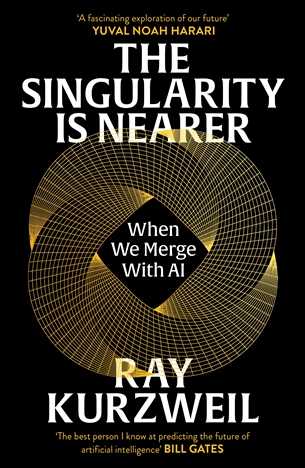
Book Review: The Singularity Is Nearer: When We Merge with AI by Ray Kurzweil. (Viking, 2024).
Ray Kurzweil is identified as a “futurist” as Merlin is identified as a “magician.” A virtual equation in the public mind. He is the foremost futurist and technology visionary of our time. A scientist, inventor, and technologist, Kurzweil is renowned for a series of bestselling books on future technology that have become almost legendary. The reason is his spectacular (and resolutely optimistic) predictions and their track record of success. Kurzweil does it all: computer science, biology, and biomedicine, philosophy, and ethics. All in service of understanding and shaping humanity’s future. He is identified above all with the concept and prediction of the Singularity, first elaborated in his 2005 book, The Singularity Is Near, and now (many books later) taken up in his 2024 The Singularity Is Nearer—including an examination of trends that tend to reinforce his predictions.
Kurzweil does it all: computer science, biology, and biomedicine, philosophy, and ethics.
This is serious stuff. The acceleration of computing power per dollar cannot be denied. Nor can its manifestation in once-inconceivable artificial intelligence (AI). Nor can its already demonstrated potential for driving neural networks that challenge the claim of biological brains to a monopoly on “intelligence.” The Singularity is billed as the crowning evolutionary human transition or transformation, in which human intelligence merges with computer intelligence to give us brains that are “millions” of times more powerful. The long human history of technological advancement will accelerate exponentially, outstripping our present ability to even comprehend, let alone respond adequately to, its outcomes. (Kurzweil has many recommendations for preparing for and controlling this exponential explosion of intelligence, human and otherwise.)
The Singularity: Still on Schedule?
The Singularity, he predicted two decades ago, will be reached around 2040, when three trends converge: the exponential increase in computing power (already spectacularly evident today), a greatly enhanced (and currently unimaginable) level of understanding of and ability to engineer consciousness itself, and advances in biology and health technologies to extend human life indefinitely. “The Singularity is a future period during which the pace of technological change will be so rapid, its impact so deep, that human life will be irreversibly transformed.”
The Singularity, he predicted two decades ago, will be reached around 2040, when three trends converge.
What? In 15 years? But that is Kurzweil. No predictions decades beyond our lifetimes. Most of the readers of The Singularity Is Nearer will be around in 2040 to see for themselves. Kurzweil was born in Queens, New York, in February of 1948 (and so is 77) and by disciplined life-extension is trying to reach the next bridges to immortality. He sure looks good.
Power, and More Power…
Driving Kurzweil’s thinking and predictions is his insight into how computing power and its cost, unlike their earlier slow but sustained progress, are now in a self-reinforcing, exponentially accelerating feedback loop. The best-known formulation of this is Moore’s Law, which originally observed that computing power roughly doubles every two years, while costs simultaneously drop. Kurzweil says this trend, where progress accelerates progress (for example, AI is used to enhance AI) has consistently held true for decades, and the acceleration keeps accelerating.
To understand the staggering implications, consider that your smartphone uses computational capacities far beyond those of the supercomputers used by NASA during the Apollo moon landings.
To understand the staggering implications, consider that your smartphone uses computational capacities far beyond those of the supercomputers used by NASA during the Apollo moon landings. One Google project, today, “Talk to Books,” has computing power enough to take any given sentence and compare it with each sentence in 100,000 books (500 million sentences), and do so in half a second.
This exponential improvement in computational capability is foundational for achieving the milestones envisioned by Kurzweil in technology, life-extension, engineering the brain (with nanobots able to reengineer the inside of cells), space exploration, creativity in the arts…“By the 2030s, the nonbiological portion of our intelligence will predominate.”
Kurzweil illustrates with the computational capacity required to simulate the human brain’s basic functions—via information, not necessarily its structure—like pattern recognition or sensory integration, which require vast computing resources. Kurzweil pushes the boundary further, envisioning a future where technology can duplicate the human brain, cell by cell, neuron by neuron, including the intricate intracellular structures such as mitochondria that play critical roles in cell metabolism (and so aging) and function.
This detailed replication would require computational power millions of times greater than the current leading supercomputers. Yet, according to Kurzweil’s projections, such computing power will become attainable within mere decades, thanks to the mathematics of exponential, self-reinforcing growth, “but most importantly, we will not be dependent on the survival of any of our [ageless] bodies for our selves [backed up on computers] to survive.”
Conquering the “Hard Problem” of Consciousness
The implications of achieving this limitless computing power are (is there any other word for it?) profound. Thus, the second of the converging trends Kurzweil identifies, and which he explored in depth in his book How To Create A Mind (2012), is reengineering the human brain, and thus consciousness.
What can philosophical and scientific advances tell us about what consciousness truly is? Kurzweil does not diverge, here, from the consensus of neuroscience: Consciousness is emergent. But not necessarily from “structure” as such, but from complex patterns of information processing. He posits that, given sufficient computational power and an accurate understanding of neural architecture, it is feasible to digitally replicate an individual consciousness.
In other words, although it is not provable, the replication of this complexity might mean not only computer structures and capabilities that surpass the complexity of biological brains, but the probable emergence of “qualia”—consciousness, awareness—“in silicon,” once the biological complexity of the brain has been imitated to the last detail. We would enhance human cognitive abilities exponentially and even achieve what today seems impossible—digitally recreate human consciousness, personality, and memories.
We assume but cannot know that other people have consciousness and it is like ours.
Taking a strict empiricist position, Kurzweil admits we never can know this, just as we assume but cannot know that other people have consciousness and it is like ours (their “red” is like our “red”). He addresses the proper ethics for interacting with entities that exhibit all our behavior, including all speech, but are not (at least, not biologically) human. He concludes that we cannot deny them human rights. There are parallels in a way to arguments about animal rights, but the ethical and philosophical headaches are different. Can a digital recreation truly represent a “continuation” of an individual’s consciousness? What are the rights and experiences of these digital entities? For example, if we grant digital minds rights, do we then accept responsibilities toward them (e.g., freedom from deletion or “digital death”)? And what are the legal implications of being able to copy, back up, or restore sentient entities?
Our Three Bridges to Immortality
Against this backdrop, mere infinite lifespan seems almost an anticlimax. Kurzweil’s predictions of advancements in biotechnology and medicine, in his book Fantastic Voyage: How To Live Long Enough To Live Forever (2004), co-authored with Dr. Terry Grossman, outline a step-by-step plan for radically extending human lifespan: “Bridge to immortality.” He defines three spans in longevity escape velocity:
Bridge 1: Today’s best health practices, including especially lifestyle.
Bridge 2: Biotech innovations of the next decade or two.
Bridge 3: Nanotech and AI that will use nanobots to repair our bodies at the cellular level and prevent aging altogether.
The first “bridge” comprises highly systematic lifestyle changes and innovations like genetically personalized medicine, advanced diagnostics, and targeted genetic interventions. During the 2020s, Kurzweil believes humanity will reach crucial breakthroughs to prolong human life expectancy. In the longer term, these advances could culminate in the defeat of aging. This possibility rests on integrating biological technologies, gene-editing tools like CRISPR, nanotechnology, and sophisticated AI-driven diagnostics capable of identifying and reversing cellular-level damage long before it results in illness.
But How Can We Possibly Cope?
 And…what about…the whole rest of life when people live indefinitely? Is AI going to create more land? Kurzweil devotes several chapters to such issues. One example of how he deals with such matters must suffice. Almost all habitable land in the world remains unoccupied. Only one percent of it is built for humans. And only half of the habitable land is used by humans at all. And of agricultural land, 77 percent is used for livestock and their feed; only 23 percent for human-consumed crops. He then discusses “cultured meat” (no more slaughtering 77 billion land animals a year (as in 2023) for 371 million tons of meat). Growing meat from cultured cells will be healthier and a nice break for the animals.
In the same fashion, Kurzweil deals with our plant food (grown via “vertical agriculture”); energy (solar is most promising without regard for “climate”); clean water; 3D manufacturing and now 3D building; and so unlimited computing power at plunging costs will sweep through the world, satisfying all basic human needs. From the deadly toilet-less hovel without clean water to prevent children from dying of cholera to the need for affordable housing in America, computing power, AI, will transform our world by making unlimited information virtually free. And to a greater and greater extent, all we require to survive—food, housing, manufactured goods, education, healthcare, transportation—will steadily approach an economic value wholly based on information. Such information becomes virtually free. Think about free Google, free Wikipedia, free Facebook, Amazon e-books. The same will become true of our physical needs (think of 3D manufacturing, online education, and experiments now in vertical agriculture that are increasingly robotic). Kurzweil argues that we won’t experience 100 years of progress in the 21st century, but more like 20,000 years of progress (at today’s rate), due to exponential compounding.
A MarketWatch headline on April 1, 2025: “Open AI Now Worth More than Chevron after $300 Billion Valuation.”
The story opens: “OpenAI in a blog post said it raised $40 billion from Japan’s SoftBank that values the ChatGPT maker at $300 billion. It comes as the company is unveiling new and more powerful models.
“Today we’re announcing new funding…which enables us to push the frontiers of AI research even further, scale our compute infrastructure, and deliver increasingly powerful tools for the 500 million people who use ChatGPT every week….”
In The Singularity Is Nearer, Kurzweil revisits earlier predictions, and milestones that support his theories. For example, he long ago predicted that artificial intelligence would pass the “rigorous” Turing Test by 2029—a point where AI can engage in conversation indistinguishable by experts from that of a human being. Recent developments, such as the language model GPT-4, which demonstrates sophisticated reasoning, creativity, and contextual understanding, strongly suggest Kurzweil’s prediction is feasible. Moreover, technological initiatives like Elon Musk’s Neuralink, direct interface between the human brain and computers, further underscore how close humanity might already be to the transformative integration of biology and technology.
All of this, by now (although not when Kurzweil began), faces an almost frantic anxiety, arousing academics, CEOs and politicians to project the awful potential risks of superintelligent AI—how its emergence might lead to unintended consequences or existential threats. And then, there are social implications such as large-scale technological unemployment, even greater wealth disparities, and ethical/legal questions raised by digitizing human consciousness. Kurzweil is aware and more than aware of these risks but argues the optimistic case: Reason can manage these problems with enough intelligent preparation, robust regulation, and a clear ethical framework guiding technological development.
The prominent, bold predictions of Kurzweil were sure to win a following of critics of his theory of the Singularity. Criticisms target unrealistic assumptions about exponential growth, the limitations of current AI, misunderstandings of the brain, and philosophical objections to the computability of human intelligence:
Paul Allen, co-founder of Microsoft, and Mark Greaves, a researcher at the Allen Institute for AI, argue that Kurzweil’s assumption of exponential technological progress oversimplifies the unpredictable nature of scientific discovery.
Rodney Brooks, co-founder of iRobot and a leading figure in robotics, contends that intelligence isn’t just about computing power but requires embodied interaction with the world—something Kurzweil underestimates.
Cognitive scientist Gary Marcus points out that today’s AI lacks the flexible reasoning and common sense of human thought, making Kurzweil’s timeline for superintelligence unrealistic.
Neuroscientist Miguel Nicolelis asserts that the brain is not merely a computer.
Neuroscientist Miguel Nicolelis asserts that the brain is not merely a computer and cannot be replicated by digital machines, challenging Kurzweil’s premise that the mind can be emulated.
Philosopher Hubert Dreyfus, a longtime critic of AI, argued that human intelligence is deeply contextual and embodied, and not something that can be reproduced through symbolic computation.
What About…?
Another review would be required to explore my own criticisms of Kurzweil’s Singularity. Here I will mention just two.
- Are life and consciousness inseparable? Kurzweil argues in best materialist fashion that if we build a silicon brain of sufficient complexity, then awareness—consciousness—will emerge as it does from our brains. I think attention is needed to the question: Is consciousness possible without life? Life requires values for survival, values generate appetites and desires, which generate goal-directed action, which provides constant evaluative feedback. In the billions or more years life evolved, every step in the emergence of mind responded solely to the imperative of survival. Thus, every function and action of our brains responds to a single inherent standard: life. What similar, unified, universal, motive and action-generating, inherently evaluative (“good for me?”) standard will be built into the lifeless brain of the silicon “intelligence”? Will it automatically conceive, motivate, regulate, and evaluate its physical and mental behavior? No amount of external programming will give its enormous complexity coherent purposefulness because no life means no values means no feelings or emotions, means no “stakes”—means no consciousness.
As Antonio Damasio encapsulated it, consciousness is “the feeling of what happens.” Feelings are not epiphenomena; they play a central role in shaping reason, decision-making, and ultimately consciousness. Even the briefest highlights of neuroscientist Antonio Damasio’s argument suggest the problem with inanimate intelligence: Consciousness is deeply embodied; it emerges not just from the brain but from the brain’s ongoing representation of the body’s internal states. (Damasio draws on clinical cases of brain-damaged patients, especially those with damage to the ventromedial prefrontal cortex, who retain intellect but lose decision-making ability. This shows the importance of emotion in rationality—a direct challenge to the traditional separation of reason and feeling. Patients with damage to the insula or somatosensory cortices show disrupted feelings, supporting the claim that the brain represents bodily states as part of consciousness.) Feelings are critical to consciousness, not peripheral. The self is constructed in layers: from basic bodily regulation (proto-self) to momentary awareness (core self) to extended autobiographical memory (autobiographical self). Rationality is rooted in emotion and cannot be understood apart from it.
In a 2012 interview, Nicolelis remarked that the brain is not a Turing machine, and likened the attempt to replicate consciousness on a computer to trying to fly by flapping metal wings like a bird—mimicking the superficial mechanics doesn’t capture the essential biological process. He also highlights experiments showing that even identical neural stimuli can result in different behaviors depending on body state and environment—suggesting context and embodiment are inseparable from cognition.
These considerations do not show the lifeless silicon intelligence to be a promising candidate for awareness.
- Our era is rapidly retrogressing—in philosophy. My other issue takes to task Kurzweil’s masterful exposition of almost universal improvement; all key trends are good. Yes, in the developed countries (and partially in the rest of the world)—except for the long-term direction of human philosophy. In the long term, it is ideas that decide the fate of civilizations. The philosophy that we call “modernism” formed during the Age of Enlightenment (essentially, the eighteenth century), represented by reason, secularity, science and technology, individualism, rational egoism, human universalism, natural rights, constitutionally limited government, and capitalism. On these achievements, we still ride today in the developed world, and particularly in the nation born of the Enlightenment, the United States of America.
But the philosophical underpinnings of modernism have long been under attack and are sadly in disrepair. Originating chiefly in German Idealism since Immanuel Kant (and disseminating throughout the civilized world), reason, individualism, constitutionalism, and capitalism have been under unrelenting attack. We see the result, today, in our universities and increasing in the professions and in politics: postmodernism. It is an anti-reason philosophy of radical epistemological skepticism; irrationalism; suspicion of science and technology; antagonism to individualism in the name of “groupism,” “identity politics,” collectivism, and tribalism; statism antagonistic to capitalism; egalitarianism as against merit. None of these is new. Most originated in the first half of the nineteenth century and led to collectivism (Marxism and national socialism), existentialism, and postmodernism. By now, modernism’s foundations are largely washed away; the superstructure has not fallen and even what is left still works as Kurzweil documents. But, as we know, when the foundations are finally gone and the superstructure is socialism, communist or fascist, progress is over.
Kurzweil is nothing if not entrepreneurial, but philosophically, he is a pragmatist. Test it. Does it work? Has it worked? And so, government social welfare, now consuming some 18 percent of U.S. GDP, has been supported by both parties. Hasn’t kept the economy from growing. So, plan on the “social safety net” taking care of most dislocations of the Singularity (jobs replaced by automation), and the abundance created by the value added to every product by essentially free information, will eliminate human poverty worldwide. Everyone, starting in America, can be guaranteed a basic income to live a comfortable life. It is all robustly empirical. Pragmatic. We will need “sensible governance”—plan for it. There will be great inequalities of wealth, but everyone will have enough.
The big problem will be how to keep life meaningful. Will there be no young people willing to spend this copious free time, supported by the state, striving for the “ideal” of egalitarianism, writing books and plays and giving podcasts (on unimaginably powerful social media or whatever) driven by age-old envy of the rich? No philosophers dramatically decrying materialism, luxury, and wealth as destroying the soul? No previous age has been without them. Will they be sedated by the effortless abundance of the Singularity?
I wish that Kurzweil had a chapter on the final triumph in philosophy of secularism, reason, individualism, rational egoism, genuine rights including property, limited government, and capitalism. The future of science, technology, and economic abundance he projects rests on collapsing foundations of modernism itself. It would be interesting to hear his commentary on the humanities and social sciences curricula of our leading universities.
Extinction by “Grey Goo” and Other Perils
In the penultimate chapter, Kurzweil addresses “Perils.” There are many frightening risks, ranging from AI mistakes in formulating and testing new pharmaceuticals to the risk of “extinction events” posed by self-replicating nanobots. Nanobots, tiny machines created by AI, are replicators and are typical of exponentially proliferating information technologies.
Scientists hold serious conferences about the problem of so-called “grey goo”: the product of nanobots consuming carbon-based matter to replicate themselves in a runaway chain reaction, converting essentially all life into a goo of nanobots. The mathematics demonstrate that, depending upon the circumstances, this process theoretically could convert the entire biomass of the Earth into grey goo, extinguishing life on Earth. This could occur in hours or days: “Each nanobot multiplying itself a thousand trillionfold would require fifty binary replications—less than 90 minutes.” Once started, it would be unstoppable unless defensive preparations were already in place. Projections like this cause many critics to say: Just forget it!
Kurzweil argues that forgetting it is not an option because nanobots are our foremost prospect for eliminating our bodily frailties, including diseases and aging. He points out that nuclear weapons also threatened extinction but humankind has found ways to prevent it that have been effective for going on 70 years (“reducing the total number of active warheads to fewer than 9,500 from a peak of 64,449 in 1986….”). Once, he points out, when schoolchildren crawled under desks in civil defense safety drills and bomb shelters were the rage, many assumed the worst was inevitable. Also, we will be much smarter, our brains enhanced by connection with the cloud, by the dawn of the age of the nanobot. And “ultimately, the most important approach we can take to keep AI safe is to protect and improve our human governance….” Oh, dear.
We Will See—and Soon
We will not have to wait long to see if the Singularity occurs and how closely it matches Kurzweil’s forecast. But the evidence that Kurzweil has assembled and the logic he offers leaves little doubt that the conversation about these emerging technologies is urgent. The trajectory Kurzweil describes is already changing healthcare, education, economics, and ethics. It would be a good idea not to wait until technological progress hits breakneck speed before grappling with the risks.
About the Author: Walter Donway


