
Reaction and the Modern Right: From Burke to Trump
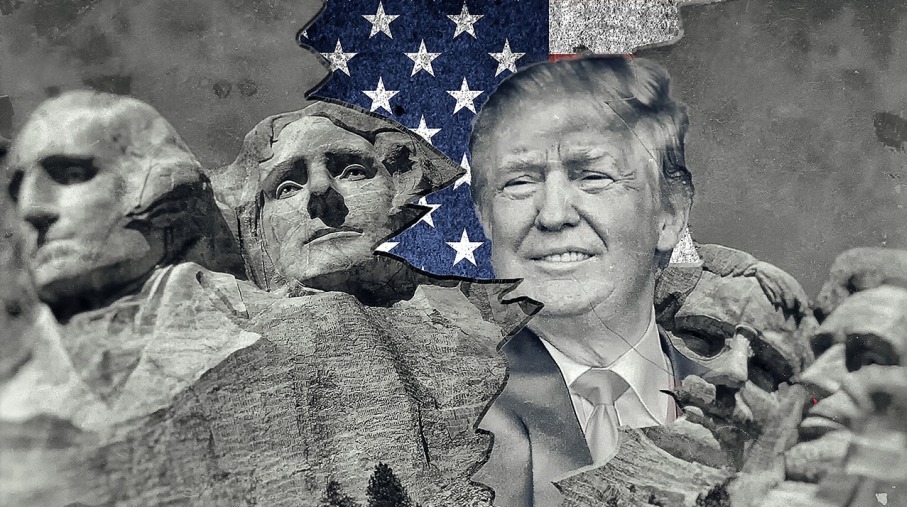
By Walter Donway
January 1, 2026
SUBSCRIBE TO SAVVY STREET (It's Free)
Is President Donald Trump more conservative or more libertarian? The question is an instance of the “fallacy of the false alternative”; he is neither.
Is President Donald Trump more conservative or more libertarian? The question is an instance of the “fallacy of the false alternative”; he is neither. He is riding a for-now-unstoppable wave of political reaction. Per se, that is not negative. Edmund Burke launched “conservatism” as a political term and position in reaction to the collapse of the French Revolution into the Terror, a lethal meltdown of Age of Enlightenment ideals. In doing so, he provoked an impassioned response from Enlightenment thinkers such as Mary Wollstoncraft, Thomas Paine, and Richard Godwin. The ensuing “pamphlet war” defined the terms that still characterize a fundamental argument on the Right, today: traditionalism versus ideology. That is, traditional, often-religious values and norms with rejection of “ideology” versus philosophical demonstrations of the case for social and political ideals and systems—the world conceived anew.
In policy and in person he is both a pragmatic businessman and an opportunist riding the politics of reaction.
President Trump is in neither camp. He is not ideological, making and defending his decisions by reference to principle; nor is he traditionalist, respectful of precedent, strict rule of law, and settled norms and policies. He is neither an Enlightenment man nor a Burkean. In policy and in person he is both a pragmatic businessman and an opportunist riding the politics of reaction.
If Trump is claimed by any camp, it is the traditional conservatives, who hope for an end to racial quotas, transgender surgery, climate alarmism, and the fever of “wokeness.” And traditional conservatives who demand fiscal responsibility, the downsizing the bureaucracy, and a more aggressive attitude toward national defense. To the extent that those demands shape his administration, he is on one side of a political divide first made explicit in Europe in the late eighteenth century and that has persisted—sometimes more, sometimes less openly—since then. In America in the 1960s, the debate opened again. I have chosen to start my account with a symbolic “opening shot” in that debate that many still remember.
Ayn Rand at Princeton: “Conservatism: An Obituary”
In December 1960, novelist-philosopher Ayn Rand stood before a Princeton University audience and delivered her lecture “Conservatism: An Obituary.” The content was as provocative as the title. Just a few years earlier, in 1957, her novel Atlas Shrugged had made her a known “player” in intellectual circles. She used this Ivy League lectern to excoriate the conservative movement of her day. In Rand’s view, contemporary conservatives were even more intellectually and morally bankrupt than the liberals they opposed. Liberals at least advanced their agenda (a creeping statism), albeit under vague euphemisms; conservatives, by contrast, supposedly valued capitalism but refused to defend it openly and by reference to reason and morality.
If American conservatives “do not stand for capitalism, they stand for and are nothing,” she said, and they were “paralyzed by the profound conflict between capitalism and the moral code…of altruism” dominant in American culture. In Rand’s telling, conservative leaders accepted an altruist morality that valorized self-sacrifice, and this left them unwilling to champion the moral right of an individual to live for his own sake, pursuing his own happiness—the moral foundation of capitalism in her philosophy of Objectivism. Caught in this conflict, conservatives even shied away from uttering the word “capitalism,” speaking instead of “free enterprise” and the “free market” in purely economic terms while dodging any moral defense of laissez-faire capitalism. Taken together, the titles of two collections of Rand’s essays say it all: The Virtue of Selfishness and Capitalism: The Unknown Ideal.
Rand was unsparing: a movement that would not name or fight for its actual ideal had no future. The strategy of trying to smuggle in freedom “by stealth”—hoping voters would support political liberty so long as it wasn’t explicitly called by its name, laissez faire capitalism—was, to Rand, a cowardly delusion now exposed as a failure. For decades, the conservate argument that “it works” had seen capitalism driven from the field by socialism, communism, and the welfare state carrying the banner of altruism.[i] In Princeton, she effectively read the last rites over organized conservatism, pronouncing it a suicide.
Rand was unsparing: a movement that would not name or fight for its actual ideal had no future.
Rand’s emotion can be separated from her intellectual content. By 1960, she had crossed swords with the gatekeeper of American conservatism, William F. Buckley Jr., the devoutly Catholic founder of National Review. (Buckley made his reputation, of course, with his first book, God and Man at Yale.) The magazine had greeted Atlas Shrugged with a venomous review by ex-Communist writer Whittaker Chambers, perversely entitled “Big Sister Is Watching You.” From almost any page of Rand’s novel, Chambers wrote, one could hear a command: “To a gas chamber—go!”—implying that Rand’s laissez-faire ideology, taken to its logical end, would be as tyrannical as the totalitarian regimes she despised (and had endured in her native Soviet Russia). Buckley later admitted he partly shared Rand’s indignation at the nastiness of this review, but he refused to retract it. The damage was done: Rand saw the Buckley circle—Catholics, traditionalists, ex-Communists, and “fusionists”—as hostile to her philosophy. Little wonder that at Princeton she aimed a dagger at the heart of the conservative revival. The Princeton speech doubled as a retaliatory broadside and a bold claim that her brand of radical capitalism was the only lifeboat for the American ideal of freedom. Anything less, any conservative modus vivendi with religion or collectivist morality, was already a dead end—an obituary waiting to be published.
For example, Walter Williams was a brilliant economist and defender of capitalist economics, but a typical talk would begin with something like this: “For the most part, in a free society, people who are wealthy have become so through effectively serving their fellow man.”
One of the great economists of our era, Ludwig von Mises, begins a chapter on entrepreneurs: “In the performance of this function they are unconditionally and totally subject to the sovereignty of the buying public, the consumers.”
An American Enterprise Institute post by two academic economists said it all in the title: “How Companies Can Earn Profits by Serving Society.”
The number of times this theme has been advanced to justify profits (and capitalism) in scholarly works, editorials, columns, courses in economics, even legion YouTube presentations (Google it)—approaches infinity. Yes, economic science has left no doubt that it is true that profits are gained by excelling in meeting the desires of consumers. But its truth does not make it a moral case for capitalism—unless you begin with the premise that serving renders an action moral whereas action motivated by self-interest is mere “prudence.”
Despite the eloquent obituary, the clash between ideological and traditionalist strains on the political right lives on.
It is rare that towering entrepreneurial achievements are characterized as “noble,” “heroic,” “virtuous,” and rarely “great” in the sense applied to politicians, artists, doctors, inventors, or generals. Because those plaudits imply an element of moral excellence.
Despite the eloquent obituary, the clash between ideological and traditionalist strains on the political right lives on. To see why, one must return to the 18th-century birth of modern conservatism in the work of Edmund Burke and the animated debate between his traditionalism and the Enlightenment ideas and ideals of his contemporaries.
[i] Rand realized that the pervasive morality of altruism was not solely religious. Altruism had been secularized in the aftermath of the Enlightenment. Immanuel Kant, by far the most influential counter-Enlightenment philosopher, though he repeatedly claimed the sanction of “reason,” had birthed the German transcendental idealist tradition to “save faith” from the Enlightenment, including his view that any action motivated by self-interest failed the test of morality. Throughout the 19th century, this philosophy dominated the West. After the American Civil War, ultimately thousands of young Americans sought graduate study in Germany, bringing home to academia, the intellectual world, and ultimately Progressive era politics Kant’s insistent equation of selfless “duty” with morality and the model of the German welfare program of Chancellor Otto von Bismarck. Although, of course, the Christian influence continued strong, Kantianism injected the morality of selflessness into the secular world of the Progressives and their political successors, most immediately the New Deal’s construction of the foundations of the U.S. welfare state. For the classic exposition of this transition from the Enlightenment (“modernism”) to the counter-Enlightenment (“postmodernism”), see https://www.amazon.com/Explaining-Postmodernism-Expanded-Skepticism-Socialism/dp/B07JVJC55G/

-

Can We Exorcise the Ghost from the AI Machine?
-

The Intimacy Marketplace Part II: The New Johns
-

The Intimacy Marketplace Part I: From Playboy to OnlyFans
-

Why Freer Governments Also Fear Crypto
-

Blockchain vs. Authoritarianism: A Global Clash for Liberty
-

Human Horticulture—a Missing Link for Objectivism?
-

Healthcare: A System That Rewards Compliance Not Patient Care
-

Mr. President, Take a Leaf Out of the Desert Storm Playbook
-

The Swamp—Muddy Waters Run Deep
-

China’s Birth Collapse Reveals the Limits of Coercion