
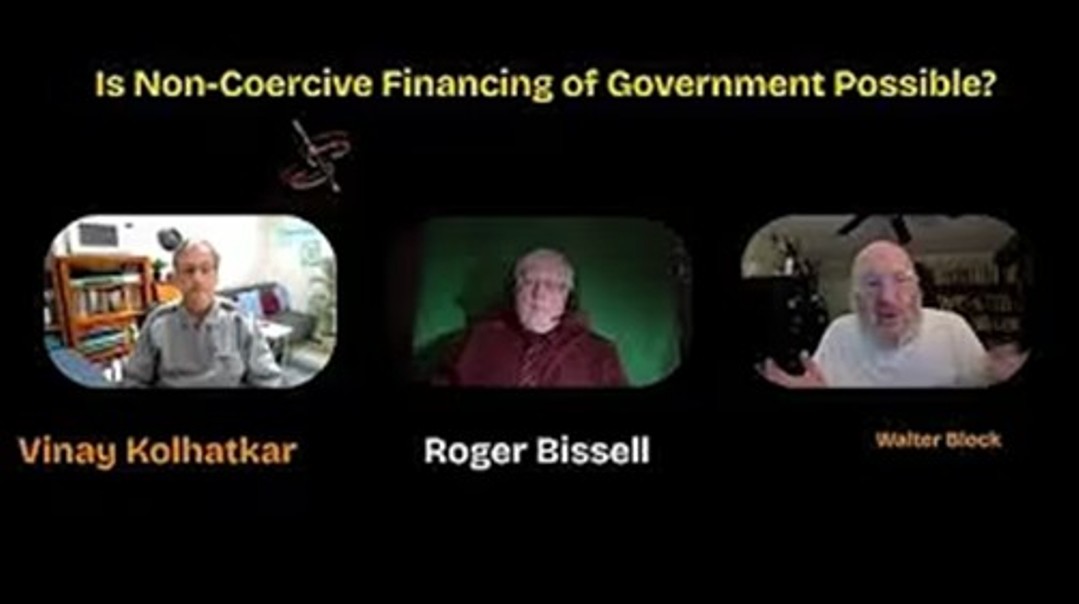
Transcript: Is Non-Coercive Financing of Government Possible?
By The Savvy Street Show
September 23, 2025
SUBSCRIBE TO SAVVY STREET (It's Free)
Controversies in Libertarianism, Podcast 7
Date of recording: September 4, 2025, The Savvy Street Show
Host: Roger Bissell. Guests: Walter Block, Vinay Kolhatkar
For those who prefer to watch the video, it is here.
Editor’s Note: The Savvy Street Show’s AI-generated transcripts are edited for removal of repetitions and pause terms, and for grammar and clarity. Explanatory references are added in parentheses. Material edits are advised to the reader as edits [in square brackets].
Additional Note (for this transcript only): Due to technical problems, we had to restart our podcast recording, and we were unable to combine the initial seven-minute portion with what made it onto YouTube. However, the moderator’s opening remarks were salvaged and are included in the transcript below. (A couple of internet glitches later in the podcast also deleted a couple of brief bits of dialogue, and we attempted to fill in the context.) We apologize for any inconvenience to those wanting to follow the transcript as they watch the video.
Summary
In this thought-provoking episode, the participants delve into the core principles of minimal government and Libertarianism. They debate the challenges of financing government without coercion, tackle the free-rider problem, and consider the balance between gradualism and immediate change. Whether you’re a seasoned Libertarian or new to the philosophy, this episode offers valuable insights into the pursuit of individual freedom and limited government.
Roger Bissell
Whether you’re a seasoned Libertarian or new to the philosophy, this episode offers valuable insights into the pursuit of individual freedom and limited government.
Good evening, everyone, and welcome to The Savvy Street Show. This is podcast number seven in our series of “Controversies in Libertarianism.” Tonight’s topic is the question: Is non-coercive financing of government possible? We are going to tackle one of the thorniest problems in libertarian political theory, and that is: how to finance vacations for retired trombone players. No, I’m just joking. It’s how to finance government services in a free society. That means a country that has a very limited government with just police, armed forces, and courts, which are the three basic ways of defending individual rights—or even a society with no government. This narrows the field down quite a bit. Sometimes we expand it to include constitutional conservatives and classical liberals, and we may hear from them a little bit tonight on an idea or two. But basically, we’re going to be talking about supporters of the ideal, limited government, sometimes called the ‘night watchman’ state, and advocates of anarcho-capitalism, which provides basic services without any government at all.
We’re fortunate to have a supporter of each of these views here tonight. Vinay Kohatkar is a novelist and screenwriter, as well as editor of The Savvy Street and co-author with me of Modernizing Aristotle’s Ethics, and Vinay favors the ideal limited government. Walter Block is an eminent economist and author of the book series, Defending the Undefendable, and his ideal is no government. Despite their differences though, both Walter and Vinay champion views that may seem almost utopian. I mean, who can look at where we are today and not think that we’re light-years away from either version of the free society. But these guys are going to take some tough questions about how we might be able to get from here to there, and maybe give us some insight and hope for the future. So, welcome to The Savvy Street Show, gentlemen!
Vinay Kolhatkar
Thank you for having me.
Walter Block
Good to be here.
Roger Bissell
All right. Now, the toughest challenge is how to pay for these essential services without taxes. Both hardcore Libertarians and Randian Objectivists consider taxation to be a form of coercion. In her article on the subject, Rand referred to taxation as an “initiation of force,” and she also referred to taxes as “forced labor and extorted income.” The Libertarians put a fine point on it and they simply say, “Taxation is theft,” and if you don’t have a mug or a t-shirt with that on it, then you ain’t you-know-what. Now, this is kind of an in-your-face to the Socialists, and they have their own slogan, “Property is theft.”
Well, we know better. We all believe that we, not others or the government, own our property, including our income, and it’s ours to use and spend as we see fit and not have it seized from us and spent on programs and projects we don’t approve of. So, how do we get these basic rights-defending services paid for, when some people just aren’t even going to pay for them voluntarily? That’s what we’re going to explore tonight, and there’ll be a lot of back and forth, so let’s get started.
I’ve drawn on the standard trio for minimal government: police, armed forces, and courts; but is that the right place to draw the line?
Question #1: minimal government. We just want to make sure we’ve got our definitions straight, so here’s a warmup question. I’ve drawn on the standard trio for minimal government: police, armed forces, and courts; but is that the right place to draw the line? Is there any strong argument to exclude one or more of them, like maybe the courts or police, from essential government services—or to include additional services like fire protection or emergency services? Or does it really make much difference? Let’s start with Walter on this.
Walter Block
Before I get into it: I’m a professor. I’m never supposed to answer direct questions. Let me just talk a little bit about Proudhon and “Property is theft.” It was like waving a red flag at me to say that. It’s totally incoherent because you can’t have theft unless there’s property, so property can’t be theft. Property is tied in with theft. So, it’s just a logical contradiction on Proudhon’s point.
Now, to answer your question—or try to wrestle with your question, in any case: The way I see libertarianism, it starts off at the top with two foundations. One is the Non-Aggression Principle: Keep your mitts to yourself, don’t be grabbing other people or their property without their permission—and two, how do you get property? Well, you get property by homesteading. We all own ourselves, we mix our labor with the land, says John Locke, and now we own land. Nozick says any legitimate title transfers. So, I domesticate a cow; you put in a corn crop. You own the corn; I own the cow. But now we barter, and now I own the thing you produce, and you own the thing I produce. But we could trace it back to homesteading and non-aggression.
I see libertarianism as dividing into four levels.
Okay, I see libertarianism as dividing into four levels. The first level, the anarcho-capitalist level, is totally consistent with this, and it eschews government entirely. Why? Because government necessarily taxes people, contrary to Ayn Rand, which I’ll get to in a second. Not only does government necessarily tax people; it also demands a monopoly of force in a given geographical area—it doesn’t allow competition. The second level down would be minarchism or very limited government, and the main people who espouse this would be Robert Nozick and Ayn Rand—those are the most famous people—and they say, armies, courts, and police, and that’s all the government does. One level below would be what I call US Constitutionalism, and here, the main exponent would be Ron Paul, and it would be as he would interpret the Constitution, not as anyone else would interpret it—not even the present Supreme Court, which is pretty good, probably the best we’ve ever had. Here we add post offices and post roads. Why? Because that’s what the Constitution said. Then one level below that, we have classical liberalism, classical-liberal libertarianism, and the most famous people associated with that would be Milton Friedman and Friedrich Hayek. They would accept armies, courts, and police, roads and highways, and post offices. They would add a few other things. They would add public goods. They would add maybe a little bit of education, a very little bit of welfare, and that would be it.
So, you really can’t say what is a government operation. It depends. There are three different views of this. Just on the back of the envelope, my estimation is that of all people calling themselves libertarians, 1% are anarcho-capitalists, like Murray Rothbard, and the other three are 33% each, roughly. Probably it’s 30%, 30%, and 40%. I think classical liberalism is a little more popular than the other two. That would be my first view of this.
Now let me talk a little bit about Ayn Rand. Ayn Rand said that we can have a government without any coercion. Well, how would the government finance itself? How would it get money for all the services? She had two things. One was a lottery, and the other thing was contracts. You could contract with the government to do something. But the problem with that, the way I see it is, why should the government have a lottery in competition with private lotteries? Why would the government be better at lotteries? Suppose the government lotteries didn’t do too well, and private lotteries did. The government wouldn’t have any money. And why should we have contracts with the government when we could have contracts with each other? So, I think that Ayn Rand is trying to have her cake and eat it—and I admire her for it. I’d like to have my cake and eat it.
I’m a big fan of limited government. I’m a big fan of all aspects of libertarianism. I just think anarcho-capitalism is best. But one of my books is The Classical Liberal Case for Israel. So, I do take [favorably] to even the classical liberal view. I say, if I were a classical liberal, what would be my view? And I think that’s a perfectly coherent thing to do. So, to summarize, there are these four sections [in the libertarian movement]. I admire Ayn Rand’s views. I’m a big fan of hers. By the way, it was she and Nathaniel Branden who personally converted me from my views when I was a buddy of Bernie Sanders. So, I have a warm spot in my heart for her. That would be my first attempt to wrestle with your very good question.
Roger Bissell
Vinay, would you like to address anything in what Walter said, particularly the contract aspect? I think Rand was saying something a little different.
Vinay Kolhatkar
Yes. Well, I’ll come to that. But first I’ll address the four layers that Walter Block spoke about. It’s a nice little segregation: the ANCAPs, the Night Watchmen state and Objectivists, and then he put #3 the constitutionalists, and #4 the classical liberals. I would reverse that order [of the last two], because the Constitution has not been anywhere near perfect. And a lot of things that have been happening in the US over the last 20–30 years, particularly in the Obama era and then the Biden era, have been way, way out of classical liberalism, the interference in free speech, the climate alarmism. I mean, you could go on and on. So, obviously those have been unfortunately permitted by the Constitution and not foreseen. That’s the first part.
I would reverse that order [of the last two].
I’m going to argue for the Night Watchman state, which is what Rand argued. And when she said the “contract,” the contract is not with the government. Her opinion was that, if you pay a little fee per contract, whatever it is, 0.2%, and only perhaps 0.01% of the contracts end up in court. [Not everyone has] to pay the fee, but only those that pay the fee have legally enforceable contracts. In other words, you could [make] a contract, and because you and Roger trust each other, you have a contract, and that could be worth $10 million. You don’t pay the fee, but then if the relationship turns sour, you don’t have access to the courts. The flaw in her argument is that she assumes that over the army, police and courts, the government already has a monopoly. Therefore, [since] people do need the army, the courts, disaster relief (which she doesn’t address), they have no option but to get it out of the government by paying a fee—or not get it at all. It’s as if the only insurer was the government. Most people would take government insurance even though it costs you 30% more than in a competitive free market. So, yes, that’s my answer for that one.
Roger Bissell
Well, I want to expand on this issue just a little bit. Is Rand being realistic in saying that we can come up with enough user fees to cover these basic things, or is this just wishful thinking? Is it going to be really difficult? Walter has already pointed out one problem, Vinay. He said that if there’s competition, the private ones may do it better—and then [when] the government [tries to provide] a court, they’ll lose out to the arbitrators. I’ve used arbitration myself, and it was a heck of a lot cheaper than having to get lawyers and stand up in front of the judge and all this stuff. So, what do you say to that? Was she just doing wishful thinking or sort of imagining hypothetically, or something?
Vinay Kolhatkar
She did qualify her statements that this kind of question that we’re addressing today is the very last question you would need to address after becoming a completely free society, and that is, as you said, light years away. She also qualified [that] this is just a kind of a sketch of what might happen, but she had tremendous optimism of the fact that it is doable and easily doable. Now, it is easily doable if you assume that the army, police and courts, like I said, are only the functions of the government, and no one else can enter. Then, yes, we need the police, and we will pay a fee and so on and so forth. So, it wasn’t wishful when you look at the constraints she put on herself.
Now, I have looked at the credit markets, and I have also looked at the stock market. The US budget, spending-wise, is coming close to $7 trillion dollars, and the defense budget of that is $850 billion itself. Arguably, that is far too much. So, if we were trying to generate $1 trillion, that would more than cover these three functions. How can you cover it? The stock market, for instance, has a turnover of about 115% of its value, and the value is $62 trillion. Now, for every turnover, if you clip the trade a small bit, and you clip the trade also on the total wealth—the US household wealth is $160 trillion, and the credit market is about $40 trillion—then altogether we’re talking about over $200 trillion that you can clip a very small bit, and that is kind of theft, as long as you don’t have the option not to get it clipped, but it is very easily doable.
You can clip a very small bit, and that is kind of theft, as long as you don’t have the option not to get it clipped, but it is very easily doable.
There are [already] several low-to-zero income tax countries in the world, but you know what they’ve done? Saudi Arabia nationalized the biggest asset, the oil revenues, and they make lots of profits out of their oil refining and selling. They charge value-added tax. They charge companies a corporate tax. So, they [go] these indirect ways, and they say income tax is zero. There’s quite a few countries like that. So, yes, the problem hasn’t been solved.
Walter Block
I wanted to get back to two things. One, the Ayn Rand proposal, and I see an incoherence here because the army, court, and police are supposed to protect everybody. So, Roger and I now have a contract, and we don’t give any money to the government. They’re supposed to protect us, anyway. And if Roger and I disagree as to what the contract means, we should be able to go to court and be covered. And if we’re not covered and if we have to pay this extra fee, well, that’s like a tax, and she’s against taxes. So, I see her position as a little contradictory and incoherent.
Now, with regard to Vinay’s reorganizing my order, I stick by my order, and I hope I can convince him. Namely, my order is predicated on how much government does; and the more government does, the lower we get. So anarcho-capitalism, the government does nothing. Minarchism or limited government, the government does armies, courts, and police. Then for constitutionalism, armies, courts, and police, plus roads and post offices, and then lower than that would be classical liberalism because it’s army, courts, and police, roads, and post offices, plus welfare and education and a few other things. So, I think my order is good based on how much the government does. It’s very objective.
Vinay Kolhatkar
Okay, let me just take that on for a little while. In the third bracket, if you are saying an ideal constitution would constrain the government to roads and a few other things added on to the basic three functions, then yes, they are classical liberal. But the existing Constitution of the US, it would be below the classical liberals given what has already happened and how much the government has gone into all sorts of things.
Walter Block
I agree with you entirely, but I was assuming a pure constitution as interpreted by you or me or Ron Paul or somebody like that, and that constitution wouldn’t do anything like that. It would just be armies, courts, police, post offices, and roads. That’s it. But if you’re going to talk about the history, well, then, obviously you’re right. So, we’re really not disagreeing.
Roger Bissell
In my case, in my profession, it doesn’t seem to make much difference whether I sit third trombone or fourth trombone. Occasionally there might be a really juicy third trombone part that I’d really like to play. But let’s go on here. We’ve touched on this issue a little bit, the free rider problem. If you’re going to provide national defense, for instance, against the terrorists and the nuclear powers and so on, everybody gets defended. If you have a nuclear shield to shoot down the missiles, everybody gets protected, even if not everybody chips in to pay for it. So, that’s what the free rider deal is, where some people are supporting the whole system. How serious a problem is the free rider? I know Walter would have a different answer for if it was a totally free market of, let’s say, fire protection or police protection. If I pay into it, and my neighbor doesn’t pay into it, but my neighbor’s house is on fire, how does he get his fire put out, or is he out of luck? Walter, go ahead and speak to this.
Walter Block
The free rider objection is an objection to free enterprise. As such, I totally reject it. Murray has written a lot about that.
Well, in one sense, the free rider objection is an objection to free enterprise. As such, I totally reject it. Murray has written a lot about that. I have also, and other libertarians have as well. Look, right now, I’m going to smile at you. See, great smile? And now you guys have to pay me 10 bucks each. Why? Because you’re a free rider on my smiling. Well, this is obviously ridiculous, and yet it’s probably true. Let’s stipulate that you enjoyed my smile or, you know, work with me here, let’s say I wear a tuxedo and people say, that’s great. Tuxedos are better than t-shirts. And now I can bill them? No. Just because I’m benefiting you doesn’t mean I can charge you for the benefit. What Murray says is that civilization is a free rider where we all free ride on everything. Language is a free rider. The fact that we can communicate is a free ride. So, the idea that you have to collect money from people because you’re giving them a benefit? No, the only time you can collect money from people is when they agree to pay, and you haven’t agreed to the smile, and the neighbors haven’t agreed on a tuxedo or anything like that.
Okay, second point. How would the private police force work, because the private police force would have to collect money? Now, I go to Roger, and I say, “Hey, I’m the private police force. Give me some money, and I’ll protect you,” and Roger says, “Well, you’re going to protect Vinay, who’s a client of yours, and I’ll just free ride on Vinay.” So, how do I limit my protection? Well, one way is, I give Vinay a little placard that he puts on his chest, and now he’s a client of mine, and I’ll protect him; and if somebody grabs you, Roger, or uses violence against you, I’ll just go like that [makes dismissive gesture] and say, “Haha, you wish you were my client.” Or I can say, “Hey, Roger, I used to charge you 100 bucks, but right now this guy is a criminal. I’ll charge you a thousand bucks and I’ll protect you.” That would be the way that we would eliminate free riders, so-called.
Now, you mentioned the case of houses. If the house is contiguous—now we’re not talking about police protection, we’re talking about fire protection—and one person has a contract, but the contiguous house doesn’t, well, that’s not going to work. The builder who built those houses in the first place is probably going to have fire protection for the whole row of houses, and when you buy that house, you buy it with a subcontract, namely, for a fire department. There have been cases where people had private fire protection, and there was a fire in the next house, and your house was about to be put on fire, and you were desperate. Sometimes the fire department would just look upon that and say, “Well, get some marshmallows and roast the marshmallows, but your house is going up in smoke.” That would be a way to demonstrate that you really should make a contract with a fire department if you want your house to be safe.
Another point is that under anarcho-capitalism, not only would we have armies, courts, and police, but all the roads would be private. I even have a book on privatizing roads and highways and streets. Well, on my road, I want people to be safe, so I make a deal with the police force to protect my road. In that way, anyone who comes on my road has to pay through me to the police, and there are no free riders in that way. So, my answer to the free rider problem is that in the market, entrepreneurs would try—not fully, not perfectly, nothing is perfect—but they would strive mightily to make sure that there aren’t too many free riders; otherwise, the service would not be viable.
Roger Bissell
Now, Vinay, I’m sure that both of you are probably familiar with the old story about the ant and the grasshopper. The ant was very prudent, and he set aside food for the winter so that when there was no more food outside, he’d have some inside, whereas the grasshopper just fiddled around and played, and he didn’t take care of putting things aside for when he might need them for the rainy day. So, is that what a truly free market in protective services boils down to? Is it, “You’re the grasshopper, you’re out of luck”? Or is there any way around this where it’s not simply, “Well, sorry, you didn’t chip in ahead of time”? Like Walter has already stated, you just might up the price if they try to opt in when the fire started, and you say, “Okay, but it’s going to cost you a lot more,” and the person would probably say, “Okay.” What do you think, Vinay?
Vinay Kolhatkar
There are several issues there. I’ll start with a personal view. Who gets the benefit of law and order in society? And the answer is billionaires or those with a great amount of wealth and income get the most benefit of trade and of security and the lack of terrorism and the lack of violence and the lack of fires and theft. [What about] the beggar on the street who only has an old smelly blanket? Sure, if his life is in danger, then he gets the benefit of his life being saved; but outside of that, nobody wants to steal his old smelly blanket or the shirt off his back. So, it is extremely fair for some people to pay more than some others. I’m not saying they pay zero, but Rand’s sentiment was that it’s like a train with empty seats, and the railroad company says the poor can ride free whenever there are empty seats, but they have to wait until the last minute. Sometimes even on airplanes, you get a seat for 10%, but you’re highly inconvenienced because you’re standing with a suitcase, and you might just get on, or you have to wait another hour till the next flight comes in. It doesn’t inconvenience anyone else. The rich are in their business class or first class. They don’t even notice if the economy class is full. That’s another way of looking at the free rider problem—that the rich really need the police services.
Now, the courts are of two kinds. There are civil courts, and there are criminal courts. As far as crime is concerned, we all together as a whole society have a vested interest in putting the violent criminal either behind bars or apprehended in a way that he can’t harm other people again. That is quite critical, so there needs to be a uniform police force that does apprehend criminals, that does have uniform laws of evidence, and that does have power. So, for instance, let us say A and B had a punch-up in a bar and there were no witnesses [except the] bartender. Now, B started the fight, but the bartender is a friend of B’s, so he says, “No, A started the fight,” and he has a little recording, [but] he says, “Oh, the camera wasn’t working,” and deletes it. Now, under the uniform legal code, the only people on the scene first are the police rather than A’s security agency and B’s security agency, and the bartender is under an obligation, which is not to give the video to a security agency, [but to the police]. He’s under obligation to give the footage [to the police], otherwise, he’s committing a crime. Both men are badly injured, but the video footage clearly shows B threw the first punch. Then there was a punch-up. Both guys got injured. So, it is B’s fault. B is the aggressor. When you have multiple security agencies, I can see a lot of difficulty in getting this done.
Who has the most incentive in setting up one national, uniform disaster agency…[it] is the sum of insurance companies.
But it’s a Rothbardian idea to involve insurance agencies. As far as disaster relief is concerned, who has the most incentive in setting up one national, uniform disaster agency…[it] is the sum of insurance companies. I don’t want to call it a regulator overlord, but an insurance cooperative—they do reinsure among themselves quite a lot; they do resolve their own conflicts—[they] could start a FEMA, and they could certainly have statewide police forces because they benefit the most in having effective policing. Of course, your insurance premium goes up, but your taxation level goes right down to zero. You can opt out of it in some cases, but then you are missing out, and you can be a small level of free rider in an isolated house. Potentially, you wouldn’t be protected, or you would be protected because it’s a crown fire, and that fire can spread. But where it concerns a row of houses, there’s always, like Walter said, a pre-existing deed, which means the entire strata or condominium complex takes insurance or it doesn’t. An insurance company will refuse to insure a few units on the top floor, a few on the bottom, and a few in the middle. They would say, “I’m going to insure the whole building. This is the price. How you share it among yourselves is your problem.” [Typically, it’s shared by square foot area.] So, that’s the partial solution to this.
Roger Bissell
Okay. I need to turn this back around to another part of the free rider problem, and that’s the issue of what they call “equity.” Now, maybe it’s not fair or wise to quote the Pledge of Allegiance to the Flag, but the last phrase in the Pledge to the Flag is “with liberty and justice for all.” It’s not liberty and justice for some. The US Constitution is supposed to provide a government that provides defense of the individual rights of all the citizens, not just the ones who can afford to pay for it. So, we really do have a problem. How do the poor get justice and protection if payments are required that they’re unable to make? Otherwise, it’s going to be what they call a “two-tier system of justice,” and I don’t see how that could be politically sustainable. Of course, if we don’t have a political system, if we just have a totally non-governmental society, well, okay, then there’s no politics, I guess. But back to the issue of the building where you have some people who can pay, and some can’t. Would philanthropy be a way of taking up the slack? Vinay, just build on what you said a minute ago, okay?
Vinay Kolhatkar
I’ll give Walter a chance to say what he was going to say, and then I’ll go back to building on it.
Walter Block
I’d like to jump in on this as well. First, I have the ant and the grasshopper, which we didn’t really fully explore, and I think that was a very important point that you made about the ant and the grasshopper. I see that the government answer to that ant and grasshopper situation was Social Security. The idea is that people are too stupid to save for their old age or a rainy day, and we’re going to force you to save. Here we have another difficulty because people who favor Social Security also favor democracy, and democracy means everyone gets to vote, rich or poor, old, young, whatever. But if people are so stupid that they won’t save for their old age, why are we letting them vote? So, we can’t have democracy. On the other hand, if we have democracy, what we’re saying is that people are not that stupid and therefore we don’t need Social Security. So, it’s sort of a contradiction because the same people who want Social Security also want democracy, and the two don’t go together.
With regard to this two-tier system, as a libertarian, I say there’s nothing wrong with a two-tier or a 10-tier system. Look, the poor don’t ride around in Maseratis. The poor ride around in a Volkswagen, let’s say. Well, if you’re rich under any system, you’re going to get better protection, and there’s nothing wrong with that. In other words, if you want better protection and you’re poor, the answer is: go get rich, and then you’ll have better protection! Why should protection be any different than the car you drive in, or whether you have lobster and steak or hamburger? The idea here is that the rich should get better things, and for two reasons. One is practical: It’ll encourage people to get rich, and the only way you can get rich in the free society is by being productive. Also [two,] deontologically, it’s unjust to give the poor [man] a Maserati. He doesn’t deserve it. He plain-old doesn’t deserve it because he didn’t produce enough to get it. Well, why should he get a Maserati level of defense? So, I would say there’s nothing wrong with two-tier or 10-tier or whatever it is.
I also want to make another point. It came to me when Vinay was talking about A and B. I want to address the question of how would a judicial system work under anarcho-capitalism? The way I would see it is, there’s not only A and B, there’s A, B, C, D, and E—Al, Bob, Charlie, David, and Ed. Now, A and E, Al and Ed, get into a hassle, and they’re both civilized people, so they’re willing to go to court to adjudicate this. They’re not going to get into a punch-up, unlike Vinay’s buddies there. So, A goes to E and says, “Hey, Edward, let’s go to Bob. Bob’s a good judge, and we’ll both go to Bob, and he’ll decide who’s right between the two of us.” And Ed says, “What, Bob? He’s your brother. I’m not going to go to him.” Then Ed offers to Al, “Hey, let’s go to D for David. David’s an honorable judge.” And Al says, “But David is your cousin. I’m not going to him.” So, they each go to their own judge. A goes to B, and E goes to D. Al goes to Bob’s court, and Ed goes to David’s court. Now, there are four possibilities. (And, by the way, when you go to a court, you sign a contract saying that you’ll abide by the decision; and the court also has a police force, so they’ll make you abide by the decision that you just signed on to.) One possibility is that B and D both find in A’s favor. Bob and David both find in Al’s favor, and that’s it. Another possibility is that the two courts, B and D, both find in E’s favor. Again, that’s simple, and there’s no question. A rare possibility would be B favors in favor of E, and D favors in favor of A, but let’s forget about that. Let’s suppose that B, Bob, finds in favor of A, Al, and D, David, finds in favor of E, Edward.
Well, now what? And when Ayn Rand was presented with this case, she said “Blank out,” that the anarcho-capitalists have no answer to this. It’s just war, that B and D have to have a fight. Now, here’s the answer to Ayn Rand. There are two kinds of courts. There are legitimate courts and illegitimate courts, legitimate courts and bandit courts. Legitimate courts have a contract with every other legitimate court that if ever we find ourselves on the opposite side of a decision, we’ll go to C. I haven’t mentioned C or Charlie. And they might even have a list, Charlie 1, Charlie 2, Charlie 3, and then we’ll draw straws and pick Charlie 5 or whatever. So, legitimate courts will settle their disputes legitimately. Bandit courts will say, “My way or the highway, and anything I say is right, and to hell with you.” Now, what Murray Rothbard says is, “Bandit courts are going to have to fight everybody. They’re going to have to fight other bandit courts and legitimate courts. Legitimate courts are only going to have to fight bandit courts. Fighting is expensive, so what’s going to happen is that the bandit courts will be moved out of the market, and there will only be legitimate courts, and Charlie will decide this issue. A lot of people say, if we had anarchism, how would the courts determine it if they disagreed? That’s how.
Vinay Kolhatkar
Okay, can I add to that? We start with rules of evidence that have to be common, at least within a state. So, crime is a difficult problem [for anarchists]. Civil courts are a much easier [issue] because at the back of every contract, you say this contract is governed by the laws of Massachusetts or New York State or Tennessee or some [state]. So, those two parties haven’t given Massachusetts 2% of the contract money or something, but they’ve already decided in a competitive federalism sense, even though both of them live in New York, that Massachusetts is the better place to go if you have a dispute to resolve. So, to some extent, that kind of competition, if you will, already happens.
You wouldn’t get a free rider issue in civil cases, because you just have to wait.
You wouldn’t get a free rider issue in civil cases, because you just have to wait. Like we have a two-tier medical system. If you have a surgery that is not emergency and elective, you have to wait for two years in the public system, and a lot of people, even middle class, have private insurance because then you don’t have to wait two years. You jump. So, there is a two-tier system, but in an emergency, everybody goes into a public hospital with large [emergency rooms], and hopefully their lives get saved. So, the sentiment that Rand expressed was, it is no load on the able to have the 2% or 5% at the bottom being free riders on the free seats, having their house protected in the case of a fire. If it is an independent house, they’re already not that poor to start with. That’s not that big a deal. Although if they have an internal fire in the house, and they call a private insurer, they say, “You’re not our client. Call somebody who is your company that will put out the fire.” So, they do suffer, and they should suffer. But injustice for all is an issue of crime, of having violent criminals roam the street, and then we need to have a system where those violent criminals are, if not taken off the street, put in some place where they might work for restitution, but it’s like a prison, a walled-in space that they can’t get out of.
Roger Bissell
Well, that’s fine once you catch them and determine their guilt, but I still am not quite comfortable with the answer I’ve gotten from either of you. Walter, in particular, you said, two tiers, 10 tiers, some people can get Maserati justice. Other people can use their skateboard, I guess. What about when you have a street in New York City or Des Moines, Iowa or something, and two fellows are walking down the street on opposite sides of the street. One of them is dressed to the nines in a tuxedo, and one of them is wearing a t-shirt, and there are two muggers out trying to see who they can pick off. One of them goes after the tuxedo guy, and one of them goes after the t-shirt guy. Okay, let’s say you’ve got two policemen. Do the policemen say, “Well, the tuxedo guy has probably chipped in big time to pay for his services, and the t-shirt guy is probably taking his chances. So, let’s go make sure that the tuxedo guy’s protected, and the t-shirt guy doesn’t have a “I paid my dues card” that he can flash, and so we presume that he’s just a free rider. So, what happens? How are they going to sort this out?
Walter Block
Well, the way they would sort it out is, they would be on a private road. If we were under anarcho-capitalism, there’d be a private road, and the private road owner would not say, “Well, protect the tuxedo guy. Don’t protect the t-shirt guy.” If he did that, he’d go out of business. By the way, I never said Maserati justice. I said Maserati protection. I think that rich people will have armed guards, where poor people won’t have armed guards. But as a matter of justice, we’re in front of a court. We have two guys, the tuxedo guy and the t-shirt guy, in front of a court. They must have absolute equal justice. So, you have to distinguish equal justice from equal protection. So, if there’s a dispute between the tuxedo and the t-shirt, absolute equal justice. The court is obligated morally—and, I think, economically—to mete out justice based on who-done-it, as in Vinay’s case of A punched B or B punched A. If the tuxedo guy punched the t-shirt guy, the tuxedo guy should go to jail, and vice versa if the t-shirt guy did it.
So, you have to distinguish between equal justice and equal protection. I certainly favor equal justice. I don’t favor equal protection, because rich people deserve more. But the point is that, suppose they’re on a public street and there are two muggings, and there’s only one cop, and the tuxedo guy paid a lot of money to the private defense agency, and they’re both clients of this same [agency]. [But, say the tuxedo guy] paid a lot of money, and he gets high protection. [The cop] should go and protect the tuxedo guy and let the t-shirt guy use self-defense. Because the more you pay for something, usually the more of it you get or the more quality of it you get. So, I see no problem, although I agree with you that a lot of people would look askance at this. But I don’t look askance at that. I say that if you paid for pizza, you get pizza, and if you paid for steak, you get steak, and steak is better than pizza. Protection should be the same way as anything else.
Roger Bissell
Okay. Maybe once we get to our preferred ideal society, everything would work out pretty well. But as far as getting there from where we are now, which is a whole different story, let’s go to Murray Rothbard’s famous button, the button of emancipation or whatever you want to call it. What’s the red button called, Walter? I don’t remember.
Walter Block
Murray says you’re standing at a podium, and there’s a button, and if you press the button, there would be full freedom. Would you press the button? Murray said, “I would blister my thumb pressing the button.”
Roger Bissell
Right! Well, a lot of people would say, wouldn’t there be chaos and disruption and complete confusion if there was a rapid transition? Shouldn’t we phase this in gradually? Now, what do you say to the whole issue of gradualism versus immediate decontrol?
Walter Block
Well, one answer to that is: suppose we had the power to eliminate slavery, and we could do it right now, but it would create chaos. So, what we do is, one-tenth of the slaves are freed for 10 years. Each year, one-tenth are freed, and at the end of 10 years, they’re all free. Should we do that? Because there would be chaos if you freed them all at the same time. The answer is that if you have the power to eliminate slavery for all, and you only did it for one-tenth of the people, then in some sense, you’re almost responsible for the slavery of nine-tenths of the people the first year, and eight-tenths of the people the second year, you see.
Sometimes, pure libertarianism goes against pragmatism.
But this is a pragmatic issue. Sometimes, pure libertarianism goes against pragmatism. For example, take slavery again. In 1861, had the government told the slave owners, “Look, slavery is no good. You bought a slave for a thousand, we’ll give you a thousand. We’ll pay you off and there’ll be no war.” Well, that wouldn’t have been good deontologically because those guys should have been put in jail. They shouldn’t have had slaves themselves, so they shouldn’t have been paid for being slave owners. On the other hand, if you had done that, you would have saved millions of lives [in the Civil War]. So, here you get a bifurcation [between pure libertarianism and pragmatism].
It’s the same thing with pushing the button. On the one hand, the argument in favor of it is, you’ll get justice right away. On the other hand, there’ll be chaos. On the third hand, if you don’t press the button, and you try to do it gradually, the people will undo it. You see what I’m saying? Take Javier Milei in Argentina. He’s a libertarian hero as far as I’m concerned. Has he eliminated everything right away? Do we have anarchy in Argentina? No. What he’s saying is, we have to go slowly. Also, he is only one person. He’s got a Congress that doesn’t agree with him fully. So, I think that, to answer the question, it’s a very complicated issue. It’s not really an issue of libertarian theory. In libertarian theory, you push the button. On the other hand, there are cases where the chaos would be such that the whole world ends. Well, we don’t want that either.
Roger Bissell
Yes. Vinay?
Vinay Kolhatkar
There’s no question that in real life, gradualism is necessary. But I want to make another point about pressing the button. Insofar as taxes are concerned, yes, in the US, your Social Security is your own, whereas in Australia, we pay millions of dollars of taxes over a lifetime, and at the end, if you’re eligible, if you don’t have enough assets, if you’re eligible for some help from the government, you might get it. It’s a classic ant and grasshopper problem. Two people earning the same amount of money, lots of taxes being taken out. The taxes are spent immediately on other people who are the needy. So, both of these guys are [say] 70 years of age. They want to retire. It’s A and B, and they say, “A has been the ant. Despite paying taxes, he has saved a lot of money. He’s got assets that earn income. You don’t get any help. Oh, B, he’s so poor, he’s on the street. He gets all the help.” You know, that can happen even if B actually earns more than A, and that is an absurd situation, which is the reason you can’t press the button, [when] the people who are 70 or 75 have already paid a lot more than Social Security, all sorts of indirect taxes, and may not be so comfortable in retirement, and all of a sudden [the government] says, “The government doesn’t do welfare. Tough luck.” You have to give an advance [warning]. So, they should get that welfare if they’re eligible for it, and anyone who’s below 60 or below 55 gets at least a 10-year period and say, “Okay, in your case, better start saving now because when you are old, there will be no welfare.” Something like that has to be there.
Now, the other equity consideration that comes into play is, as I said, the court system where it’s a criminal court [of] the state in a conventional theory. It’s the state against the offender who might have 13 child victims as a pedophile, or he might have several victims as a violent offender. He needs to be taken out, not as in killed, but taken out of society and put somewhere where everybody is safe. So, the “and justice for all” gets a big tick because that’s a benefit to all of society. But if there is a civil case, like I said about the medical issues, and you don’t have your contract duty paid upfront, the courts either won’t hear it or, if you go to a private arbitrator, the private arbitrator is going to say, “Well, the fee is $30,000 because you didn’t pay the premiums, your house caught fire, and the bill is $30,000. If you had no insurance, you’ve got to pay $30,000. [On the other hand,] if you had insurance, you pay the excess, the first $1,000, and the insurance company pays $29,000. So, if you weren’t wise enough, then it’s equitable. We’ve had cases in Australia where people’s [houses] got flooded. They didn’t pay for flood insurance. The insurer had refused [due to risk]. It was an accident waiting to happen; they built their houses right next to a raging river. Then the government still caved in and paid them money because they [became] homeless. But in such cases, it is equitable that they don’t get money from the government or anywhere else.
Roger Bissell
Well, we’ve tried to figure out the best way to get from relatively unfree to relatively free—the freer, the better. But then, there’s also the problem of libertarian regret, not by us, but by the people who used to be in an unfree society, and now they’re in a free society [and they decide that, “Oh, we don’t like this too well.” How do we resist the pressure? What’s the best way to build into the process of freeing up the society so that people don’t get tempted to backslide and say, “Oh, let’s go back to the good old days”? How do you prevent that? Vinay, go ahead.
Vinay Kolhatkar
Milei wasn’t voted in because he’s libertarian. Suddenly, a mass of Argentinians did not become libertarian. They just voted for change.
Well, Milei’s Argentina is an outstanding illustration. Milei wasn’t voted in because he’s libertarian. Suddenly, a mass of Argentinians did not become libertarian. They just voted for change. And now, if this change is highly positive, which it is so far; 50% of Argentina was below the poverty line, they can see that number is a lot less. And in another two years, if the economy is doing well, you have the evidence of almost everybody is better off, except what Rand would have called the moochers. Even the moochers see more opportunity. Rather than mooching their neighbors, they now see opportunities for employment or entrepreneurship in their own society. So, they’re all simply far less poor. I think if you have free enterprise for 10 years, there won’t be any poor left, potentially, in many of these economies.
There’s always a relativity between rich and poor. But if you use the poor old index, remember the United Nations keeps moving their poverty index so that there’s always 20 or 30% [that are poor], in some places. But if they use the old method [gauge], then practically it has gone down from 11% to 2% virtually everywhere in the world. So, if you don’t move the index, there would be no poor, and everyone could afford some level of insurance.
I still see the insurance company as a natural house, as a collective, to fund a police force and potentially even an army, and obviously all that sort of fire and disaster relief, because the better those functions are, your claims are less. And if you take too much in premiums, and you have a police force that’s just sitting on its heels because there’s nothing wrong happening, then you have to reduce your premiums because too much money is getting wasted.
Walter Block
The question before the house is, how do we promote liberty? If I could put words into Roger’s words. And I would say, well, how are we doing? And I ask, who are the people that have most promoted liberty by converting more people to libertarianism than anyone else? And the answer is Ayn Rand for my generation. She converted more people to libertarianism. She didn’t like the phrase “libertarianism.” She liked “Objectivism.” But by golly and by gum, if she’s not a libertarian, nobody’s a libertarian. She’s a libertarian par excellence. And she converted masses of people with her novel. So, one way to do it is: go write a novel that is a bestseller forever, practically. Who’s the second person that converted more people to libertarianism than anyone else? Ron Paul for the generation after me. So, go into politics and be like Ron Paul. who is just exquisite in terms of his presentation and his arguments. Milton Friedman, I think, would be the third person who converted more people to libertarianism. Maybe it’s a tie between him and Hayek, I’m not sure. They both won Nobel prizes in economics. Go do that.
For lesser mortals like us, in the US, there are 50 states, and each state has a think tank.
But for lesser mortals like us, in the US, there are 50 states, and each state has a think tank. In Louisiana, it’s the Pelican Institute. In each state, there’s a think tank that tries to promote liberty within that state. When I was in Canada, I worked for the Fraser Institute, which is sort of like the American Economic Association, AEI, or Hoover Institute. There’s also the Free State Project, where all libertarians move to New Hampshire, and now New Hampshire can have more of an effect than otherwise. There’s also the Mises Institute, which I’m having a little difficulty with—the one in Auburn, Alabama. But there are 10 other Mises Institutes—in Germany and France and England, everywhere. The Independent Institute is another one that should be mentioned. The Reason Foundation is another one. So, there are many, many institutions and organizations that are doing this. Then we have fundraisers like…who is the chief fundraiser of libertarian movement? He donated money to the Cato Institute and should be mentioned. [Roger: The Koch Brothers.] The Koch brothers. Charles Koch deserves mention because they say the army marches on its stomach. We march on money. And not just Charles Koch, but many, many contributors to libertarian enterprises deserve a mention in promoting liberty.
Each of us in our own way. Me, personally, I teach, and I have 12 former students who are now economics professors and hopefully are conveying the message of freedom. I know for a fact that most of them are doing exactly that. Even what we’re doing now, having Savvy Street [Show], and Savvy Street is promoting liberty, not only in this particular instance, but in many, many other ways, by having blogs and publications, and I’ve also published for the Savvy Street newsletter or blog or whatever it’s called. All libertarians now have maybe not a legal duty, but certainly a moral duty to promote liberty by example and by writing. Try to write [for] the Wall Street Journal, the New York Times, or the newspapers or libertarian journals like the Journal of Libertarian Studies.
Roger Bissell
Well, it really is “all hands, on deck,” and I agree with you. We should do what we can in any way we can. Vinay, would you like to add some thoughts to that before we close for today?
Vinay Kolhatkar
Just a little about backsliding, [which] was the second part of your question. “How do we get there?” is a good question. Like Milei and the examples right up there, and as things get better, more and more people get convinced. But if you did have 75–80% of people absolutely convinced that this should stay, then the best way to prevent backsliding is to have an ultra-strong constitution where the First Amendment would be changed [so that] not just “Congress shall make no law,” but that “neither Congress nor Parliament shall seek to influence free speech by any means financial or otherwise,” and the rest of the clause stays the same. The second amendment, you would have no militia, so you are allowed to defend yourself on those streets, etc. There would be a third amendment—that’s all you would need—which is that you prevent the state from ever doing any scientific research, so they can’t fund it. You prevent them from influencing economic actions of economic actors, so they’re thrown out of the economy completely. You can have such an ultra-strong constitution, and then that is taught in different schools about how good it is and things get better all the time. I think that [it] would sustain itself [see, e.g., https://www.thesavvystreet.com/a-bill-of-natural-rights-for-australia/]
Roger Bissell
Yes. I think that not only does everybody have to just figure out “What can I do best?” but also, Vinay, you’re talking about approaching it from the top down, thinking of what constraints can we place, checks and balances, etcetera. But also, [there’s] responsibility. Our culture does not have a strong sense of individual responsibility like it used to. When I say our culture, there are a lot of responsible people out there, and we’re three of them here, but a lot of people have been addicted to government programs taking care of them. Somehow, parents have to start doing a better job of parenting. I don’t have the full answer to that, but I think that’s the direction, part of the solution.
We have one more podcast in our series coming up in two weeks, and I confess, I don’t remember the title of it. Vinay, do you remember? [Vinay: Yes, it’s about social problems, low birth rates, polygamy, those kind of issues. How do you deal with those in a libertarian voluntary society? You might have too much polygamy and birth rates too low.]
Well, I’m off the hook because I helped raise seven kids.
Anyway, we will see you all in two weeks. Thanks for tuning in, and thanks to you gentlemen for a very, very interesting discussion. Everyone, keep tuning into The Savvy Street Show, and stay savvy. Thank you again. Bye-bye.

-

China’s Rare Earth “Monopoly”—and Why Markets Will Break It
-

Australia Needs a Fairness Doctrine—Who Will Propose It?
-
Audio State of Play Trump Presidency as at 2 Feb 2026
-

The Economic Solution to Kidney Shortages
-

High-Stakes Gamble: Is College Still Worth It?
-

Analyzing the Trump Presidency: State of Play, February 2, 2026
-

Will the AI Tsunami Ever Control Us?
-
US Panel Discussion State of Play
-
Mathematics and Ethics: A Discussion with Professor Franklin
-

Transcript: Podcast with Professor of Mathematics James Franklin