
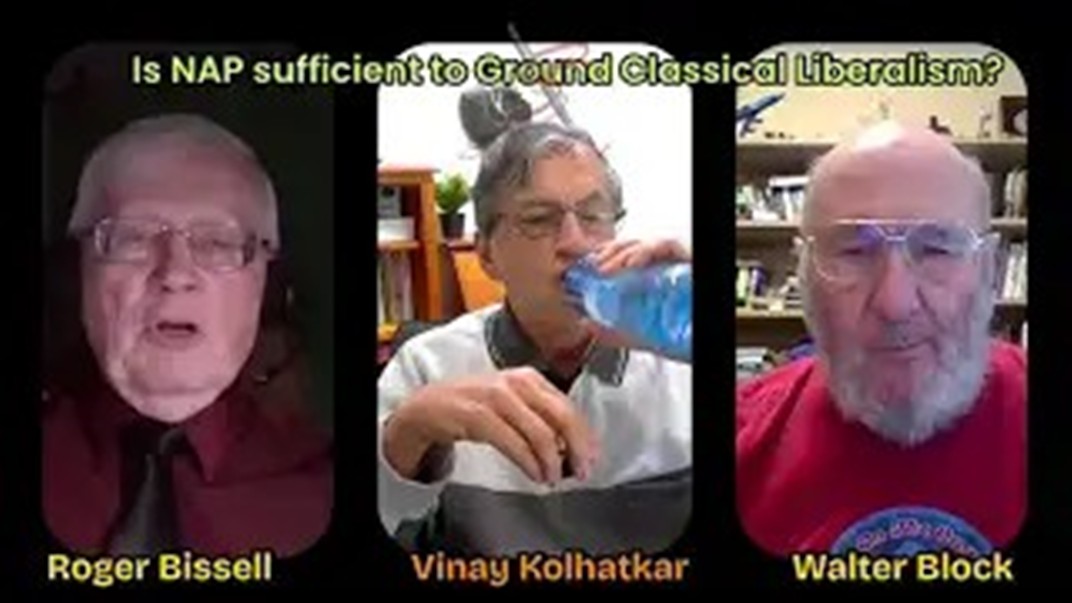
Transcript: Is the Non-Aggression Principle Sufficient to Ground Classical Liberalism?
By The Savvy Street Show
August 23, 2025
SUBSCRIBE TO SAVVY STREET (It's Free)
Controversies in Libertarianism, Podcast 5
Date of recording: July 30, 2025, The Savvy Street Show
Host: Roger Bissell. Guests: Walter Block, Vinay Kolhatkar
For those who prefer to watch the video, it is here.
Editor’s Note: The Savvy Street Show’s AI-generated transcripts are edited for removal of repetitions and pause terms, and for grammar and clarity. Explanatory references are added in parentheses. Material edits are advised to the reader as edits [in square brackets].
Summary
Roger Bissell moderates a deep dive into the core tenets of libertarian philosophy, focusing on the Non-Aggression Principle and private property rights.
In this episode of The Savvy Street Show, Roger Bissell moderates a deep dive into the core tenets of libertarian philosophy, focusing on the Non-Aggression Principle and private property rights. Joined by economist Walter Block and co-host Vinay Kohatkar, the discussion explores the foundational ideas of self-ownership and voluntary exchange, drawing on insights from John Locke and Murray Rothbard. The conversation also tackles the practical implications of these principles in modern society, addressing issues like immigration, intellectual property, and the ethics of restitution.
Tune in for a thought-provoking exploration of how these libertarian ideals can shape a just and prosperous society.
Roger Bissell
Good evening, everyone, and welcome to The Savvy Street Show. I’m Roger Bissell, and I’m your moderator for this installment, number five of our series on libertarian controversies, and this one is going to center on the bedrock principle of libertarianism, which is the Non-Aggression Principle. If you hear us use the letters N A P [or say it as a word, “nap”], we’ll try to enunciate so that you can hear them clearly, but that’s what we’re referring to, the principle that you should not aggress against other people. To anybody who loves liberty as the three of us do, there’s something really appealing about this principle. It’s very clear, very simple. Thou shalt not initiate force. Respect the personal freedom and property of your fellow human beings. We have two guests here tonight who have quite a lot to say about this: Walter Block, the eminent economist and author of the series on Defending the Undefendable, and my co-host and co-author, and chief editor of The Savvy Street, Vinay Kohatkar. Welcome to both of you, gentlemen.
Walter Block
Good to be here. Thank you for having me.
Vinay Kolhatkar
Thank you.
Roger Bissell
Good to have you. Now, the concept of “live and let live” really captures the Non-Aggression Principle very nicely. I think most people understand that, even if they might blink a little bit when they hear “Non-Aggression Principle.” We’re going to examine tonight whether this principle is enough to have a practical and a strong political philosophy. We’re going to look both at the theory that underlies the principle and some of the implications for policy issues. So, let’s start by defining our terms. We say that we want a society that lives by the principle of non-aggression. We don’t want any of this aggression stuff. What is aggression? Is it just being belligerent and violent and unpleasant, engaging in physical attacks on others, or is there something more to it than that? I’d like to hear from Walter first.
Walter Block
Thank you. I think we need one more principle. I’ve been admiring Vinay’s shirt, and I think I’m going to go over and grab it. Now the question is, am I a violator of the Non-Aggression Principle? It all depends upon whose shirt that is. If he stole it from me yesterday, I’m just repossessing it. He’s the bad guy and I’m the good guy. On the other hand, [if this is] the first time I saw the shirt, it’s his shirt, it’s not mine, so if I grab it, I’m the bad guy. I initiated violence, I initiated aggression. So, we really need a theory of private property in addition to the NAP, and I think most libertarians go along with John Locke and Murray Rothbard, who said that we own ourselves, we start off that way, and then we mix our labor with the land and we own the land. Then I put in a crop and I have corn, and Vinay captures a cow and domesticates the cow and he’s got milk. Then Robert Nozick said, any legitimate title transfers. So, now Vinay and I trade, we have a barter, and I now own the milk even though I didn’t produce it, but I can trace it back to his homesteading and the voluntary agreement, and he also has corn even though he didn’t produce that.
I think everything is cool if we have the Non-Aggression Principle and private property rights.
So, I think everything is cool if we have the Non-Aggression Principle and private property rights, and [aggression is] not only the initiation, but the threat thereof. I’m now going to threaten you, Roger. I have a gun here, you can see the gun [points], and I say, “Give me your money, or I’ll shoot you,” and it’s okay to say that here, because you know we’re just engaging in philosophical discussion. If it was in a play or a movie, that’s fine [too]. But if I was serious, and I said, “Here, I’ve got a gun, and I’m going to shoot you,” I don’t even need a gun. I can say, “Give me your money, or I’ll beat you up,” or something like that, [that is also] a threat.
Roger Bissell
Your bullets aren’t going to go all the way from where you are to where I am anyway, so I feel like I’m fairly safe!
Walter Block
Well, I’ve got an ICBM, so if you don’t give me money, I’m going to get you, boy. What I’m saying is that it’s not only physical violence, but it’s also the threat thereof.
I [also] wanted to get in a word against antiwar.com. Antiwar.com is a wonderful libertarian blog, but I think it’s misnamed because we libertarians are not against war. We’re only against offensive or initiatory war. We’re not against defensive war. So, if somebody attacks us and we fight back, we are engaging in war, but that’s okay. Similarly, the Mises Institute has its motto, free enterprise and peace. Well, we’re not in favor of peace. We’re not pacifists. If somebody attacks us, we need not be pacifists. Some of us could be pacifists. But we don’t have to be pacifist in order to be libertarians. That’s my opening statement on this issue.
Roger Bissell
All right. How about you, Vinay?
Vinay Kolhatkar
Aggression is the initiation of force or of a threat to use force or the initiation of deceit.
Okay, you asked for a definition and here it comes. Aggression is the initiation of force or of a threat to use force or the initiation of deceit, including subtle manipulation [which] is also deceit. So that’s a definition of aggression. We can go into more detail where all that comes from if we need to, but that’s all I’ll say. What we need to avoid is [violating] what we call “the second order of humaneness” in our book on ethics. [It is] pretty close to this NAP principle.
Roger Bissell
Well, Vinay, if I say that I really, really like your shirt, am I engaging in aggression, if I don’t really, really like it?
Vinay Kolhatkar
Not at all. That’s a good counter because NAP, at the end of the day, is a core principle. But we have to ask the question, where did this principle come from? And in what circumstances can you depart from the principle?
So, the first order of the day is not so much to define as to describe and understand the world around us—metaphysics, if you will. The world around us obeys certain natural laws, and when human beings discover those laws and engineer things with those laws, you go from science to technology and engineering, you get quite a lot of prosperity, provided there’s also a civilization, a division of labor, just laws, and just conduct.
That [outcome] depends on the nature of human beings. Human beings are naturally curious.
That [outcome] depends on the nature of human beings. Human beings are naturally curious, they’re self-actualizing human beings, so if you ask the question, what does it take for an ethics to be universal, and what does it take to self-actualize? The answer would be, if everyone was free to self-actualize, make mistakes, correct themselves—the cornerstone principle would be that if you have your own ethics, you’re trying to do the best for yourself, but while you’re doing it, there is a principle of universalization that should allow everyone else to do the same thing. The only way this can be implemented in society is the lack of aggression, as we defined it. Homesteading is based on the value of life and the kind of world we are in. Nature is beautiful, but it’s also hostile to us, and we need to tame nature. That’s why we have those principles.
There can be instances like the famous instance of Immanuel Kant [’s famous illustration], I call it the Kantian Killer, in order to exaggerate it. There is a killer who knocks on your door. He wants to kill your daughter, and he asks you where she is, and Immanuel Kant says, “You should tell him the truth,” which is an absurd answer. You should try in every which way to engage in deceit that is successful so that he doesn’t find her, because after all he’s the one threatening force, you owe him nothing, in fact, you owe him a lie.
There’s another illustration which I explored, in fact, in a novel. There’s, let’s say, a 15-year-old girl, she’s depressed, there’s nothing wrong with her physically, and she’s about to jump off the Millennium Bridge in London right into a freezing Thames River. You are a taxi driver and this is an actual scene. She’s put one leg over the railing and if she throws herself down, she is going to die. There are seconds left. There’s not enough time to call the cops or the coast guard, let alone philosophize. So, in this instance, the cabbie runs and pulls her off the railing. She might hurt a foot. [Has the cabbie] aggressed? Yes. But the NAP was put in place to value life and have an ethical and civilized society, and I don’t believe any jury in the world would convict this cabbie because he’s done the right thing by saving her life. In due course, her depression may go, and she may very well thank him for saving her life. Now, she might stay depressed and make more attempts, and the third attempt may be successful, unfortunately, but he obviously hasn’t done anything wrong, and he’s done a lot of good, so that’s my answer.
Roger Bissell
Okay. I want to come back to the question of deceit, because there is an aspect of deceit that I think plays into libertarianism, as far as rights are concerned, and I’d like Walter to come in on this. It’s not just initiating force like physical force, like hurting someone’s body or taking their property. What about fraud? Fraud is [when] you’re trying to get some person’s material values from them, or to get them to do something that they wouldn’t willingly do if they knew the truth, but you’ve lied to them. So, Walter, do you have any comments about fraud and whether it should be part of libertarian principles? I don’t mean that it’s good. I mean that it’s bad [but how is it bad?].
Walter Block
No, I agree with you. It’s akin to theft. One way I can get the shirt from Vinay is to grab it. Another way is, I could engage in fraud. Somehow, I tell him I’m going to buy it and then I just don’t send him the money. And it’s the same thing. It would be indistinguishable from a libertarian point of view whether I stole his shirt by grabbing it off his body or off his closet or I said I’ll buy it for a hundred bucks and he agreed and he sends it to me and I just don’t send him the hundred bucks. It doesn’t matter. It’s all the same thing. On the other hand, we don’t owe each other the truth. If you ask me what time it is and I say it’s 17 o’clock, I lied, but it’s not a violation of rights because I have free speech. Now, if you hired me to tell you the time and then you asked me the time and I purposely lied, now I’m engaging in fraud against you. So, I think we have to distinguish [that from] telling the truth, which you’re not required to do. Certainly, Vinay’s point [is valid] about you don’t have to tell the murderer where your daughter is.
I wanted to comment on Vinay’s point about the girl in the process of committing suicide. I have a problem. It’s a 15-year-old girl. Well, she’s a child, so I don’t care. You just grab her and keep her, and when you do that, you’re not invading her or anything like that. On the other hand, if she’s 25 years old, and you grab her, and she says, “Look, I have stage five cancer, and it’s excruciating, and the morphine no longer works. I’m just in diabolical pain all the time. I appreciate that you stopped me because you didn’t know, and I’m not going to sue you for assault and battery, but you’ve got to let me go.” Now if you still keep her and she’s 25, an adult, then you’re committing assault and battery. I’m sure Vinay and I agree on this. I’m just elaborating on his very important point.
I wanted to mention another situation where there’s a seeming contradiction. There was this movie, Doctor Strangelove, and the situation was that we have to call the president to save the world. And if we don’t call the president, there’ll be ICBMs going here and there, and we’ll all die. But we don’t have a dime. This is before cell phones. However, there’s a Coke machine. It’s got a lot of dimes in there. One character in Doctor Strangelove is about to take his rifle and shoot the Coke machine to get the dime to save the world, and somebody else says, “This is an attempt to undermine our philosophy, so you can’t do that. That’s private property. That’s theft.”
It’s not saying you should never violate the NAP, it just says that if you do, you are a criminal and you have to pay the penalty.
So, to go a little deeper into the Non-Aggression Principle, it’s not saying you should never violate the NAP, it just says that if you do, you are a criminal and you have to pay the penalty. And if the Coke people said, “You ruined our machine and it cost $300,” you have to pay whatever the penalty is. So, we’re not saying you can’t ever violate the Non-Aggression Principle. We’re just saying if you do, you’re a criminal. Obviously, you’re going to shoot the stupid machine to get the dime to make the call to save the world. But this is an attempt to undermine the NAP, and I think we have to be more sophisticated about it. We’re not saying never violate the NAP. We’re saying if you do, you’re a criminal, and you have to pay a certain penalty for being a criminal. You have to make recompense. Someone said [Vinay] no jury would indict you. Well, no jury is going to give you more than a slap on the back of the hand for shooting the machine.
Roger Bissell
Well, we got an awful lot out of that first question, and I appreciate that. One of the most attractive things about our philosophy and this principle [NAP] is that it’s really simple, but is that all there is? I think Vinay started delving into that, and Walter added the fact that we need property rights as the foundation also. Are there, though, more basic principles that [they rest] on? Vinay, you mentioned that there has to be some principle that is universalizable, that is applicable to everybody. Of course, there are situations like the honesty principle, for instance, which is not a political principle, it’s an ethical principle, and there are obvious situations like the Kantian situation, where the killer’s at the door, and you lie your ass off in order to save your daughter. You don’t owe a killer the truth.
I wonder, [though,] if we’re trying to get people to come on board, if we’re forming a community or society, how do we get everyone to agree, unless there is a shared understanding of this principle and of maybe what lies underneath it? There are people who are Buddhists, Muslims, people without any religious faith, Jewish, Christian, etc., and they may agree in principle that we want a law against murder, but they might not even agree about what murder is. [We want] to get them to agree to as many things as possible, like what theft is, what rape is and so on, and that this is just simply, you don’t do this, [but] how in the world do we get people to understand what they are agreeing to in forming a community? A part of that also is, how do you bring up your kids? How do you teach them civics? I think that’s what we used to call it back 50 or 60 years ago. I don’t know what they call it now, if they even have a name for it or if they even teach it. Walter, I want to start with you again on this. What practical ways are there that you can think of for getting everybody in line with the principles of the community or of the larger political body or whatever?
Walter Block
Well, we really have two questions on the table. One is, how do we get agreement among the most people? And the second one is, what underlies the NAP and private property rights? What justifies them?
As for getting people to agree, first we have to get places like Harvard and Columbia to pass the Sodom and Gomorrah test. What’s the Sodom and Gomorrah test? God was going to smite Sodom and Gomorrah because they were evil and an angel pleaded with God, let me go there and find 10 righteous people and then you’ll save the places and God agreed. He went there, couldn’t find 10 righteous people. Well, Harvard has got what? 2,300 or 3,200 professors, I forget which number, something like that. Can you find 10 professors out of the 2,300 who read conservative literature? No. Well, how are you going to get people to agree if they’ve never even heard of an alternative, a much better alternative than the Marxist nonsense that they teach there? So, one way to get people to agree is to allow not skin color diversity, but ideological diversity. Too many of our universities just don’t have it. Another problem is, I once wrote a paper on sociobiology, which is the theory of why we behave the way we do, based on genetics a million years ago. What percentage of the votes do the libertarians get? In the US, 2%, give or take. So, it’s going to be hard to get people not only to agree, but to agree to libertarianism. I don’t want them to all agree on Marxism. I don’t want them to agree on libertarianism. So, we have biological impediments there. So, that’s one answer to one question.
What justifies the NAP and private property rights in the first place?
Now, the other question is, what justifies the NAP and private property rights in the first place? What justifies libertarianism? There are various theories. One is religion: God said so. I wish God would speak louder, but that’s one possibility. Ayn Rand, what does she say? It comes from “A = A.” Don’t ask. I don’t know, but that’s her view. Another one is natural law, natural rights. Many philosophers use that. My own favorite is my old buddy, Hans Hoppe, who had this theory called “the argument from argument,” or Argumentation Ethics. He said, “Look, the only way to get to the truth is to argue, to discuss. If you and I are having a dispute, and I shoot you, well, I didn’t really win the argument, because I didn’t argue.” And then he asked, “What do you need in order to have an argument? First, you need the Non-Aggression Principle. Maybe you can’t shoot, but you’re an arguing person. Then you need a place to sit or to stand, and now you have private property rights.” Now, I’m only giving a 30-second view of this, but I think it’s brilliant and creative, and that’s my favorite justification of the NAP. However, just speaking for myself, I’m not that interested in what causes or what justifies the NAP. I’m much more interested in what follows from it. What can we deduce from it? Should we have legalized prostitution or should we have labor unions or should we have minimum wages, or should we have free trade or tariffs? I’m more interested in the implications of it. But since you asked what justifies it, there are four or five different theories out there, and my favorite is Hans Hoppe’s.
Roger Bissell
Vinay, what’s your take on this?
Vinay Kolhatkar
Okay, I’m going to have, apologies, a slightly expansive answer. I have a slight disagreement with Walter Block. Each and every case of violation of NAP doesn’t actually and shouldn’t make you a criminal. The case of the woman jumping over the bridge—suppose she was 18, and in the hypothetical [case], she is perfectly healthy, not [with] stage five cancer or anything. Yes, you have aggressed against her, but like I said, even if she tries to sue you, no jury would convict you. Normally, it’s a principle in law. It’s all about the greater good. I hate the term “greater good,” but there is a compelling reason for your action, and it is to the benefit of the woman who was saved. So, that’s the first thing.
The second thing was, you asked about deceit and subtle manipulation. Now, the definition of “aggression” that I gave already had the avoidance of deceit. Fraud is just another form of deceit.
Subtle manipulation is a very strange thing. When you don’t proffer something in a conversation, is that subtle manipulation? Yes.
But subtle manipulation is a very strange thing. When you don’t proffer something in a conversation, is that subtle manipulation? Yes. Is it okay? I would say, in a business negotiation, it is okay not to show all your cards, because it is a business negotiation. In Asia, everybody haggles with the street hawkers, and hawkers know it. They also start with a higher price than they’re willing to take, and you start with a lower price than you’re willing to pay. But if you have a strong friendship with someone, it is best to proffer and be very, very open, as open as you can be.
Now, coming back to where does NAP come from? I think we answered that question already, which is that there’s metaphysics, the nature of world around us. There’s ontology, our nature. And the questions we asked were, could a system be devised that primarily informs us as to what we ought to do with ourselves—a system not mainly containing rules of conduct, but [including] how we deal with others. That system does have to be founded [on something]…a base of it is the NAP. It’s not a complete system, if it is based just on that, but once you have the metaphysics and ontology in place, then you can go towards the full system.
Walter Block
I’d like to pipe up on this. I don’t like 15-year-old girls and I don’t like 18-year-old girls, because 18 is right on the verge of a child. Let’s talk about a man who’s 40 years old, and he’s in perfect health, and he wants to commit suicide by jumping off a bridge. Would it be justified to grab him and not allow him to do that? I’m not sure what Vinay’s view is, but my view is, it would not be justified to do that. Maybe it’s justified to do it for five minutes and say, “Are you sure you want to do that?” But you’ve got to let him go, because he is the owner of his body. So, do we agree on that, Vinay?
Vinay Kolhatkar
Yes, we do. If you grab his arm and try to persuade him, and he is not easily persuaded, then at some point, you’ve got to let him go. But if I was a juror and the person didn’t let him go, I wouldn’t convict him of assault and battery if all he did was hold that person back, maybe for half an hour, maybe till he calms down, because at the end of the day, someone who absolutely wants to end his or her life is going to succeed, anyway.
Walter Block
I think we agree that you can talk to them for half an hour, I don’t know what the number is, 20 minutes, an hour, who knows? But after that, it becomes assault and battery.
Vinay Kolhatkar
Yes, at some point you’re going to let go. But if it’s an emergency, you don’t even know the person. She’s a stranger. You don’t know exactly what her age is. She’s got one leg over the bridge. You run and grab her. Maybe you injure her foot, [and] so on.
Roger Bissell
Is the Non-Aggression Principle sufficient to protect individual rights and liberty in these kinds of areas?
Okay, I have to break in here because this is not a discussion of suicide, and we spent almost half an hour circling the question of suicide. I’d like to move on now. Walter suggested that we look at policy implications because that’s really kind of interesting. What are the implications of the NAP? Vinay, I’d like to go to you about what are the minimum additional principles or sub-principles of the NAP to deal with some of the really persistent social challenges we have. We’ve got declining birth rates across a lot of the Western world. We’ve got uncontrolled migration in quite a bit of the Western world. We have non-traditional domestic arrangements. We’ve also talked in the past about children’s wellbeing. So, is the Non-Aggression Principle sufficient to protect individual rights and liberty in these kinds of areas of concern, or do we need to expand upon the principle, or do we need additional principles as well? So, go ahead, Vinay, and give us your thoughts.
Vinay Kolhatkar
How do we get the message across? Normally, you would get it across in law, so the founding principle of jurisprudence would be non-aggression/
Thank you. Earlier, you said, how do we get the message across? Normally, you would get it across in law, so the founding principle of jurisprudence would be non-aggression, but it would not be enough as we discussed in the other podcasts on immigration, on foreign policy. We had to have NAP and something else. For instance, [suppose] there is an immigrant who is not being aggressive at all, all he wants to do is come and find a place to live, seek a job, and he’s been offered a job by an employer, so he’ll be able to live a very peaceful and productive life. Yet, we find that we are in favor of putting restrictions on such an individual, because we have some aggregate numbers that we can’t take 30 million a year into the US. That prevents some people from simply applying for a job, getting it and coming there. So, we have to go beyond NAP in just drafting an immigration policy. Also, for foreign policy, you have to say, who are our friends and who do we cultivate—which nations are our friends? How do we respond to any imminent threat? These are nuances that cannot automatically be addressed by NAP but can be addressed by bigger principles. What is the nature of human beings? What do they seek? What are their needs? One need is respect from others, and one way to get respect from others is to make yourself tremendously productive. Another way is to get power, like politicians do, power over other people’s lives, legal power to commit aggression. Unfortunately, because that’s inherent in human nature, we have this difficulty of getting around to a society in which non-aggression becomes a cornerstone principle. That’s all I have for now on this.
Roger Bissell
Okay. Walter.
Walter Block
I’m not sure I go along fully with what Vinay said about respect. You have to be productive. Bernie Sanders, my old high school track team buddy, used to inveigh against millionaires and billionaires. You know, he doesn’t do that. He now just inveighs against billionaires. You know why? He’s now a millionaire. Now look, there are two ways to become a billionaire. One is to steal it, whether with a gun or through politics, and the other is to create a great product and benefit humanity. A lot of people hate billionaires, so they don’t give them respect, even though they earn their money honestly, unfortunately.
Do I have a right to discriminate not only against the haired people, but gays or women or blacks or Jews? Yes, sure.
I also wanted to talk a little bit about criticisms of what we’re now talking about. One of them is Triple L, “live and let live.” I don’t think “live and let live” follows from libertarianism, because let’s say I hate people with hair. I don’t have any hair anymore. I just hate people with hair, and I have a restaurant, and I say no men with hair can come in, only bald men and women. Do I have a right to do that? Do I have a right to discriminate not only against the haired people, but gays or women or blacks or Jews? Yes, sure. Now, this sounds horrible. You’re going to hurt the poor victimized group! But there are three people I would mention who have done more than any other three people in demonstrating that this right to discriminate will not hurt the victim. And these people are Gary Becker, Thomas Sowell, and Walter Williams. They’ve shown over and over again that if you discriminate against someone, then their wage falls; but if their wage falls, you can make more profit by hiring them. So, the whole thing doesn’t work. But the point is that bigotry and hatred on the basis of sex or race or sexual preference is a right. So, we don’t necessarily favor it. I favor it, but we don’t have to favor it as libertarians. I wanted to mention another one, and that is sometimes when somebody’s not breathing, a doctor cuts his throat in order to help him breathe. That’s not assault and battery, even though it looks like assault and battery because, as Vinay was indicating, this was an attempt to help the guy, not to hurt the guy.
I wanted to mention two more points. One is, I’m on the 25th floor, and I lean over my balcony and I fall. Happily, Roger has an apartment on the 15th floor, and he’s got a nice big flagpole, and I grab the flagpole, and I’m starting to move down the flagpole. What I want to do is to go into Roger’s house, his apartment, and then get on the elevator and get back up to my house on the 25th floor, but Roger says no, and it’s his private property. Our hearts go out to me because I’m innocent, and I want to just get back to my house, and Roger says, “If you move one more step toward me, I’m going to shoot you.” Now what the critics of libertarianism say is, “Would you drop?” No, I’m not going to drop. I’m going to keep going, and hopefully, I’ll bluff him. I’ll engage in deceit and fraud and hope he won’t shoot me. One argument against libertarianism and private property—he owns the flagpole—is that I’ll die, and I’m innocent, and that sounds horrible. My answer to this is: okay, I’m going to die, but this is a pretty rare case, and more people will die if we don’t respect private property rights. So, it sounds horrible that I’m going to die because Roger is a rotten kid and he won’t let me into his apartment, but somebody looking like me might have beat Roger up, and he was afraid of me. He has every right to shoot me. So, that would be one case.
I also want to talk a little bit about immigration, since it was raised. My view is open borders, completely open borders. Now look, you people, idiots, think that new babies come from sexual intercourse. You’re just wrong. You’re fools to believe that. Where do new babies come from? They come from the stork. The stork brings new babies—with a blue blanket, it’s a boy, with a pink blanket, it’s a girl. Well, where does the stork get the babies from? From the country Storkovia. So, if you’re really against open borders, you have to have population control like they did in China. You’re only allowed to have one kid or maybe no kids because babies are immigrants from the country called Storkovia. So, we have to have open borders, now, from the libertarian point of view. Now, the problem with that is, some of the immigrants are murderers and rapists, and we don’t want them. So, I think the libertarian answer is, let’s privatize every square inch of the country, not only the land but the water, everything, no more parks, no more roads government owned. Everything is privately owned. Now you want to invite somebody from Mars. Well, if you invite somebody from Mars into our country, you have to be responsible for them. If they commit a crime, we’re going to come get you for inviting them. Not only are you responsible, how do they get out of your house? Well, they have to get on the road. Then the road owner has to agree to accept them to be on the road. So, what I’m trying to do is have our cake and eat it, too. On the one hand, open borders; on the other hand, we have to protect ourselves against maniac immigrants—and I think this is the way to have our cake and eat it. See, too many libertarians want to jettison libertarian theory, like Hans Hoppe, for example. He doesn’t want to have open borders, but I think he gets in trouble with the Storkovia example. Also, he’s jettisoned libertarianism in order to gain utilitarianism. Pragmatic implications are we don’t want people who are murderers and rapists and other people like that. So, I think the correct implication of the Non-Aggression Principle for immigration is open borders and privatize everything, and you’re responsible if you invite a Martian or somebody from somewhere else.
Roger Bissell
Vinay, do you want to come back on any of that?
Vinay Kolhatkar
Yes, on one matter, I was going to just take the example of a fellow called Alexander the Great. At the age of 16, he led his troops into combat, and supposedly he achieved a lot of great things in his teenage years. Now, from a non-aggression point of view, he was an invader and he didn’t achieve great things, right? He also had the advantage of being privately tutored by one of the greatest, if not the greatest. Aristotle was his tutor from age 13 to 16—ethics, politics, and another thing called eristics (it’s the art of debating). We have created a society in which we have said adults [have to be] aged 18, and the mental maturity of people is not complete until they are in their late 20s. If you look back on your own lives, almost everybody says, sure, I was more mature at 30 than at 20. But they also say I was more mature at 40 than at 30 and at 50 than at 40, and it goes on and on. So, does that mean we should just keep treating everyone like a child until they reach 65 years of age, and then they retire, so, nobody works?! I think we have significantly underestimated human beings and made the education system extremely long, extremely rigid. Everybody’s got to learn algebra and geometry in high school instead of finding their paths and getting onto the workforce at age 15, 16.
I had a co-author, Walter Donway, and we wrote a book called Media Wars, but the subtitle of the book is more explanatory because it says, “the battle to shape our minds,” and that battle is on. I reject the notion that we all have to be led by the government and other experts, and [that] we have to be mollycoddled. I think the more freedom we grant ourselves and our children, the more productive we can all be, the more happy we can all be, and the more self-actualized we can all be.
Roger Bissell
Yes, for sure. Going back to Alexander the Great, I think one of the problems was that he was too ambitious. If he’d simply tried to be Alexander the Pretty Good, I think everything would have turned out a lot better.
Walter, the next question I want to start with you. The whole issue of addressing injustices to your rights and property—I’m sure I know what you’re going to say, but not exactly how you’re going to say it because you’re always very interesting—suppose you don’t want to provide compensation or restitution to someone after you’ve caused them harm or, in a parallel issue, suppose you feel like, “Well, yes, I signed the contract to buy this car, but I really don’t feel like making the payments.” Isn’t that a form of aggression? And, if it is, explain how it connects to the Non-Aggression Principle, or if it’s a sort of auxiliary principle, [try to] connect it the best you can. Go ahead.
Walter Block
Well, I certainly agree with you that if you buy a car and you’re supposed to be making the payments, and you make two or three payments, and all of a sudden you say, “This is getting boring. I don’t want to make more payments,” the owner of the car or the previous owner of the car should be able to repossess it from you, and you should be paying a penalty based on what the contract says, and if the contract doesn’t say anything, then we have to intuit what the Non-Aggression Principle would say. My own theory of punishment is fourfold. First of all, the Bible says a tooth for a tooth, an eye for an eye. I say two teeth for a tooth. So, I’ll steal your pen because I can wave it around, and now you capture me. Well, the first thing, I have to give back the pen—your pen. The second thing is, what I just did to you should be done to me, namely, you should get another pen of mine. So, that’s two teeth for a tooth. The third one is, if I immediately after stealing your pen went to the police station and said, “I don’t know what came over me. I was crazy. Here’s the pen back,” then there are no costs of capture. On the other hand, if I hide out for five years, and you guys are trying to find me, well, who’s going to pay for all of that? Me. Fourth, and this is the most controversial, when I stole your pen, I scared you. I don’t care if you’re Arnold Schwarzenegger or Muhammad Ali, and you fear nothing, I scared you objectively. Well, you have to scare me. Now, one way to scare me is to go “Wooooo!” [Walter makes a scary face and noise.] Another way to scare me is a little Russian roulette, with the number of chambers and the number of bullets and the place where…is it [the empty chamber] here, or is it [at] the tip of my finger? It’s a very draconian punishment theory, so don’t violate the Non-Aggression Principle if my views on punishment theory are implicated.
I wanted to mention something else on this. How about reparations? Now, there was slavery in the US. This was a horrible thing, much worse than just stealing labor, although stealing labor was a part of it. So, what should have happened in 1865 when slavery ended? What should have happened is that the slave master should have been enslaved to the ex-slaves. Got it? Now, it’s not a white or a black thing, because there were black slave owners, [too]. I don’t think there were any white slaves, but there were black slave owners. But most of the slaves were black, and most of the masters were white. What should have happened is that the masters should have become slaves to the ex-slaves. Now, what about the plantation? Well, who put their labor into the plantation? [We go back to] John Locke and homesteading—who homesteaded that plantation? Well, it wasn’t the white guy. He was just there with a whip, whipping the slaves. It was the slaves, so they should own that. Now, suppose that there’s a plantation, and there are ten slaves. Well, each slave should get one-tenth of the plantation. It doesn’t have to be the same square footage because this meadow is better than that meadow so the poorer meadow should get more land, but that’s a minor deal. Okay, it’s now, what? 150 years later. Should we have reparations for slaves? There are two groups, the right wing, the left wing, and us libertarians, or at least my view. The right wing says, “Look, I never had a slave. There’s no slavery nowadays, so there’s no reparations whatsoever.” The left wing says, “Yes, all whites owe all blacks reparations.” My people, I’m Jewish, we came here, my grandfather, in 1895, something like that, 1902, long after slavery. Why are we paying anything? Then there are black people who just came over to this country two years ago. Why should they get any money from slavery in the US? So, I think that it’s inoperable. The correct view is that if there’s some black guy in Harlem who says, “I can prove that my great-grandfather was on Jones’s plantation, and right now Jones’s plantation is owned by Jones’s great-grandson,” who is innocent, he’s just the recipient, he’s holding stolen property, because that property really belongs to the slave’s great-grandson. Now, possession is nine-tenths of the law. Vinay is into the law, and I’m sure he’ll agree with this. The burden of proof is always on the plaintiff, so the black great-grandson has to prove that his great-grandfather was on the plantation, and we assume that the grandfather would have given it to the father who would have given it to the son. If he can prove this, then he should get one-tenth of that plantation. Now, the problem with that is the thing called statutes of limitations. Statute of limitations says, look, after 50 years or 100 years or whatever it says, property is the way it is, and we’re not going to change it. I say that that’s not fair, that’s not proper, that’s not libertarian. There is such a thing as a natural statute of limitations, namely, the further back you go in history, the harder it is to prove anything. But if this black young man in Harlem can prove that his great-grandfather was there and working on the plantation, I think he should get it. So, the proper libertarian view is not all reparations from all whites or blacks and not none, but whenever you can prove it, you got it.
Roger Bissell
Vinay, you might have something to say about a different aspect of reparations or restitution, and so on, but while we’re talking about the Civil War, and I know this wasn’t your country’s civil war, but I know that hundreds of thousands of men from the North and from the South were drafted into the military of the two countries, and many of the draftees were sent to their deaths. Now, you can say, and it is true, that slavery is a terrible thing, but I would submit that the draft is selective slavery. That’s what we always called it in the sixties, “selective slavery.” Some had to go [to Vietnam], and some were sent to their deaths, and they had no choice unless they wanted to run away from their country [and] go to Canada. So, do you see any [way to make] reparation to the people who died in the Civil War? [Making reparations to] their descendants would be even harder than reparation to slave descendants. But go ahead and comment on this or any other aspect of restitution that you’d like to comment on.
Vinay Kolhatkar
Firstly, this illustration, which is quite complex, both the one that Walter talked about, and [the one] you did…these are historic wrongs. In some cases, even if we didn’t have the statute of limitations, it is tremendously hard to ascertain the facts, because everyone will say, “My great-[great—great]-grandfather was a slave.” How do you prove it? And what was their productivity? Where were they a slave? Now, the draftee situation may be slightly easier to establish: an ancestor who was killed in the war. But if we go back a couple of hundred years, there’s going to be a lot of situations where governments have aggressed against your ancestors, and then everybody deserves compensation. Where is the money going to come from? Well, it’s the same: everybody, the taxpayers, and then we are pretty much going to have bankruptcy at the sovereign level.
I wanted to go back to the central issue about NAP. If I’m engaged in a casual conversation with someone at the pub or they’re having a beer and they want to talk about libertarianism, they’re sort of half serious, so it’s nice as a conversation opener, because it’s quite simple. But if they really want to dig into it, you want them to read Murray Rothbard, Walter Block’s Defending the Undefendable, Ayn Rand, John Locke, and then have a three-month or a six-month period where you engage, and you still won’t get all the answers.
But the shortcomings in NAP—last night I was looking at it, and I listed 10 things.
But the shortcomings in NAP—last night I was looking at it, and I listed 10 things. First, as you mentioned, restitution. You know a crime’s been committed by sending your great-grandfather’s great-grandfather off to war, and he was killed. What’s the right amount of compensation? We don’t know [that] just from NAP alone. We don’t know the pathway to a libertarian utopia, however defined. We don’t know, if we agree on a minimalist state, how exactly to get that taxation. There are some answers, but nothing that is perfect. We don’t know about the right immigration levels, about foreign citizens’ right to seek work, about the right of employers to employ foreign citizens without taking permission from the government. If you have a Rothbardian world that is effectively manned with independent jurists basing themselves on common law, if we did that today, you’re going to find a lot of jurists that are corrupted by neo-Marxism, and it’s going to be very hard to find the kind of jurists that Rothbard would rather have. We don’t have a theory of education, pedagogy, or the curriculum and customization. We don’t have a theory of child rearing and the functioning of families. We don’t have a theory of childhood. How can we all become Alexander the Great at age 16 without actually invading other lands? A couple of others, we don’t have a theory for redemption. Roger and I attempted that, as to what is the right amount of redemption and restitution if you admit to having committed a moral wrong. We don’t have [a theory on] the limits on the rights of governments to classify information as secret. By and large, they overdo it like nobody’s business, and make its disclosure an act of treason, punishable by death, which is ridiculous.
Roger Bissell
Yes. I have one more issue I want to delve into here, and I’m going to actually narrow it a bit because there’s so much that could be said about it. I wanted to talk about property, but in particular—and I know this is very controversial, so let’s just explore a bit in our remaining time—the issue of intellectual property. Now, I know all three of us are writers. [Also,] I’m a musician and I’ve done recording musician work, also, and composing. So, this is an issue of things that we have produced, created; and yet once it’s out of your hands and the publisher has it, it’s no longer a tangible object like your clothes washer or your piano sitting in your living room or whatever. So, Vinay, I want to start with you. How does the NAP or homesteading or property extend to intellectual property, or does it? Go ahead, Vinay.
Vinay Kolhatkar
I will avoid the whole section of patents, which is very complex, but copyrights are much simpler than patents, and I absolutely believe that my reputation is part of my intellectual property, so, I believe in the law of defamation—not correctly applied in the US, but I won’t go into the details how. I absolutely believe that if you have a copyrighted work, Roger, and someone steals it and starts selling the books under their name, and they cancel “written by Roger Bissell,” and they put their own name and start selling it at half the price, yes, absolutely, they’re depriving you of royalties from your book. So, that’s my answer.
Roger Bissell
Well, that would be fraud, though, and fraud is already a no-no.
Vinay Kolhatkar
Absolutely, Copyright becomes an easier case than limited-time patents.
Roger Bissell
I see your point. Walter?
Walter Block
Well, Vinay and I only agree on 99% of everything, and this is in the 1%.
Well, Vinay and I only agree on 99% of everything, and this is in the 1%. I’m a big fan of Stephan Kinsella on this. I think he is the chief, my guru, my mentor on IP, intellectual property. I don’t think that Vinay’s reputation…he can’t own his reputation. Well, that’s defamation. That’s different than IP. So, we disagree on defamation, also. My reputation…I can’t own it because it consists of your thoughts. How can I own something that consists of your thoughts? So, I think defamation law, libel and slander, is non-libertarian. On IP, if you steal this pen, I no longer have this pen. If you steal my idea, I still have the idea. So, what did you steal from me?
Third, I wanted to mention, I think, Roger, you’re guilty of what I call a typographical error when you said there was a civil war in 1861 in the US. A civil war is when two armies each want to run the whole place: 1917 in Russia, civil war; 1936 in Spain, civil war. In 1861, it was not a civil war because the South didn’t want to run the North. The North wanted to run the South, but the South didn’t want to run the North. The South just wanted to secede. Nor was it a war over slavery. My mentor on this is my old buddy, Tom DiLorenzo, who quoted Lincoln as saying, “Look, I want to keep the country together.” I’m putting words in Lincoln’s mouth, a la Tom DiLorenzo. “I want to keep the country together, and if keeping slavery will keep the country together, I’m going to keep slavery. If getting rid of slavery will keep the country together, I’ll get rid of slavery.” So, it was not over slavery, it was over secession, and we libertarians believe in free association—namely, you shouldn’t be compelled to associate with anyone against your will. Murray Rothbard favored two wars. One was the South in 1861, and the other was 1776 when the 13 colonies were trying to secede from the UK.
Roger Bissell
Exactly right.
Gentlemen, I enjoyed it very much. And in about two weeks we’ll get together for podcast number six, which will be on [right and left libertarians]. And all you viewers out there, thanks for tuning in, and we’ll see you again next time. In the meantime, stay savvy.

-

China’s Rare Earth “Monopoly”—and Why Markets Will Break It
-

Australia Needs a Fairness Doctrine—Who Will Propose It?
-
Audio State of Play Trump Presidency as at 2 Feb 2026
-

The Economic Solution to Kidney Shortages
-

High-Stakes Gamble: Is College Still Worth It?
-

Analyzing the Trump Presidency: State of Play, February 2, 2026
-

Will the AI Tsunami Ever Control Us?
-
US Panel Discussion State of Play
-
Mathematics and Ethics: A Discussion with Professor Franklin
-

Transcript: Podcast with Professor of Mathematics James Franklin