
Transcript: The Power of Narrative, with Robert Bidinotto
By The Savvy Street Show
August 29, 2025
SUBSCRIBE TO SAVVY STREET (It's Free)
Date of recording: August 5, 2025, The Savvy Street Show
Host: Vinay Kolhatkar. Guest: Robert Bidinotto
For those who prefer to watch the video, it is here.
Editor’s Note: The Savvy Street Show’s AI-generated transcripts are edited for removal of repetitions and pause terms, and for grammar and clarity. Explanatory references are added in parentheses. Material edits are advised to the reader as edits [in square brackets] and ellipses[…] to indicate omissions.
Vinay Kolhatkar
Good evening and welcome back to The Savvy Street Show. Today as well we have someone special in the studio. His name is Robert Bidinotto. He is a best-selling author, a big-time, long-time, admirer of Ayn Rand, and a former editor-in-chief of The New Individualist, which magazine I think is no longer published.
Welcome to the show, Robert.
Robert Bidinotto
Thank you so much for the invitation. I really appreciate the opportunity to chat with you this evening.
Vinay Kolhatkar
You’re welcome. Now let’s start a little bit with your life journey. You said it was influenced by Ayn Rand. Perhaps you can tell us how it came to pass.
Robert Bidinotto
Well, it’s a long story that I’ll try to keep short. I was born and raised in western Pennsylvania in a fairly rural area. As I often say, the biggest club in my high school was the Future Farmers of America. In this kind of an environment, someone like myself—very much a book reader, interested in ideas even very young—I felt like a fish out of water. And through the influence of several people connected with the high school—teachers, a librarian, and several other people—I became interested in first, anti-communism, then conservatism.
Frederick Bastiat and his writings were a big influence on me and sort of set the table for my later interest in Ayn Rand.
Then through The Freeman magazine, I became interested in what is called libertarianism or classical liberalism. Frederick Bastiat and his writings were a big influence on me and sort of set the table for my later interest in Ayn Rand. And as a young kid, I became politically interested and active in a group called Young Americans for Freedom, which [was] a big deal back then.
I encountered people from all kinds of outposts on the political right, including some people who called themselves Objectivists. I didn’t know what that was. But I read a good chunk of The Fountainhead. You have to understand, I was born in a Catholic Italian family. And what Rand was talking about was pretty alien to the ethics that I had been raised with. I read The Fountainhead—I think it was in the sophomore year or junior year in high school—and I was troubled by the ethics and also by Rand’s apparent atheism. It wasn’t until I encountered Atlas Shrugged in my freshman year in college, in the college [bookstore] when we were buying all [our] freshman year books…
I’d heard the “Who is John Galt” slogan many times in Young Americans for Freedom. Didn’t know who he was, but the book looked interesting. I read it in the first few weeks of my freshman year in college, and I must say that Rand completely ruined my college career—because I was a major in economics and studying under a well-known economist of the Austrian school, Dr. Hans Sennholz, who was a student of Ludwig von Mises. I lost interest in economics as such and became much more interested in moral philosophy. That’s where my heart really was. And I wanted to become a writer. So, I saw very little use for a degree in economics. And so, after my junior year, I decided I didn’t want to pursue economics anymore. And I didn’t have enough credits to go anywhere else. So, I decided to drop out of school and go seek my fortune as a writer, and became a freelance writer for many years, and had all kinds of adventures from there.
But I became very interested in Ayn Rand and her philosophy, attending courses, reading all of the books. At Grove City College, where I attended school, there was a wonderful group of young underclassmen who were highly intellectual, and they represented just about every variety of people on the right you can think of. There were followers of Murray Rothbard; there were followers of a fellow, sort of an anarchist, named Robert Lefevre. We had Misesians, [we] had everything. And there were some Objectivists there, too. It was wonderful to be able to debate all of these ideas late [into the] night. And I got much more of an education in philosophy and politics from those late-night, three-o’clock-in-the-morning arguments than I did through any of my classes.
I’ve been interested in Rand’s philosophy ever since, and got involved in some Objectivist organizations and publications, and have written copiously for them over the years. And also, I’ve gotten involved in journalism—did investigative journalism for Reader’s Digest, among other places. I’ve been writing nonfiction and fiction and editing magazines and books ever since.
Vinay Kolhatkar
You’ve just launched a new book, is that correct?
Robert Bidinotto
I’ll hold it up for you here. 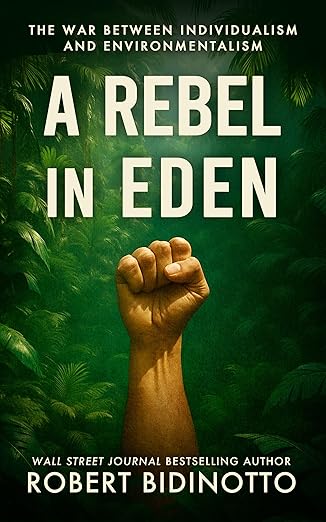 It’s called A Rebel in Eden, and its subtitle is The War Between Individualism and Environmentalism. And it draws upon my many articles and essays, and a lot of the research that I did for Reader’s Digest on subjects like global warming, ozone depletion, [and] pesticide residues on food. I did a lot of articles in investigative journalism on that. That has been an abiding interest of mine. I wrote this [book] as a compilation of a lot of the articles and essays and reviews that I had done in the past. And the reason I did that is that I asked myself the question, “Why is it that a point of view that is so false, so impractical, and in my view, so immoral—why has it had such a following? Why has that following persisted with such intensity for so many decades? What’s that all about?”
The book, in I think a unique way, tries to address that by pursuing two different paths. One is the appeal of environmentalism in some elements of human psychology. And the other is on a parallel track; and that is the popularity of basic premises of environmentalism that go back into Western mythology and Judeo-Christian mythology, way back into antiquity. Many of the core premises of environmentalism are part of the indelible mythological history of the West. And I believe that the roots of environmentalism and the source of its popularity come from both of those sources: from aspects of human psychology, which we can go into a bit; and from this mythological legacy of the West—a mythological legacy that, in many little-understood ways, has transported some of the most radical principles of environmentalism into the 21th century, where they now blossom and flourish.
Vinay Kolhatkar
Is it only the West though? [By] my understanding, even in the East, the kind of veganism or vegetarianism of Buddhism and Hinduism [is prevalent]; religions of the East also imbibe some environmental narratives.
Robert Bidinotto
I believe that you’re right. I know that, for example, there is a classical mythology about “the myth of the ages.” And it goes from the Golden Age—which was an era in the past, the distant past in the myth—an era that is regarded as perfection.
Description of this perfection was: an automatic existence for human beings. No risk, no effort. The sun always shone. It was like the song “Camelot,” where the rain never fell till after sunset, you know, [and] by 8 a.m. the fog will disappear. It was a myth of man’s harmony with nature, where everything was automatically provided to him. And that myth, you’ll find it in Hindu mythology, you’ll find it transculturally. That was “the Golden Age,” and it was in the distant past—which is very significant (when we talk about the psychology, I’ll go back to that distant past).
Then what you have is a slow decline. You have a Silver Age, a Bronze Age, and then an Iron Age. In classical mythology—such as the work of Ovid, the Roman writer, who developed that myth in a very detailed way—this Iron Age, which he described as truly terrible…was the immoral disintegration of human society and human culture. And that Iron Age has all of the elements…of contemporary capitalism: [of] private property, which is a horrible thing to him, [and] the use and development of natural resources for the betterment of human beings, which he regarded as a desecration of nature. Many of the fundamental premises of environmentalism can be found in the work of the Greek writer Hesiod, and then in Ovid, developed even more explicitly—where this…past era of perfection and harmony with nature, and [an] automatic primitive existence that was bucolic and idyllic, slowly declines. Man’s corruption was the use of nature, which [the classical writers] regarded as the destruction of nature, the abuse of nature. And you get what is called the “declensionist mythology”—[a] slow…decline of human society and civilization from its original state of perfection.
When you get to the Judeo-Christian mythology from chapter two of Genesis—we’ve got the Eden myth.
And then, when you get to the Judeo-Christian mythology from Genesis—chapter two of Genesis—we’ve got the Eden myth, which is astonishingly like the Golden Age myth, where again, the Garden of Eden is a realm of perfection where man does not have to use any effort or face any risks. Everything is automatically provided to him. He lives in direct harmony with nature. This is a parallel myth.
And my final piece of evidence—as to the influence of these myths, and their role in the genesis of environmentalism—that comes back to Rachel Carson’s 1962 book, Silent Spring, widely regarded as the seminal work of contemporary environmentalism—as the book that launched the environmentalist movement, the modern environmentalist movement. Everyone from Al Gore to, you know, all of the activists, they talk about the indelible role that that book played in launching the environmentalist movement.
Why? The very first chapter of the book is a parable, in which Rachel Carson introduces Silent Spring with a story about a community, a wonderful community, living in harmony with nature. Everything was idyllic and everything was just perfect…a perfect, pastoral, passive existence. And then chemicals came along, agricultural chemicals. And man started intervening with the environment, through his crops, and so on. He used ag chemicals and pesticides, and so on. And the end of this short chapter is that the Spring fell silent. Songbirds all died, the critters died, [they were] no more. And “man had done it to himself.” That was her language. Man had done it to himself.
What Rachel Carson did, essentially, was resurrect the Golden Age myth, resurrect the myth of Eden. And that chapter of that book is almost universally cited in environmentalist literature as the spark of the contemporary environmentalist movement.
So, you see that it did have these mythological roots; and the resonance of that ancient mythology was so indelible in our culture that she was able to capitalize on that and launch the environmentalist movement to a fresh generation of our contemporaries.
Vinay Kolhatkar
I remember when I was young, [I] used to read comic books, Batman, Superman, probably age sort of 10 to 13 or nine to 13. One comic book hero was the Phantom. And there is an idyllic island called the Island of Keela-Wee (see also: https://thephantom.fan/phantom-mythos/isle-of-eden/), where the sand is 50 percent gold dust. And it’s not only people that live in harmony.
But would you believe it? Tigers and lions live in harmony with deer and rabbits.
But would you believe it? Tigers and lions live in harmony with deer and rabbits, the whole lot. And nobody eats each other. Somehow, everybody survives. The lions and tigers survive on plant food.
So, what is the power behind these narratives and myths? Why should we be concerned that a myth is unreal or untrue?
Robert Bidinotto
Well, I think we find that people are attracted to many things that are untrue and even destructive. I want to get back to that point in a little bit. But I think that the other part—we talked a bit here about mythology as a source for environmentalism; I think the other part of it is human psychology.
In my book, A Rebel in Eden, in chapter two, I discuss the basis for what might be regarded as…the personal analog of mythologies, of cultural mythology. And that is what I call Core Narratives.
Now, we use the word “narratives” a lot these days; it’s bandied about. And a narrative is nothing more than a story. It’s a story which has usually [a] beginning, middle, and end; and a story…usually provides a causal sequence of events. This led to this, [and] this led to this…it’s a causal sequence of things that happen, at least in a plotted story.
A Core Narrative is what I believe we start to acquire while we’re still very, very young.
When we are first born, our parents provide for us for everything. We are helpless dependents. [But] we don’t have to assume, face, or confront any risks. We don’t have to exert very much of any kind of effort. All of our needs are met automatically, and we live an automatic existence. As we develop, we begin to explore the world around us through play and just investigation or satisfying our curiosity.
And [then] we encounter those two immutable elements of effort and risk…. If we want to learn how to walk, we have to exert effort, and we have to face the risk that we’re going to fall. Sometimes we fall, and it hurts us, and we cry. But most of us will work our way through all of these problems and exert effort, confront risks, and thereby learn what amounts to self-responsibility. I almost use that term as a definition of individualism. Self-responsibility, taking responsibility for oneself, is the core of an individualist outlook. So, we begin to develop our personalities that way.
When we act on an emotion, we strengthen it.
When we act on an emotion, we strengthen it. When we stop acting on an emotion, it tends to wane and disappear. And when we act on effort and confronting risks, we become adventurous, we become bold, we become interested in the world; our successes lead to other successes. It’s a feedback loop that confirms the initial emotions that we have. We learn to be brave about facing risks and assuming responsibility. If you do that consistently, you wind up to be one kind of a person, with one kind of an outlook; and your Narrative about the world is: “the world’s my oyster.” Even [if] it’s [only] subverbal, [and] we don’t say these things aloud…we have a story in which we are a protagonist. We are going to go out into the world, and we’re going to make something of ourselves, and make something of our time on the planet.
On the other hand, suppose we become trapped in fear. We fear risk, and we start resenting effort, and…we start feeding those emotions by succumbing to laziness and succumbing to fear. [Then] we’re going to develop a very different outlook toward ourselves in our relationship to the world, and to the society around us. We’re going to develop a very different narrative. We’ll see ourselves as maybe passengers, spectators, even victims, victims of circumstances around us. And we’ll begin to develop a storyline in our head in which we cast ourselves in one of these kinds of roles.
So, we can develop a heroic role toward the world—or this crabbed, truncated view of our potential and what the world is all about. And the same thing goes for [our view of] society. Are other people…opportunities for us? Do we look forward to meeting new people and cooperating with them? Or do we resent them? Do we fear them? Do we want to manipulate them? Do we think that they represent a kind of a shortcut [to our success]? [Do] we act as parasites on them?
All of these things become part of a Core Narrative, which is very much akin to a lot of the mythology that you see in cultures. You look at Greek mythology, and you see…the range of human emotions, from envy, hatred, and jealousy, rage, to all of the heroic kinds of emotions, on full display. And we become, I believe, attracted to stories when we’re very young that reflect our…our core emotions.
You mentioned Batman and the Phantom and all those things. When I was a kid, a lonely kid in the middle of this farm country in western Pennsylvania, I became enamored of Batman, the Lone Ranger…[and] who is the other one that I liked?…Zorro! I liked Zorro. And why? Because I saw a lot of evil in the world around me, and a lot of malice. And I liked these justice characters, these guys who are doing vigilante justice. And of course…I’m now writing vigilante justice thrillers—my book Hunter, here [holds up a copy of the novel].
These worldviews turned into stories. I think they’re pre-philosophical. And I also believe that as we develop these stories and cast ourselves in these roles, we later on become attracted to conscious philosophies and ideologies and religions that reflect that inner emotional [state] and Narrative—you might say…those narrative elements, that legacy…in us. I think philosophy comes later, and it comes as almost a ratification of our worldview and those Core Narratives.
Vinay Kolhatkar
Let me just stop you one minute there. One of our common intellectual heroes besides, well, the physical heroes—you’ve got Batman and Zorro—but one of our common intellectual heroes is Ayn Rand. And I think she did identify this phenomenon, if you will; but she called it a sense of life rather than a Core Narrative, which is pre-philosophical. And it has to be, because you can’t function without some kind of a guiding philosophy, whether it’s religion or [by] parents or somebody, by the time you are [old enough]. You can’t function on nothing from age four till 14 or two till 14, 15, then you start to grasp formal philosophy. So, the trouble I have with that kind of explanation that Rand also gave, [is that] she didn’t say she was deterministic about the outcome, in that the sense of life always prevails and you are, like you said, attracted to those philosophies which confirm your sense of life.
Even in Ayn Rand’s fiction, there is no complete redemption.
Now, even in Ayn Rand’s fiction, there is no complete redemption. Even Hank Rearden is a good guy from the beginning; he just corrects some of his philosophical premises. Peter Keating doesn’t change into an [individualist]; even Gail Wynand has regrets, puts a gun to his head, but doesn’t change. So, this is a critical issue.
Are we set for life because of whatever myths were around in our culture at the time, or can we change ourselves? Now, Ayn Rand’s formal answer is, yes, we can change ourselves. What’s your answer?
Robert Bidinotto
I think she makes the point most explicitly about sense of life in the essay in The Romantic Manifesto where she talks about “Philosophy and Sense of Life.” It’s the second essay in there, in chapter two. And rereading it very recently, I found myself taking some exceptions to what she was saying.
What a Narrative does is put…the premises of a sense of life in motion.
She says in one passage, that when one acquires a conscious philosophy later in life, that you can go back with that, change your values, and then change the emotions that came from the values. I have been around many students of her philosophy for decades, and I see very little of that kind of changing going on. And I have seen that the residual sense—she calls it sense of life—she lumps together what I call Narratives with sense of life. She talks about the emotional element, and then she talks about the things that…I would put in the realm of story. I think you need to separate out Narrative [from sense of life], because the idea of a story has a causal element to it, [while] a sense of life is static. [Sense of life] is that emotional state, [a] general outlook toward the world…in a freeze frame. It’s static. And what a Narrative does is put…the premises of a sense of life in motion. It’s active. [A Narrative] says, “All right, because I think the world is open to activity and that I have capabilities…I’m going to go out and do this. I’m going to go out and make something of myself.” The Narrative takes the fundamental premises about reality and about the world, and it puts them into an active frame.
I think [Narrative is] a very important bridging concept—a Narrative [as a bridge] between a sense of life, and formal philosophy, abstract philosophy.
And I don’t think that Narratives and sense of life can change that easily. I don’t think you can talk yourself out of them that easily, simply by changing your view, your conscious view of the world. I think that they become so habituated and so deeply ingrained that—in my experience and observation and reading—the only times I see that happening are usually when someone’s life becomes just enwrapped in turmoil, [and] they reach some sort of a crisis period, and they begin to question all of their deepest-seated values, the entire path of their lives. Then they may be open at that point to a kind of “conversion” experience. That’s why you see so much of that happening in prisons. You see people discovering religion, prisoners discovering religion.
And it’s quite sincere in many cases. They’ve hit rock bottom in their lives, and they know that they need to change. At that point, they’re open to something fresh and… new. So, what happens? A new Narrative comes in. If it’s a religion, which it usually is, they discover Christ. Somebody comes in [to talk] with [them about] a new worldview, and that worldview offers them hope and meaning and identity—which they used to have in their old Narrative, their previous Narrative.
But in terms of fundamentals, I don’t have experience [in] changing somebody’s fundamental outlook on life at the core and at the root—not the way we’re talking about it here.
The reason it is so difficult to change is that a Narrative offers you a sense of purpose, a sense of meaning, an identity. It’s who you are. It’s what you see as your place in the world. And you don’t give that up lightly—you don’t relinquish that at the drop of a hat, or…just argue yourself out of it. It becomes an almost indelible part of your personality—just as these cultural myths have become such an indelible part of our culture, because they serve analogously the same kind of purpose for a culture.
That’s one of the reasons why I have spent over 50 years trying to persuade people philosophically. And the people I find that are most receptive to whatever the subject is, or whatever I have to say, are those people who already, in many fundamental premises, agree with me. Maybe we’re arguing about something that’s derivative. But in terms of fundamentals, I don’t have experience [in] changing somebody’s fundamental outlook on life at the core and at the root—not the way we’re talking about it here, in terms of a sense of life and in a corresponding Narrative—an identity, a purpose, the course of action, the meaning of their life. I don’t see that sort of thing changing by intellectual argument. So, I dispute what Rand said in The Romantic Manifesto in that essay. I don’t think it’s that easy at all. I don’t—well…in fairness, she didn’t say it was easy.
Vinay Kolhatkar
Yes, she in fact says it’s hard and it takes a lot of psychological retraining, in her words.
Robert Bidinotto
What would motivate somebody to acquire a philosophy that says, “let’s jettison all of those old things?”
Right…. Since sense of life and Narrative are the source of motivation, what would motivate somebody to acquire a philosophy that says, “let’s jettison all of those old things?” Where would that motivation come from? I mean…let’s say that they have a fundamental value that they place in the truth—[in] discovering the truth. The truth means more to them than anything else. And…their discovery of facts that clash with their worldview leads them to a kind of a crisis. Then they might be open to discarding what they used to believe. But I think that’s really rare. And I don’t think it’s an easy process at all, or a very common process.
Vinay Kolhatkar
All right. I agree it is indeed very rare, but Rand [said] in written words, nonfiction words, frankly even fiction, she’s recommending, implicitly and explicitly, an explicit philosophy as the way to change one’s inner sense of life and what you call the Core Narrative—which is a very distinctive term because that’s saying there’s a Narrative which isn’t about a story about the world as Batman or Jesus. It’s the story of you and your own worldview and your place in that world. That’s got to flip to the metaphysical can-do attitude.
And I agree, it’s very rare to see that done by philosophy.
Robert Bidinotto
Yes. Yes.
Vinay Kolhatkar
My sort of anecdotal evidence, if you will, is it has happened to people who are very high IQ—at least in the top 5 percent cognitively—as well as prone to intellectualism, which is not always common among high-IQ people. So, if you have both those elements—which by definition leaves more than 95 percent out there who won’t change by reading an Ayn Rand book; they won’t even take it up. So, what do we do about all those people, what’s the way you think they can be changed? Because we’ve had Objectivists, as you said, for 50 years trying to change people with philosophy, and they haven’t succeeded. Libertarians haven’t succeeded. Conservatives maybe somewhat have succeeded, with perhaps religious narratives. I’m not sure what the key weapon is these days. What’s our way out to a better world?
Robert Bidinotto
When we talk about the importance of Narratives, I think that the clue [to] the answer, or an answer, has to be looked at through that lens. Rand herself understood enough…about this to say that we need a new art and a new [aesthetics] to develop a new culture. And I believe that that’s correct.
We need a new compelling mythology, or the basis for a new compelling mythology. And that can only come through, I believe, the narrative arts.
We need a new compelling mythology, or the basis for a new compelling mythology. And that can only come through, I believe, the narrative arts. I specify the narrative arts because it’s storytelling that really can capture imaginations, can inspire people, [can] cause them…in a deeply personal way and in an emotional way, to look at the analogs of characters in a story and [in] their own lives, and the lessons learned. They learn them experientially, by sharing the path of a character in a story. And it can open up new vistas for them, new possibilities that they might have thought were hopeless.
I won’t say that anybody should take up writing fiction for missionary reasons. Usually that winds up to be very bad writing. It becomes very propagandistic and didactic, and there are no real characters. But I think people who have an inclination to want to tell stories—whether it’s movies, TV shows, novels, plays, acting, whatever—if they are interested in the narrative arts on a personal level, and they have the right attitude, the right sense of life and personal Core Narrative—I think their values and their worldview will be reflected in the kind of writing they do. I know that in my novels, that is certainly the case. My view of justice, for example—which is core to all of my Dylan Hunter thriller series—is very similar to Rand’s own view of justice. And my vigilante character is very much akin to her Ragnar character, Ragnar Danneskjöld [in] Atlas Shrugged.
These kinds of things, when communicated, they can touch millions and millions of people. That first novel in my series, Hunter, has a readership that far exceeds any of my nonfiction. And if you look at Rand herself, her fiction far and away exceeds the readership [of] her nonfiction. If you ask yourself a simple question—Would anybody have known of Ayn Rand had she only written nonfiction?—I think that the honest answer would have to be she would have been regarded maybe as a minor philosopher somewhere, but she would never have had the influence without the dramatization of her ideas through a storytelling.
You and I are both fans of the same book, the way, Vinay—that’s The Storytelling Animal by Jonathan Gottschall.
Vinay Kolhatkar
Yes, I have to thank you for that. You referred me to it, and then since then I have referred to it in some other journal articles that I’ve written.
Robert Bidinotto
It’s a wonderful book, and it provides—I think especially in the surprising footnotes in the back of it—a lot of the scholarship that supports many of the things that we’re talking about here: the importance of story.
I read the article that you wrote recently about this, and I agree with all of it. I would add one more thing to the list of the benefits that fiction provides to people. And that is: I think what fiction [also] does is provide…causal explanations of things. It’s not just persuasion; but in early mythology, primitive tribes are trying to understand the world around them. And they dramatize their understanding of causality—gods did it, spirits did it. They develop very complex mythologies out of all of that—and hierarchies of gods and goddesses and demons and so forth, that are operative in the world—to explain natural phenomena.
What a story will do is—among many of the other things it does—one of the unrecognized things is: it provides a causal sequence of events. It’s clear in a mystery, it’s clear in a romance, it’s clear in a thriller; but generally speaking, even apart from genre literature, a story provides people an understanding of cause and effect in the world.
When we’re little kids, how do we learn cause and effect in the world? Besides direct experience, we have all the stories that our parents tell us. How does the world work? How does society work? We are told stories, we read stories, we watch TV shows, story books of all kinds, cartoons; and we learn about the world and the causal sequences in the world around us, both metaphysically and socially. We learn cause and effect through storytelling, very early on.
I think before we have theory, and before we have theories which explain causal sequences, we have stories. You might say: “a story is a populated theory.” It is a theory that’s dramatized. And so we are “the storytelling animal,” in that respect.
I think that’s how we reach the culture—to the extent that anybody wants to assume a mission of reaching the culture and persuading people. You do it through storytelling and dramatization. That way, people can relate [our ideas to] their sense of life and their worldview, their Narrative. Their Narrative will resonate to the Narrative of the artist. And when those things happen, you say, “I love that book.” “I love that movie.” “Man, that character really spoke to me.” “That situation really spoke to me.”
I think that [storytelling] is essentially our wedge. I don’t think, however, pontificating and lecturing and think tanks, and all of this sort of thing, is going to make much difference, except around the periphery—and largely with people who already accept our Narratives.
Vinay Kolhatkar
Well, I don’t know about you, but I find myself taking three or four years to construct a novel. I kind of insist on having at least one character undergo a radical transformation. As you said, it’s not for everyone. And it’s every bit possible that whatever you write may not sell all that well, may not become the new Bible or Atlas Shrugged. So, what about the minor tweaks—like, for instance, there are politicians; some of them are given to adding a little narrative in their speeches, like Ronald Reagan, or [we] can think of some who manage to motivate a lot more people.
Robert Bidinotto
Yes, he [Reagan] was referred to as “the great communicator.” And it’s because he could tell stories. He was a wonderful storyteller. He would illustrate the political principles and economic principles that he was talking about through storytelling. Sometimes they were funny stories. Analogies, metaphors, storytelling—these are the kinds of things that engage not just the intellect, but also that deep emotional residue where people can say, “yes, I can relate to that.” It’s not just “I understand that,” but “I can relate to that.” You give me somebody who is a good storyteller versus somebody who has all the right ideas, and I’m afraid that the person who has all the right ideas is at a disadvantage.
Ask yourself some questions, like—I mentioned Rand, her fiction versus her nonfiction. How about Karl Marx: how many people were influenced by Das Kapital? versus The Communist Manifesto, which was his story of class conflict, that was intended for the masses. By far The Communist Manifesto really set the communist movement in motion.
Ayn Rand became Ayn Rand when she was reading stories. She was a romantic visionary, from a very young age.
And if you look at Ayn Rand herself, her own personality: Ayn Rand became Ayn Rand when she was reading stories. She was a romantic visionary, from a very young age. When she encountered this character in a French story named Cyrus, that character, by her own testimony, became a model for all of the hero characters that followed.
She later said that she needed to become a philosopher in order to explicate and objectify her understanding, and to explain to people, the meaning of her characters. But the characters came first. Her vision came first. Her love of these kinds of hero characters came first. Her philosophy was an adult creation, not a juvenile [one]. She was not convinced [to like] those kinds of hero characters because some philosopher came along and persuaded her to like those kinds of characters. No, she liked those kinds of characters first and then gravitated to a philosophy and [to] identifying philosophical principles that would illuminate what those characters were all about.
I think that for most people—even bad people…who have an aversion for self-responsibility—those people gravitate naturally toward philosophies that rationalize that sort of thing. They identify with the bad guys. They identify with the losers, with the nihilists. How [otherwise] can we explain this fantasy that people have of pro-Hamas and anti-Israel affiliations. I mean, to turn morality on its head, when it’s obvious that you have terrorists who are slaughtering innocent people—and yet they’re getting the sympathy from a certain faction of society? Who are those people? And you see so many of them with purple hair and nose rings and living really alienated, socially alienated lives.
Just a funny example here—all this controversy about this actress, Sydney Sweeney, and her jeans commercial, and how [implicitly alluding to her good looks]…she did a play on words, with, “I’ve got great jeans”—you know, she’s wearing these blue jeans, American Eagle blue jeans. I saw a video of some creature, a female creature, I believe, who was attacking Sydney Sweeney; and…she was a homely lady with a nose ring and the purple hair and everything else like that. Obviously not in the same physical league of beauty as this actress, and using Marxist and woke drivel to denounce her, saying that [Sweeney is] representing racism, and all of that—when it’s clear that this was envy. It’s clear. I mean, you just look at this creature, and juxtapose her picture with Sydney Sweeney’s, and you see that philosophy, for her, was a rationalization for her envy and her hatred.
You see it in Ayn Rand’s own characters in her novels—like Ellsworth Toohey. You look at Ellsworth Toohey; he starts out as a small child hating and resenting the boys that are more handsome and more popular and more athletic than he was, and he’s malicious toward them. James Taggart, the same thing. They are later drawn to leftist philosophy—as an excuse for their hatred and loathing and envy of those kinds of people. It’s not that the [leftist] philosophy convinced them to be envious people; the envy led them to the [leftist] philosophies.
And that’s what I see is happening in the world. It’s a gravitation from the emotion to the Narrative, then to the philosophy—not the other way around.
So, we’ve gone full circle now [in this discussion]. And that’s where I dispute what Rand had to say in “Philosophy and Sense of Life,” when she said that…you can change your [philosophical] premises and…[then] reconstruct society and individuals, based on just changing their [conscious, explicit] philosophy. We used to think [that] back in the day, when I first discovered Ayn Rand in the early ’60s, or the late ’60s. The story back then was: all we have to do is capture the philosophy departments of a certain number of universities, and we would change the culture.
Dream on. I don’t think it works that way. Changing abstract premises is not the same thing as changing psychology. It’s a much more complicated route than that.
Vinay Kolhatkar
It is indeed. There’s one other thing I was going to touch upon—Rand’s use of invective in her nonfiction, and an extraordinary use of metaphors even in her nonfiction. It’s just beyond parallel, actually. And is that another form for people who are not going to end up writing fiction—to sort of sprinkle the right sort of metaphors, right sort of stories in their nonfiction writing and speech like we said with Reagan, just bring them to the party?
Robert Bidinotto
Metaphors are certainly a device where you’re concretizing abstractions.
Yes. You raise a good point. Metaphors are certainly a device where you’re concretizing abstractions. What you’re doing is you’re bringing abstract ideas into a concrete form that also has, usually, an emotional element to it. It’s evocative of something. It connotes something emotionally. Who was it—Byron? [note: it was Shelley]—who said, I think, that “poets are the unacknowledged legislators of mankind.” And poetry, of course, is replete with metaphors and all of these literary devices. So yes, [Rand] does that in her nonfiction a great deal. She certainly doesn’t write dry nonfiction. Even when you think of some of her most abstract stuff, like her writings on epistemology, she still concretizes those abstractions by coming up with examples, always trying to concretize things. And she goes back and forth, between the concrete and the abstract, to make these things real to people. That, of course, is part of the storytelling skill and craft. So yes, you’re right about that.
But, I do think what we need— There are old movies that I can think of, contrary to environmentalism and what it pushes, that extol the heroic developer…. I would love to see more fiction that romanticizes inventors, business people, entrepreneurs, people who—
You know, we say the pioneers were part of our mythology, the rugged individualist mythology of American culture. I’m just reminded, my absolutely favorite folk song of all time is by Gordon Lightfoot. It’s called “The Canadian Railroad Trilogy.” And I recommend that to anybody who wants to understand the power of mythology and storytelling. He romanticizes the building of the Canadian Railroad in the 19th century. The lyrics, the whole thing, is just beautifully done—beautifully sung, beautifully written.
“There was a time in this fair land when the railroad did not run—when the wild majestic mountains stood alone against the sun—and long before the white man, and long before the wheel, when the green dark forest was too silent to be real.”
And then he goes into talking about the rail men, the railroad men who built the railroad laying down the track. And the whole song, which goes on for quite a long period of time, ends with:
“On the mountaintops we stand, all the world at our command…. We have opened up the soil, with our teardrops and our toil.”
Where are you going to get in contemporary music or fiction that sense of life, that sense of spirit? It is a romanticization— I could not help but think of, you know, in Atlas Shrugged, the legend of Nat Taggart, the grandfather of the heroine Dagny Taggart. It’s almost like his life set to music.
What we need is a whole lot more of that sort of thing—in song, in poetry, in plays, in novels, in movies, TV shows—where creators, producers, are romanticized. Rand, you know, she gave us only a few novels—and that’s not enough. I mean, you can’t change a whole culture just based on a few stories. You need a constant replenishment of those kinds of stories and those kinds of Narratives.
Vinay Kolhatkar
Okay, coming back to you, where can people find you and your work?
Robert Bidinotto
Well, they can find me by going to my website, RobertTheWriter.com. My fiction can be found on Amazon. You just type in my name and you’ll find my books there, including my fiction. Or you can look up my fiction website, where I go into my own ideas about fiction writing. There’s a whole lot there, including a lot of background information about my novels.
You can reach me through those websites and on Amazon and read about my novels—and also [about my] latest nonfiction book, A Rebel in Eden. There I discuss …the history of all the mythology that we were discussing…the mythological roots of environmentalism, and how it clashes with the Western mythology that arose out of the Enlightenment period.
Vinay Kolhatkar
Thank you. To the viewers, we are also going to include links to Robert’s work in both the transcript of this podcast as well as below the video in the YouTube channel when published. And to all those viewers and listeners out there, thank you for listening in and tuning in. That’s the way to become savvy about the world and about yourself. And thank you, Robert. Alright, bye for now.
Robert Bidinotto
And thank you, Vinay. Thank you so much.

-

The New Humanoid Workforce: When Labor Becomes Capital
-

Muddling Through—Until We Don’t
-

Part II: Can We Exorcise the Ghost from the AI Machine?
-

Can We Exorcise the Ghost from the AI Machine?
-

The Intimacy Marketplace Part II: The New Johns
-

The Intimacy Marketplace Part I: From Playboy to OnlyFans
-

Why Freer Governments Also Fear Crypto
-

Blockchain vs. Authoritarianism: A Global Clash for Liberty
-

Human Horticulture—a Missing Link for Objectivism?
-

Healthcare: A System That Rewards Compliance Not Patient Care