
The Underground Man in the Age of the Algorithm
By Walter Donway
May 25, 2026
SUBSCRIBE TO SAVVY STREET (It's Free)
Parents of adult children may nod at this account of a recent call—an SOS—from my son. He moved a few months ago from Brooklyn to a rural town in western Massachusetts and immediately came under pressure about work, transportation, insurance, doctors—all negotiated in hours online. And now, he cried, he could not do the simplest thing: buy a train ticket for a trip to New York City. His card works everywhere else. He tries again and again. He gets no meaningful feedback. He is not told “declined” or “authentication required.” He presses “submit” and nothing happens. His rage begins not when the machine says no, but when it says nothing. He is not shipwrecked, jailed, or stranded in a blizzard, but I hear its emotional equivalent. His despair is almost metaphysical. It brings to mind the sense of impotence in the face of an inimical universe that we hear in the pages of Dostoyevsky’s Notes from Underground. “I’m in a rage! I’ve been trying for an hour to buy a f—–g train ticket! I have entered my information, checked it, re-entered it, checked it, re-entered it fifty times There followed a few choice generalizations about life itself. . . .
When those layers fail silently, the user experiences not an intelligible “no,” but a void.
Increasingly, digital systems require exact compliance across multiple hidden layers: form fields, client-side code, fraud screening, issuer authentication, session state, and unclear status messaging. When those layers fail silently, the user experiences not an intelligible “no,” but a void: no explanation, no recovery path, no visible human authority. Official Amtrak materials confirm that online and app purchases are screened through issuer-run systems such as Mastercard ID Check and Visa Secure, while modern payment documentation from processors such as Stripe and Adyen shows how browser-side confirmation, redirects, issuer challenges, and missing authentication data can all become failure points if the interface does not surface them clearly.
In “10 Usability Heuristics for User Interface Design,” the Nielsen Norman Group warns that “The design should always keep users informed about what is going on, through appropriate feedback within a reasonable amount of time.” And: “Communicate clearly to users what the system’s state is—no action with consequences to users should be taken without informing them. Present feedback to the user as quickly as possible (ideally, immediately).”
Yet, with this triumph comes an ever-more-pervasive experience: the sense of being processed rather than engaging in an interaction.
We live daily through versions of the same scene. The insurance portal that insists your physician’s referral hasn’t been received. The password-reset process that sends a code to a phone recently replaced, then offers help only through the account one cannot enter. The online government form that rejects an address where one has lived for 20 years. The hospital intake tablet that asks questions no patient in pain can sensibly answer. The chatbot that warmly apologizes while solving nothing. Commander Reid Wiseman, orbiting Earth aboard the Artemis II mission, radioed Houston: “I have two Microsoft Outlooks, and neither one of those are working.” And astronaut Christina Koch, the first woman to fly around the moon, reported in best IT help desk jargon: “No joy seeing the device in the list of available devices when I attempt to re-pair it after doing the Bluetooth forget.” One reporter wryly commented: “Even billion-dollar space hardware runs the same glitchy consumer software we all use every day. There is a certain democracy of frustration here.”
The Promise is Real
Our civilization today depends upon scale, coordination, speed, and records no village clerk or neighborhood merchant could have managed. A continental rail network, a banking system, instant communication, searchable archives, next-day delivery, vast inventories, precision logistics—these are achievements. Markets and technology have enlarged the ordinary citizen’s domain beyond what kings once commanded. Yet, with this triumph comes an ever-more-pervasive experience: the sense of being processed rather than engaging in an interaction.
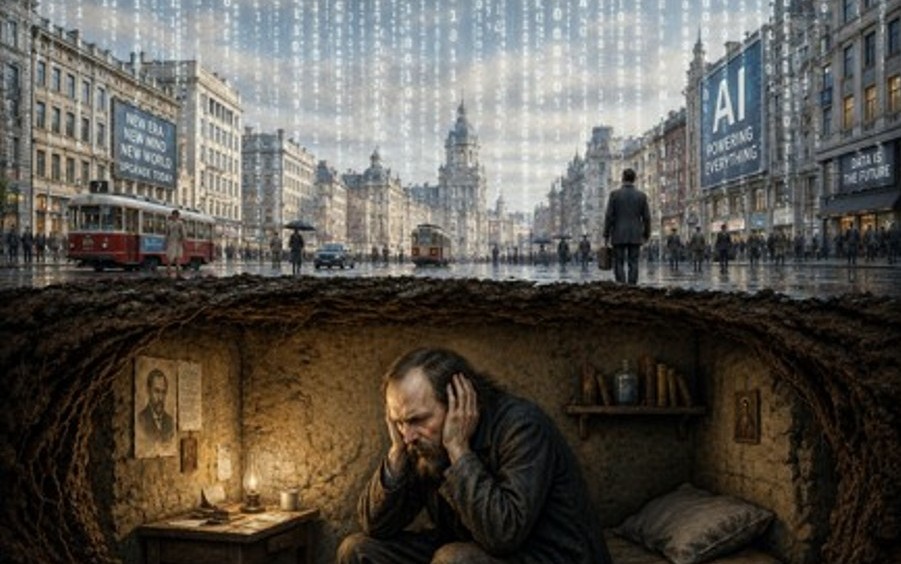
It is a sensation with its own literary patron saint: the unnamed narrator of Fyodor Dostoyevsky’s Notes from Underground. The Underground Man is spiteful, wounded, self-contradictory, often ridiculous. He is also prophetic. He rebels against the idea popular in nineteenth-century Utilitarianism: the “happiness calculus” of Bentham and Mill that human beings can be reduced to calculable interests and made content by efficient arrangements. Give man comfort, security, prosperity, and scientific management, the reformers suggested, and social conflict will progressively evaporate. The Underground Man responds that “even if man really were nothing but a piano-key, even if this were proved to him by natural science and mathematics, even then he would not become reasonable, but would purposely do something perverse . . . He will launch a curse upon the world, and as only man can curse, [it is] by his curse alone he will attain his object—that is, convince himself that he is a man and not a piano-key!”
Agency, volition, is the defining characteristic of human beings.
He is not in the final analysis rebelling against reality; he is asserting that agency, volition, is the defining characteristic of human beings. Artificial intelligence from the outset has been premised on a mechanistic model. Prof. John McCarthy, proposing the historical Dartmouth conference of 1956, coined the term “artificial intelligence” (a “spiffy” term, he explained) and ever since we have been arguing about what it means. In fact, he was referring to logic machines, the mechanistic, deterministic model of thinking that Alan Turing had proposed. “Intelligence” would be defined solely by output (the “Turing test”) with no reference to “mind,” “consciousness,” “agency,” or any other concept derived from introspective evidence.
Today, intelligent machines of almost unfathomable capacity and compute power (a high-end Blackwell chip that performs 300 trillion calculations per second), and human intelligence (minds), increasingly shoulder aside each other for the same operating space. Like two species converging on the same habitat, homo sapiens and silicon cognitoids trod the same paths but are struggling to understand one another—and grimly speculating if the habitat is big enough for both of them.
Underground in the Digital Present
Our systems assume that if enough data are collected, enough choices structured, enough friction removed, and enough incentives tuned, human conduct can be smoothly guided. Recommendation engines will anticipate desire. Dynamic pricing will optimize purchase behavior. Navigation software will route traffic. Human resources software will screen job applicants. Predictive policing will allocate patrols. Educational dashboards will personalize instruction. AI assistants will answer inquiries, summarize disputes, and soothe user ire.
It is impressive—astonishing—but even when it works, AI does so without any awareness whatsoever of the creature being managed. Human beings did not evolve to seek outcomes alone; survival has always meant agency. We want a train ticket, but we also want the sense that we purchased it knowingly, can alter it intelligently, and can appeal to someone answerable when reality changes. We do not want only medical care; we want confidence that a person grasps the particulars of our case. We do not want only efficiency; we want recognition. The economist calls these “intangibles,” and they are, but they are also real and often decisive.
Firms that save customers time, reduce humiliation, and preserve trust gain business.
Markets understand this better than bureaucracies—because they must. Firms that save customers time, reduce humiliation, and preserve trust gain business. Yet firms are tempted by the managerial dream of automating first and asking forgiveness later. Labor is costly. Software scales. The spreadsheet often celebrates savings that the customer experiences as being abandoned.
It is a tension that explains a paradox of advanced economies. We live amid astonishing conveniences, yet life often feels cluttered with exhausting petty obstacles. One can order a rare book in seconds from across the world but spend 40 minutes correcting an obvious billing error no human is empowered to fix. One can summon maps, weather, prices, and news instantly, but lose an afternoon to a bureaucratic loop generated by mismatched databases. The great abundance of technological civilization coexists with micro-exasperations that steadily erode goodwill.
The Political Economy of Knowledge Dispersion
Classical liberalism and a broader Anglo-American tradition emphasize dispersed knowledge, local judgment, voluntary exchange, and institutional humility. No planner knows enough to direct society in detail. Prices convey information no ministry can gather. Traditions often embody wisdom no theorist explicitly intended. Liberty is not only morally attractive; it is epistemically necessary.
Digital administration bids to reverse this insight. It imagines that enough centralized information, coupled with sufficiently subtle algorithms, can bypass countless messy acts of situated judgment. Why let an employee decide when a rule engine can decide uniformly? Why let a station agent improvise when a workflow can prescribe? Why tolerate variance when dashboards can standardize?
Explosive adoption of AI speaks to its obvious virtues. But AI also carries costs hidden from management reports. Local discretion can solve anomalies instantly. Informal authority can calm conflict. A clerk who says, “I see your problem—let me fix it,” may create more social value in two minutes than an elegant backend system creates all week.
Without discretion, if no one may decide or deviate, then no one owns the outcome—and there is no responsibility. The citizen confronts not a mistaken person but an surd algorithm. Anger then has nowhere legitimate to discharge itself. It curdles into generalized resentment: against corporations, government, technology, elites, modern life itself.
This is one reason seemingly minor customer-service disasters can produce outsized fury. The fury is cumulative. It represents not one failed transaction but 50. Each incident says, in effect: adapt yourself to our categories or remain stuck.
Dostoevsky had plumbed the psychology of human agency. The Underground Man will sabotage his welfare if the price of it is submission to a system assuming its own omniscient rationality. He insists on the “most advantageous advantage”: the freedom to choose even foolishly. In contemporary terms, people will endure inconvenience, pay premiums, reject optimized choices, or embrace eccentric alternatives simply to preserve authorship over their own lives.
One implication, of course, is the enduring (and increasingly nostalgic) appeal of human-scale institutions. The independent bookseller who remembers a customer’s taste. The local banker who knows a borrower’s character. The physician who departs from a checklist because something in the room feels wrong. The proprietor who bends a rule for a plainly decent reason. These are not grace notes. They are competitive advantages rooted in human nature.
Artificial Intelligence Now Sharpens the Issue
Large language models can already perform tasks once requiring trained staff: drafting replies, explaining policies, translating documents, triaging requests, summarizing records. They may soon mediate much of daily commerce. Used wisely, such tools can liberate human workers from drudgery and return them to higher-value roles. Used foolishly, they can become velvet-lined labyrinths: systems that sound empathetic while denying recourse.
We are discovering how much the distinction matters. A machine that says, “I understand how frustrating this must be,” or “we value your call,” may provoke more anger than silence. It mimics caring without the substance of accountability. It offers sympathy like a vibrator offers sensuality.
We are entering an era in which institutions will be tempted to substitute synthetic attentiveness for actual service. Investors may applaud the earnings margins. Users may revolt.
The better path is not Luddite. It is technological realism joined to realism about human nature.
The better path is not Luddite. It is technological realism joined to realism about human nature as well as our long experience with humane institutional design.
This is no small matter. The legitimacy of free institutions depends upon whether or not ordinary people experience them as responsive and fair. If capitalism comes to mean endless extraction through impersonal interfaces, its moral reputation will suffer. If technology means being trapped in systems one cannot question, political demands for coercive remedies will grow.
The fusion of liberty and tradition—an old aspiration of Burkean conservative thought—has something timely to say here. Liberty respects the individual chooser and limits centralized control. Tradition reminds us that inherited practices often encode truths about human beings: our need for face-to-face trust, moral responsibility, tacit judgment, patience, and room for exception. A civilization that forgets either liberty or tradition will build brittle institutions.
My own most recent example is comically small. While typing these reflections, my finger strayed somehow to the wrong key. My document vanished into cyberspace like water down a flushing toilet. Many readers will smile grimly in recognition. It was trivial. It was recoverable. It was also, for an instant, infuriating. Why? Because one’s intention had been overridden by a mechanism indifferent to context.
Scale that sensation upward across medicine, travel, finance, education, employment, and public administration, and one sees why the topic matters.
The Underground Man lives because he names something perennial in us. We are not only consumers of outcomes. We are agents who wish to steer, protest, revise, appeal, refuse, and sometimes simply be heard. Systems that honor this truth will prosper. Systems that ignore it may be efficient for a season, but they will accumulate enemies.
The age of the algorithm does not abolish human nature. It reveals it.
Walter Donway is the author of A Serious Chat with Artificial Intelligence (2026)
About the Author: Walter Donway


