
Blockchain vs. Authoritarianism: A Global Clash for Liberty
By Walter Donway
August 7, 2026
SUBSCRIBE TO SAVVY STREET (It's Free)
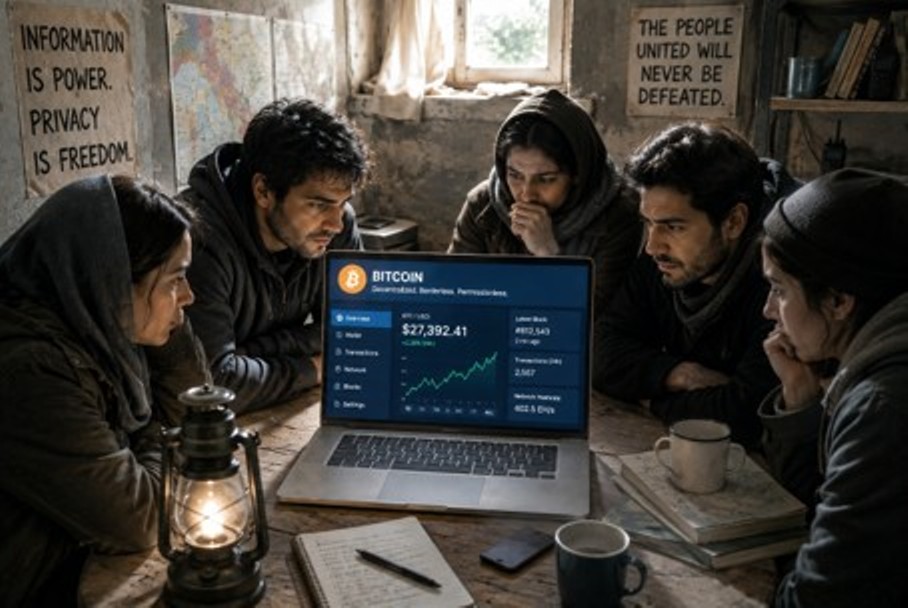
- Following years of brutal military junta rule and crackdowns on traditional bank accounts, activists and mutual aid groups in Myanmar turned in 2025–2026 to increasing use of the decentralized networks of blockchain/cryptocurrency technology for the funding needed for protests to survive.
- In the July 2024 presidential election in Venezuela, Nicolas Maduro, claiming victory despite overwhelming evidence of an opposition landslide, weaponized the state-run digital “Fatherland” card system and monitored all traditional bank transfers. To work around these authoritarian measures, opposition networks and independent journalists depended upon blockchain (USDC stablecoins on decentralized, low-fee networks) to pay local election-monitoring volunteers and fund underground operational costs.
- As the Kremlin’s internal financial grip tightened, effectively blacklisting and labeling all domestic anti-war and human rights groups as “extremists” or “foreign agents,” traditional cross-border financing became a ticket to life in prison. Prominent exiled opposition media outlets and legal defense funds (such as groups supporting political prisoners) fully migrated their domestic crowdfunding apparatus to Bitcoin and Monero.
Such tactics for surviving authoritarian repression began as improvised workarounds.
Such tactics for surviving authoritarian repression began as improvised workarounds. Late one night in October 2020, as protests against police brutality surged in Nigeria, young activists huddled over their phones in Lagos. The government had just frozen their bank accounts, halting funds meant for first aid, food, and legal aid for protesters. Undeterred, the activists tried something new: they posted a Bitcoin address. Within days, donations poured in from around the world—almost $150,000 in cryptocurrency—keeping the protests alive. A tweeted endorsement from Twitter’s CEO even helped broadcast their Bitcoin appeal, much to the Nigerian government’s ire. The sight of young dissidents effortlessly bypassing financial censorship sent shockwaves through Nigeria’s ruling class.
Since then, similar scenes have played out across the globe. (The Guardian, among others, reports regularly on the “blockchain dissidents” and their clashes with governments.) In Belarus, a protestor fired from his job obtained relief through a Bitcoin grant; in Hong Kong, activists use blockchain tools to preserve anonymity. These are instances of a unique 21st-century struggle: authoritarian regimes versus blockchain systems leveraged in defense of dissent.
Yet, even freer countries, as we will see, often bristle at the use of these tools. The contest between centralized power and the liberating potential of decentralization is as old as politics, of course, and the stakes are always high. So, it is with technological decentralization.
A Decentralized, Anonymous, Immutable Ledger
Blockchain technology came on the scene in 2009 with Bitcoin’s launch.
To review: Blockchain technology came on the scene in 2009 with Bitcoin’s launch by the pseudonymous “Satoshi Nakamoto,” to create digital cash outside government control. Blockchain is a distributed public ledger, a network of computers that collectively verifies and records transactions in an immutable chain of data “blocks.” The design has features crucial for dissidents. First, it is decentralized so that no single “authority” can censor or halt transactions, making the system extremely resistant to control. Second, it offers pseudonymity: users are identified by cryptographic addresses rather than personal identities, affording a degree of privacy and anonymity. Third, once information or value is recorded on a blockchain, it’s nearly impossible to alter or erase (immutability), which can safeguard evidence or speech from being “disappeared.” Finally, cryptocurrencies like Bitcoin enable peer-to-peer financial autonomy. Anyone can send value directly to anyone else globally without needing a bank’s intermediation. Privacy, censorship-resistance, pseudonymity, immutability, and user autonomy—all make blockchain systems a natural ally of those seeking liberty under authoritarianism.
In recent years, these same properties have been extended beyond Bitcoin itself to a broader ecosystem of decentralized networks, including dollar‑pegged stablecoins that preserve many of the same censorship‑resistant qualities while reducing volatility.
Funding Dissent
When the protests erupted in Nigeria, the government not only met protesters with bullets and tear gas, but also choked off funding. Bank accounts of protest groups and even food suppliers were suddenly suspended. A coalition of feminist activists leading the fundraising had its accounts closed. They turned to Bitcoin with results reported above. One observer noted that the government suddenly realized people could bypass official structures entirely to mobilize and fund dissent—igniting fear among rulers. But the impact was lasting; civil society groups in Nigeria now keep some funds in crypto “as an insurance policy” in case of future crackdowns. And when, predictably, the Central Bank of Nigeria responded in 2021 by banning banks from servicing crypto users, many Nigerians simply shifted to peer-to-peer Bitcoin exchanges out of the government’s immediate reach. Thus, the ban neither stopped crypto nor protests; it drove transactions underground. Not for the first time, Bitcoin established its credentials as a financial lifeline when traditional channels fell under state control.
Today, many groups increasingly rely not only on Bitcoin but on dollar‑pegged stablecoins such as USDT or USDC, which offer price stability while retaining the ability to bypass state‑controlled banking systems. For activists who must pay rent, medical bills, or food suppliers, stability can matter as much as censorship resistance.
When Belarus’s strongman, Alexander Lukashenko, blatantly rigged the 2020 election, a massive protest erupted; the regime responded with repression. Thousands were arrested, fired from jobs, and beaten. To assist their hard-pressed compatriots, Belarusian activists and tech entrepreneurs set up the BYSOL (Belarus solidarity) fund abroad. But getting aid into Belarus remained perilous; the regime monitored bank transfers and searched people at border crossings for cash. The counter was Bitcoin. BYSOL’s founders chose Bitcoin because it is “the only payment method that can’t be controlled by the authorities,” one organizer explained. The government could freeze local bank accounts, but not a crypto wallet on the internet. BYSOL raised more than $2 million (via Facebook, PayPal, and crypto) and began quietly sending $1,500 Bitcoin grants to Belarusians fired for protesting. Recipients, many new to crypto, were guided to install wallets on their phones, receive BTC, and convert it to local currency in peer-to-peer transactions that the state could not easily trace.
One fired worker, Maria, “figured it out in 10 minutes” and used her Bitcoin grant to pay months of rent and buy a laptop for a new job. “Now I know that anybody can figure it out,” she said, reflecting on how empowering it felt to access funds the government couldn’t block. Another activist noted a preference for crypto because “we don’t need any personal meetings or to carry cash.” Even as Lukashenko’s regime labeled BYSOL “extremist” and stalked its donors, the fund survives thanks to Bitcoin’s censorship-resistant rails. “The government has blocked all the classical ways of getting money into the country, so we had to find an alternative,” says BYSOL’s founder. “Cryptocurrencies [are] an easy and safer way for us.”
Under Vladimir Putin, Russia moved in 2021 to outlaw jailed (now deceased) opposition leader Alexei Navalny’s organizations as “extremist,” making it illegal to donate to them. For years, Navalny’s movement had relied on crowdfunding–including accepting Bitcoin donations–to sustain its anti-corruption work. With new laws threatening donors with prosecution, Navalny’s team explicitly urged supporters to switch to cryptocurrency to fund the cause. Leonid Volkov, Navalny’s chief of staff, explained on YouTube that the regime can easily track or freeze any money flows in Russia’s banking system, so “we need to get away from it. Since the state is squeezing us out of… the normal banking system, we will patiently teach everyone to use cryptocurrencies,” he said. Bitcoin, he noted, “cannot be traced by Russia’s authorities” in the same way as can bank transfers.
Although blockchain transactions are public, and in that sense can be traced, individual users can obscure their identities.
That is, although blockchain transactions are public, and in that sense can be traced, individual users can obscure their identities, so that for Russia’s embattled opposition, crypto has become a vital loophole. A Bitcoin wallet controlled by Navalny’s organization has received 658 BTC over five years ($30 million at current value) from supporters, especially during waves of protests. “Cryptocurrencies act as a deterrent against the authorities’ attempts to block our fundraising,” Volkov told The Moscow Times. (Navalny, a Russian dissident who founded the Anti-Corruption Foundation and led opposition to Putin’s dictatorship—becoming known around the world as a fearless voice against the evils of Russian state repression—died of unknown causes in 2024 in a Russian prison above the Arctic Circle.)
Knowing the opposition can fall back on Bitcoin, officials may hesitate to completely shut down other channels; thus Bitcoin’s mere availability may help to protect traditional donation routes, too. Navalny’s movement uses crypto not only for direct donations but as a currency converter; thus, supporters abroad often send money via PayPal, which the team instantly uses to buy Bitcoin that they roll over into rubles in Russia, skirting strict currency controls. While crypto still makes up only 10–15% of their funds, it’s a critical reserve or safety net. Putin appears to have learned he cannot snuff out all decentralized currencies, so the regime has resorted to partial measures such as banning officials from owning crypto and forbidding Bitcoin payments for goods. But short of shutting down the internet, an open blockchain remains accessible to dissidents. As Volkov put it: “They realize they can’t block our fundraising through Bitcoin… [We] will be able to get funds anyway.”
From Africa to Eastern Europe, as long as activists can connect online, they can receive help from anywhere in the world, changing the dynamic of civil resistance. A Nigerian policy analyst may have captured the essence. He said “EndSARS” movement catalyzed government’s crypto crackdown precisely because it proved that people could “bypass government institutions to mobilize,” sending “shockwaves” through the establishment. Authoritarians fear empowerment. One Nigerian crypto exchange operator observed, “The authorities know it’s out of their control, and what scares them is they are not used to being in this position.” In sum, blockchain-based money has given dissidents a Plan B for funding grassroots movements and humanitarian relief that rulers struggle to detect or stop.
Privacy and Censorship—Resistant Communication
Blockchain technology’s anti-authoritarian implications go beyond finance. No repressive regime long survives without controlling information: censoring media, surveilling citizens, and rewriting history.
During Hong Kong’s massive pro-democracy protests in 2019, participants learned to avoid the state’s digital surveillance. They ditched traceable digital payments (like the city’s transit smart cards) in favor of cash, fearing the police were using subway records to identify demonstrators. Their concerns were justified; police later raided a protest fund, arresting its organizers and seizing HK$70 million ($9 million) from its bank accounts on allegations of money laundering. Other groups promptly turned to financial and technological workarounds. One anonymous team running HK Map Live–a crowdsourced map of police deployments–relied heavily on Bitcoin to pay server bills while preserving donor anonymity. When Apple banned the map’s app, the website stayed online thanks to Bitcoin-funded resources.
Hong Kong Free Press, battling for Hong Kong’s independence from Chinese Communist one-party dictatorship, turned to Bitcoin when it ran into trouble with a traditional payment processor. By using an open-source crypto payment system, HKFP quickly raised nearly 2 BTC (thousands of dollars) to support its journalism and kept the funds in Bitcoin to avoid potential bank interference. A popular protest Telegram channel even educated 30,000 followers on buying protective gear via Bitcoin and how to trade crypto peer-to-peer in Hong Kong. Thus, cash remained king for on-the-ground anonymity in Hong Kong’s movement, while cryptocurrency became the means of receiving global support and keeping online services running, free from government or corporate choke points. The value of “censorship resistance,” once an abstract concept, became painfully concrete amid a crackdown.
In the People’s Republic of China, censorship is omnipresent, particularly online, where posts critical of the regime vanish in minutes. In 2018, amid China’s nascent #MeToo movement, a former student named Yue Xin wrote an open letter exposing a decades-old campus sexual assault cover-up. Censors scrubbed her letter from every web forum, even blocking upside-down reposts that creative netizens tried. But some tech-savvy supporters had another idea: they embedded the full letter into the Ethereum (cryptocurrency) blockchain. By sending a tiny Ethereum financial transaction carrying the letter’s text in its data field, they effectively “permanently stored the text in the public domain,” beyond the reach of internet police. The letter–and messages of support from other Chinese universities–now live on thousands of computers globally, beyond censorship. Furious authorities resorted to blocking the transaction’s view page on Chinese apps, but they could not erase the data on Ethereum. This ingenious tactic demonstrated blockchain’s potential as a permanent record of truth. Similarly, when Chinese citizens wanted to preserve information from COVID-19 whistleblowers, they turned to blockchain platforms and decentralized file storage to create indelible archives outside the “Great Firewall.” In an age when authoritarian regimes routinely rewrite history and delete inconvenient facts, the blockchain is an immutable notebook from which censors can’t rip pages.
The persistence of such records has taken on new urgency as regimes increasingly deploy artificial intelligence to automate censorship and historical erasure. An immutable ledger frustrates not merely human censors but machine‑driven suppression itself.
Decentralization can protect communication channels themselves.
Beyond publishing content, decentralization can protect communication channels themselves. Encrypted messaging apps and decentralized web services (often inspired by blockchain’s distributed model) are harder for regimes to shut down. Protesters in Iran and Russia have experimented with peer-to-peer messaging tools, some built on blockchain networks or using similar distributed nodes, without a central server that authorities can block. These early initiatives echo the lesson from money: A network with no center is difficult for any central authority to completely control. Even if regimes ban such apps or the entire internet, users often can reconnect through VPN (Virtual Private Network), satellite links, or alternative nodes. (A VPN creates an encrypted, private tunnel for your internet traffic, masking your IP address and location. It also protects your online privacy, security, and anonymity by hiding your activity from your own ISP and other potential trackers.) Thus, decentralization, as epitomized by blockchain, has gone on to empower not just financial freedom but also a degree of informational autonomy.
The global clash between authoritarian regimes and blockchain systems may tell us, in time, whether the ideals of individualism, human rights, and capitalism will flourish or instead struggle still harder in the digital 21st century. One Belarusian activist said of learning to use Bitcoin, “It is a way to make people feel alive… We cannot simply give up.”
About the Author: Walter Donway


