
The Intimacy Marketplace Part I: From Playboy to OnlyFans
By Walter Donway
August 23, 2026
SUBSCRIBE TO SAVVY STREET (It's Free)
Playboy published its first issue in 1957, when I was 13. That year or soon thereafter I learned the trick of volunteering to assist the Salvation Army’s newspaper and magazine pick up in my neighborhood. My friend, Ricky, and I would ride in the back of the truck on the pile of stuff and burrow through it for copies of Playboy. Where else could we see naked—excuse me, bare-breasted—girls? The corner variety store wasn’t going to sell you a copy. Really, other than issues of National Geographic, featuring semi-nude African tribal women, Playboy was it. Incredibly exciting. Shocking. Of course, I learned later that Playboy was just the hyper- “respectable” public face of “pornography.” There were back channels.
This article is about modern pornography and how it no longer is anything like the pornography business that many people imagine.
This article is about modern pornography (no apologetic quotation marks) and how it no longer is anything like the pornography business that many people imagine. As my personal recollection suggests, during the Playboy years (to many the age of innocence, to some the first crack in the edifice), sexual imagery was a scarce luxury good. It was professionally shot, gently transgressive, expensive at the local store, and filtered through a mostly male editorial staff that chose the women, poses, fantasies, and girl-next-door copy on lifestyle aspirations.
A bygone era? A friend of mine, then a young woman of 18 living in Wisconsin, had prevailed in a teen beauty contest and had photos published in a local magazine; two emissaries of Playboy travelled from Chicago to ask her mother in person if her daughter might be a Playboy bunny and thereby earn a lot of money.
“No!”
It Was a Different Age
Playboy’s circulation peaked at about seven million in the 1970s. That tells us how great the demand was and how centralized the supply remained. But the decline of sophisticated entertainment for men, with interviews with Vladimir Nabokov and Ayn Rand, was implicit in its strength. Once erotic images no longer were scarce, the old combination of editorial curation, print distribution, and advertiser support lost its moat. By 2015, Playboy itself acknowledged that free internet pornography had made nude photographs ubiquitous—and its print circulation had fallen dramatically. By that time, of course, it had elicited a gasp from the nation with its first revelation of pubic hair. What were things coming to? We had no idea. And that is our story.
Brave New Industry
The economic results were an explosion in the available “supply” of mostly women, a collapse of distribution costs, and audiences and models in ever-finer niches.
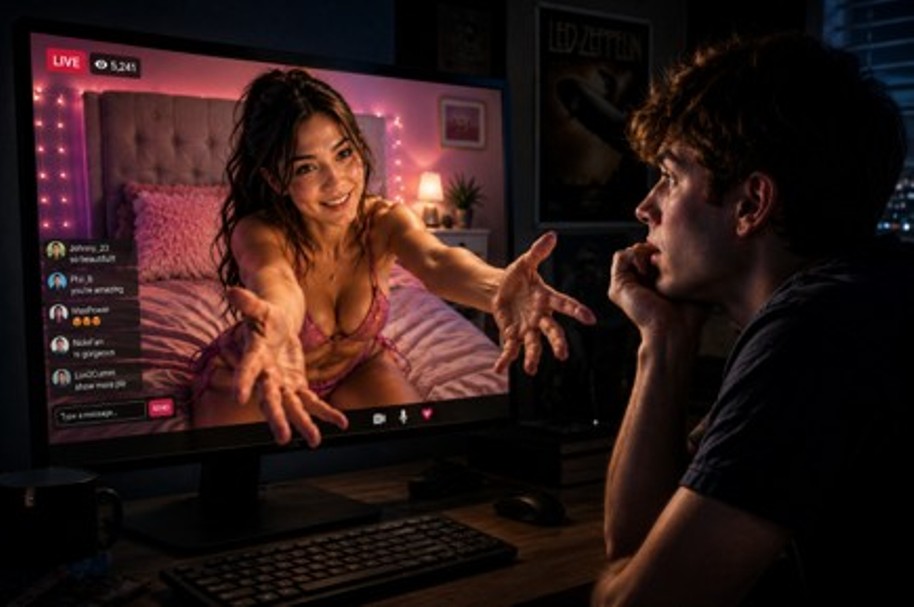
The decisive change was not to “more explicit.” It was to an entirely new industry. Internet sites reorganized porn around search, categories, uploads, and free streaming; webcam sites reorganized it around live interaction with women and tips; subscription platforms like the mighty OnlyFans, reorganized it around recurring payments, paywalled archives, and the sale of access to a person, usually a woman, rather than only a video. A UK government pornography review describes sites as environments built around a landing page, a search bar, categories, ads, user uploads, and free viewing alongside paywalled material. Research on perhaps the dominant site, “Pornhub,” which pops up first in almost all searches, illustrates the “platforming” of pornography and makes the larger point. (One available statistic: about 3.6M Canada-located Pornhub visitors per day.) What changed was discoverability, ubiquity, and the conversion of porn into a platform business. The economic results were an explosion in the available “supply” of mostly women, a collapse of distribution costs, and audiences and models in ever-finer niches.
The technological preconditions, naturally, were the spread of internet access, smartphones, and 24/7 social media. The International Telecommunication Union estimates that some six billion people, or three-quarters of the world’s population, were online in 2025. The Pew Foundation reports that 90 percent of adults in the United States own a smartphone.
When almost everyone carries a networked camera, editing app, and access to a payment interface in a pocket or purse, the production of sexual content no longer requires a studio in the old sense. It can be a “selfie,” pseudonymous, and modular. A creator can make subscription posts, custom clips, livestreams, and upsell messages across several platforms at once. No, the technological revolution did not eliminate intermediaries—far from it—but it lowered the barrier to entry so that vast numbers of new entrants became possible.
This is one key to a huge industry, but not one reliably measurable. Published global estimates conceal differing definitions, but credible numbers for the worldwide “adult entertainment” market are large—$59.7 billion to $65.95 billion in 2024. (The digital-only market in 2025 was $43.87B.)
A single large internet platform can be huge. OnlyFans, a platform open to all “content creators”—musicians, exercise gurus, comedians but with overwhelming sexual content that is either self-created or studio-created—reportedly processed about $7.2 billion in fan payments in fiscal 2024, generated roughly $1.4 billion in revenue, and counted about 377.5 million fan accounts and 4.6 million creator accounts. One finds page after page with a grid of photographs—many obviously selfies, girlfriends, boyfriends.
You can open an account on OnlyFans and upload “creator content” of any kind if you are 18 years old—yourself in the nude, not as in Playboy but often revealing every orifice, having sexual intercourse, oral sex, or any inventive scenario. You set up the terms, but roughly you get 80 percent of the revenue; OnlyFans gets 20 percent.
This is only one example, of course, not the whole sexual-content economy, but the figures show how much of that economy now lives inside creator-platform infrastructure that blends social media, payment rails, and adult entertainment. Any 18-year-old woman or man anywhere in the world with access to the internet theoretically can open a OnlyFans account, photograph herself or be photographed, and market the results on OnlyFans.
Technically, this is “decentralized” production but on centralized rails; millions of accounts can “produce,” but the platforms still govern onboarding, moderation of content, consumer billing, blocking of countries with legal barriers, searchability, and removal. It is still not the wild west of individualism.
Many top subscription creators use “chatters” or managers to impersonate them in communications with fans.
New intermediaries, however, have appeared in the supposedly democratized creator economy. Studies of webcam platforms show that “studios” still play a major role. Human Rights Watch documented severe labor abuses in Colombian webcam studios, including long shifts, wage theft, unsanitary conditions, and coercion into unwanted acts. Other reporting has shown that many top subscription creators use “chatters” or managers to impersonate them in communications with fans. Recent UK reporting has described a growing market in OnlyFans management firms that can pressure women toward more explicit content. So, the middleman is not gone. He has become a manager, a moderator, an optimization partner, a studio operator, or a promoter.
Why Do They Do It?
Many of us have wondered why literally millions of attractive young women (putatively but often hardly believably 18 or older) choose to enter this world. Not surprisingly, it starts with money. In peer-reviewed interviews with 22 U.S.-based OnlyFans creators who were largely new to sex-industry work, the researchers found recurring motives: the visibility and acceptability of the OnlyFans site, the sense that it offered better earnings than other gig or service work, sexual self-expression, preexisting audiences or content libraries, and pandemic-related disruptions to employment. If so, this pushes back against sentimental explanations. Many creators do not begin with a deep ideological commitment to sexual liberation or with a pathology of self-exposure. They begin with an income opportunity that seems comparatively flexible, scalable, and under their own control:
“Our participants felt comfortable becoming OnlyFans content creators as a result of the societal pervasiveness of OnlyFans combined with broad participation from celebrities and peers, which decreased the stigma of creating on OnlyFans.”
Platforms sell not only erotic pictures and videos, but a form of companionship.
Earnings are tough to document, but by any measure highly unequal. If one simply divides reported OnlyFans “creator” payouts by total creator accounts, the arithmetic average works out to roughly $1,246 to $1,288 per creator account per year (2023–2024), which is a modest sum and not a median. In the 22-person study, median earnings were just over $1,200 total to date, even though the upper end of the sample reached $332,000. This suggests a classic long-tail market: a few stars, many small earners, and a mass of hopeful entrants.
Social disconnection has become a serious public-health problem.
What many fail to realize, or wish to deny, is that platforms sell not only erotic pictures and videos, but a form of companionship. This impacts the demand and, as a consequence, women’s willingness to supply. Relevant here may be the U.S. Surgeon General’s advisory on loneliness and social connection, warning us that social disconnection has become a serious public-health problem. Research on users of erotic webcam videos may align with that background condition. A 2024 Journal of Sex Research study of 2,047 LiveJasmin clients described these platforms as offering a constrained but meaningful sense of “genuine” intimate connection. In other words, the market is not only for witnessing sex acts; it is for bounded authenticity. Consumers are often paying not merely to look, but to feel seen by a specific person. That demand increases the exchange value of intimacy and encourages creators to monetize precisely those signals—eye contact, tone, responsiveness, confession, memory, exclusivity—that once belonged more securely to the private sphere.
This is Part I of a two-part article.

-

The New Humanoid Workforce: When Labor Becomes Capital
-

Muddling Through—Until We Don’t
-

Part II: Can We Exorcise the Ghost from the AI Machine?
-

Can We Exorcise the Ghost from the AI Machine?
-

The Intimacy Marketplace Part II: The New Johns
-

The Intimacy Marketplace Part I: From Playboy to OnlyFans
-

Why Freer Governments Also Fear Crypto
-

Blockchain vs. Authoritarianism: A Global Clash for Liberty
-

Human Horticulture—a Missing Link for Objectivism?
-

Healthcare: A System That Rewards Compliance Not Patient Care