Book Review: Dictators and Disinformation by Jay Friedenberg
By Marco den Ouden
October 16, 2026
SUBSCRIBE TO SAVVY STREET (It's Free)
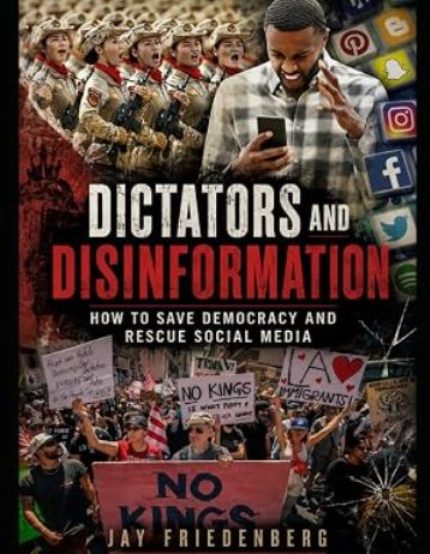 This review is based on an Advance Reader Copy of the book that I received from the author (Publisher: Veritas et Moralitas Press, October 2026)
Ever since Plato launched his devastating critique of unrestrained democracy in The Republic, there has been concern over democracy’s tendency to subversion by authoritarian elements. But in the development of modern liberal constitutional democracy, safeguards were built in to prevent this from occurring.
These safeguards were threefold:
- a focus on liberty as the foundational touchstone of democracy
- the idea that constitutions are created to act as a restraint on political power
- the primacy of reason and the search for truth as pivotal in maintaining the liberal democratic order
But as Jay Friedenberg explains in his new book, Dictators and Disinformation: How to Save Democracy and Rescue Social Media, liberal democracy has been under a sustained attack by both left and right for over a decade and unless this growing tide can be stemmed, we may see the collapse of western civilization.
The early chapters discuss the problem. As Friedenberg puts it,
Democracy is backsliding around the world, with governments globally becoming more autocratic, nationalist, and populist. Our news in turn has reverted from trusted, journalistic-based organizations to citizen driven social media that is rife with falsehoods, encouraging rage and polarization. (page 4)
These two fundamental institutions—government and public discourse—are increasingly being undermined by political polarization and the replacement of truth seeking media and institutions by emotionally driven clickbait pandering to the worst within us.
“Politics and news feed off each other,” Friedenberg continues, “often in a downward spiral.” Disinformation and polarization form “a negative feedback loop where truth and democracy get progressively degraded.” (5)
As for liberty, one of my online friends recently noted that the word “liberty” seems to be entirely missing from modern discourse. Yet the ideal of liberty, especially in the form of classical liberalism, Friedenberg argues, is essential to stemming the autocratic and propagandistic tide.
Friedenberg goes on to discuss the evolution of power structures and how power often becomes concentrated. The ultimate concentration of power is the dictator. And such power is often self-sustaining.
History has shown that autocratic regimes tend towards loyalism and sycophancy (Libman, 2025). Followers in the inner political circle tend to tell their leaders what they want to hear because the deliverer of bad news often meets a bad end. As a result, these leaders can become more disconnected from reality and less capable of effective decision making. (10)
A society so ruled becomes “rigid and inflexible.”
The second part of Friedenberg’s thesis is that disinformation works as an enabling factor for the rise of autocratic government. Disinformation may be better recognized as propaganda. That is information with an agenda. And that agenda is rarely truth or knowledge.
The characteristics of propaganda include “the selective presentation of facts (sometimes called “card stacking”), appeals to emotion rather than careful reasoning, simplification of complex issues, and the use of symbols, slogans, and striking imagery.” (11) A common form of modern propaganda is the meme. Memes are not created to convey truth through reasoned argument. Their aim is to produce an emotional response.
Friedenberg goes on to discuss the importance of the epistemic infrastructure necessary for truth to emerge. He goes to the writings of M.P. Lynch (On Truth in Politics: Why Democracy Demands It. 2025) and Jonathan Rauch (The Constitution of Knowledge: A Defense of Truth. 2021) to support his case.
Truth cannot flourish under authoritarianism because these governments seek to monopolize information and suppress independent inquiry. Truth in his (Lynch’s) estimation performs two democratic functions. It enables citizens to hold governments accountable and it allows collective reasoning about common problems. Without truth, democratic deliberation degenerates into contests of power. (15)
Friedenberg introduces an interesting phrase to characterize modern social media disinformation—”truth decay.” The phrase was coined by Jennifer Kavanagh and Michael D. Rich in their 2018 book with that title.
He discusses Rauch’s view that two iterations of this “truth decay” are troll epistemology whose purpose is not necessarily to persuade people that a false claim is true. Instead, it seeks to convince people that no truth exists at all, that everyone lies, experts are corrupt, and that objective knowledge is impossible. (17)
And cancel culture—”attempts to silence those who disagree with their ideology.”
Friedenberg discusses truth in communication, especially as it relates to journalism versus propaganda, at length.
He goes on to discuss the causes of this backsliding towards autocracy. Perceived government failure has created widespread disenchantment with the democratic process. Governments seem hamstrung and mired down in procedural wrangling and an inability to effectively deal with existential crises.
Friedenberg notes that the 2025 Freedom House Report marked 2024 as the 19th consecutive year that freedom as measured by political rights and civil liberties has declined. The forms this backsliding has taken seem to be ripped right off the front pages of today’s newspapers.
Backsliding can take several forms, like the failure to uphold the rule of law; the weakening of institutions such as an independent legislative and judiciary; reduction of civil liberties as manifested in restrictions on freedom of speech and press; and undermining electoral integrity in forms such as voter suppression, gerrymandering; and executive overreach. (27)
He goes on to argue “that a return to classical liberal governing values is necessary, those based on representative governments, diversity and plurality, decentralization of power, and a working system of checks and balances.” (28)
He contrasts three different kinds of politics: Progressive, Conservative, and Libertarian. Without going into details (you can find them in the book), these positions can be summarized as (paraphrasing):
- Progressives are optimists who believe in material and spiritual progress but distrust capitalism’s ability to deliver these goods. “Their axis is the oppressor-oppressed, contrasting those in power with those who have none.”
- Conservatives are pessimists who focus on “the darker side of human nature that must be kept in check by social institutions like family, religion, and government.”
- Libertarians “support the right of each individual to make choices … and believe that people can think and act appropriately in their own best interest.” (29)
Friedenberg acknowledges some value in each of those positions, but avoids being doctrinaire though he clearly favors a libertarian approach.
If we only stick to our preferred heuristic, then nothing will ever get done and the country will devolve into political gridlock. It is better to get out of our fixed mindsets and relate to what opposing groups are thinking. This will enable us to better communicate and cooperate with one another. (29)
“Being open-minded does not mean abandoning our ideology or trying to convert everyone else to it,” he continues. “It does mean that we need to engage in deeper thinking about issues and not to have knee-jerk emotional reactions.” (30)
He goes into considerably more discussion on politics and political systems. A thorough analysis of the different types and styles of politics. These include looks at fascism, communism, nationalism, populism, and tribalism. Tribalism encompasses the others to a large extent. It favors the group over the individual. And he sees the cure in pluralism and decentralization.
One antidote for the ills of tribalism is pluralism, which is to recognize that diverse groups can each have it their own way as long as they don’t forcefully impose their views on others (Kaul & Salvatore, 2020). This assumes that they are acting within a legal framework that recognizes their right to practice their beliefs and participate in the political process. Constitutional democracy is a form of government that legally recognizes the individual as sovereign and which tolerates diversity of belief. (43)
Pluralism, decentralization, a system of checks and balances, and a market economy are all important factors in maintaining a robust and responsive liberal constitutional democracy.
Friedenberg goes on to discuss all of these factors in more detail. He then devotes a chapter to authoritarianism in all its variants in considerable detail. This includes a section on “The Case of Donald Trump.”
Subsequent chapters look respectively at Saving Democracy, Polarization, Disinformation, and Rescuing Social Media.
In Saving Democracy Friedenberg looks at some of the structural problems in American governance and looks at various ways of fixing them. He looks at various political institutions and how they can be reformed, noting problems with the Electoral College system, the Supreme Court, the Senate, and such things as the filibuster, voting systems, and gerrymandering. He considers alternatives such as Direct Democracy, Cellular Democracy, Deliberative Democracy and other conceptual experiments in democratic theory.
He believes the current structure is too rigid and inflexible.
It’s about time that Americans looked at the Constitution not as a sacred scroll handed down from heaven but as a document that is meant to change along with social conditions. If we could pass an amendment to make it easier to pass further amendments, this would be a strong first step towards creating more robust and accountable institutions. (105-106)
I don’t agree with him on this point. Difficulty in amending the constitution is designed to ensure changes won’t be made capriciously. The checks and balances built into the constitution have so far managed to prevent an overt dictatorship. But countries like Hungary and Russia have had despotic rulers like Viktor Orban and Vladimir Putin change the rules of the game to keep themselves in power and competing elements out. I see the difficulty in effecting constitutional change as a safeguard, not a problem.
But Friedenberg acknowledges that institutional change is not enough.
But changes to institutions alone are not enough. Most citizens are woefully inadequate when it comes to critically evaluating information. This means we need an educational system with better training in social media literacy, critical thinking and scientific reasoning. The current distrust in journalism, science, and academia has been sown largely by populist autocrats in recent years who don’t want a competing narrative. These institutions need to fight back and convince the world that truth is different than opinion and not just what a leader or party says it is. (106)
The chapter on Polarization also dissects the problem in some detail and looks at possible solutions.
And the chapter on Disinformation takes a deep dive into modern social media and its role in disinformation and propaganda. “The digital age makes the speed and influence of propaganda much more powerful,” he avers. (126) This spread of false information is not always deliberate.
By one estimate 40% of media users unknowingly share fake news (Konopliov, 2024). On X/Twitter, just one percent of users (800 “superspreaders”) was found responsible for about 35% of Covid-19 vaccine misinformation retweets daily (Pierri, et. al., 2023). This misinformation has been found to propagate quite rapidly. False political information was found to disseminate up to six times faster than true information on X/Twitter and falsehoods are 70% more likely to be retweeted (Aimeur & Brassard, 2023). (127)
Friedenberg looks into how and why disinformation is spread by social media. He delves further into the concept of “truth decay” introduced earlier. He lists various causes of “truth decay”: cognitive bias, the demise of traditional journalism, “the inability of the education system to teach civics, media literacy, and critical thinking,” and polarization. (130)
Truth decay has horrible consequences. If individuals can’t tell what is true from what is false, they will believe anything. If people think truth can’t be known, they are more likely to believe their own opinions or those of their in-group. They will be less likely to trust educators or experts and more likely to believe what is being espoused by their politicians or religious leaders. (131)
And he goes on to offer a variety of solutions. One I found intriguing because of its acronym is the CRAAP Test. These are five questions a consumer of digital news should ask when evaluating online information. He lists these as:
- Is it Current? When was it published? Are their references current? Is currency important for your topic?
- Is it Relevant? Does the info relate to my topic? What audience is it written for? Is it an appropriate level for my needs?
- Is it Authoritative? Who is the author/organization? Are they qualified? Is it edited or peer-reviewed? If a website, does the URL tell you anything?
- Is it Accurate? Where does the information come from? Are there references? Are there errors, broken links, etc.?
- What is its Purpose? What’s the purpose of the information? Advertising? Scholarly work? Opinion? Is there bias?
These guidelines were “adapted from the American Library Association’s guidelines, California State University, Chico.”
The chapter continues with an in-depth look at conspiracy theories and science denial.
Online “influencers,” celebrities, and podcasters have become the new journalists.
Where we get our news has shifted from legitimate news organizations that employ investigative reporters and do fact checking to informal sources that are more opinion based. Online “influencers,” celebrities, and podcasters have become the new journalists. Their appeal is based on attractiveness, popularity and charisma rather than knowledge or professionalism. (146)
Friedenberg concludes with a chapter on Saving Social Media. He starts with arguments for the value of free speech, but also looks at the dark side, things such as hate speech and doxing. And he offers a variety of ways to counter such problems including the problem of propaganda and disinformation. These include making media companies legally liable for the content on their platforms, regulating social media companies like utilities are regulated, “transparency of posted content would allow users to know who is posting and to help validate the authenticity of their claims,” such transparency should include revealing sources of funding for paid advertising.
Social media companies should also be transparent about what sort of data they collect from users and who they supply it to.
But, Friedenberg adds, “Mandates from the government are problematic.” (155) He leans towards market solutions. He notes such alternate social media as “Polis, Kialo, Bluesky, and Mastodon.” He elaborates on each of these alternate platforms.
But these fill only niche markets. Ultimately it requires a considerable shift in consumer choice to make such ventures a real success and a real alternative.
Ultimately it is up to the individual to become a more critical and discerning user of social media.
Ultimately it is up to the individual to become a more critical and discerning user of social media. And the book can be seen as a clarion call for recognizing the importance of truth and liberty. As Friedenberg concludes:
The most important take home lesson from this book is the importance of truth and of liberty. Freedom is necessary for a flourishing democracy and truth is necessary to counter propaganda and for understanding and resolving social problems. These two values go hand-in-hand. Both politicians and citizens need to see the world the way it is, not the way their party or tribal group wants them to see it. (180)
This is a superb and timely book chock full of interesting ideas. It draws attention to a serious problem and offers tentative solutions. The book is well documented. A worthy addition to the growing literature on dictatorship and disinformation.

-

Book Review: Dictators and Disinformation by Jay Friedenberg
-

The New Humanoid Workforce: When Labor Becomes Capital
-

Muddling Through—Until We Don’t
-

Part II: Can We Exorcise the Ghost from the AI Machine?
-

Can We Exorcise the Ghost from the AI Machine?
-

The Intimacy Marketplace Part II: The New Johns
-

The Intimacy Marketplace Part I: From Playboy to OnlyFans
-

Why Freer Governments Also Fear Crypto
-

Blockchain vs. Authoritarianism: A Global Clash for Liberty
-

Human Horticulture—a Missing Link for Objectivism?