
The New Humanoid Workforce: When Labor Becomes Capital
By Walter Donway
October 1, 2026
SUBSCRIBE TO SAVVY STREET (It's Free)
The world’s largest semiconductor company, Nvidia, is committed to delivering its first wave of robots early next year.
The world’s largest semiconductor company, Nvidia, is poised to shift its focus to what is called “physical AI” (a.k.a., robots) and is committed to delivering its first wave of robots early next year. Production will be in collaboration with South Korea’s LG and will feature new Nvidia innovations, including its Cosmos world models for data generation and its Isaac simulation frameworks, which enable any robot to master new tasks with minimal retraining.
Nvidia CEO Jensen Huang did not downplay the significance: “Physical AI has arrived. . . . NVIDIA’s full-stack platform . . . is the foundation for the robotics industry, uniting a worldwide ecosystem to build the intelligent machines that will power the next generation . . .”
Within this new army of robots, however, a potentially far more personal (and controversial) cadre of humanoid robots will be intended to meet expected explosive demand for home care for an aging population.
A potentially far more personal (and controversial) cadre of humanoid robots will be intended to meet expected explosive demand for home care for an aging population.
In a June New Yorker article, Stephen Witt, reporting on visits to several humanoid robot development companies, captured the humanoid-robotics moment at exactly the right altitude: close enough to the factory floor and demo kitchen to expose training bottlenecks, safety concerns, and investor theater, yet with enough scope to reveal the industrial race taking shape among firms such as 1X, Figure, Tesla, Apptronik, Boston Dynamics, Unitree, and others. He shows that the field is moving out of the laboratory, preparing not prototypes but products to ship to customers this year—or so the companies vow, in some cases even setting a delivery date. Among the most advanced is 1X’s NEO, now, after many iterations, quiet (many robots clank) and alluring (its “frightening factor” tested with all age groups now frightens only infants). NEO is still not proof against falling on elderly ladies; teleoperation (not complete autonomy) remains deeply embedded, motion data (for “pretraining”) are scarce compared with language data, and credible experts still doubt that home deployment is safe or near at hand.
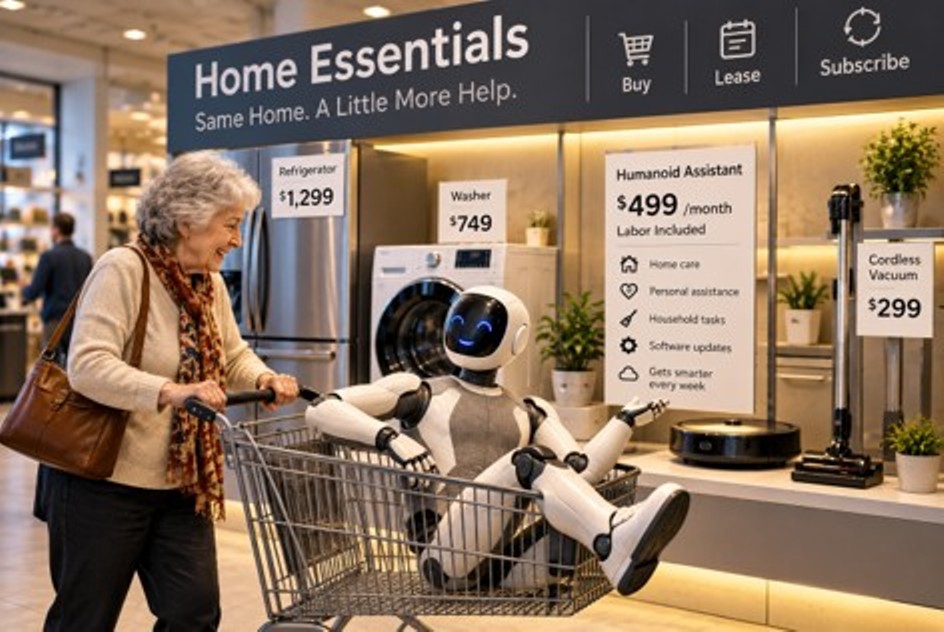
Humanoids do not yet abolish the distinction between goods and services, but they blur the line in practice. A washing machine has always been a good that reduced demand for household labor. A humanoid is a capital good that can supply human-labor-like services across many tasks in environments built for human beings. It can be bought, leased, subscribed to, or deployed under a service contract. Firms that now buy labor for wages may increasingly buy the same labor capacity as a depreciable asset plus software and support. Households may do the same.
It is hard to miss the significance of this for an economy that is already mostly services. The World Bank puts U.S. services at 76.3% of GDP.
It is hard to miss the significance of this for an economy that is already mostly services. The World Bank puts U.S. services at 76.3% of GDP. The U.S. Bureau of Labor Statistics projects 765,800 annual openings for home health and personal care aides over 2024–2034, a total of 7,658,000. For decades, economists distinguished goods from services mostly by reference to human performance: a product is manufactured and sold, a service is rendered by a person. Even before humanoids, that distinction was shifting. We use software that substitutes for clerical labor, search engines that substitute for librarianship, and GPS navigation that substitutes for local knowledge once monopolized by taxi drivers and delivery workers. Humanoids are pushing the same logic into the physical world.
“Compute” in large language models is devoted to absorbing an ocean of text and then using algorithms to generate new text. Compute in humanoid robots is devoted to perfecting operation in the human environment, including taking directions. But development of the latter is far behind the massive refinements achieved in the former. (One resource is Nvidia’s Omniverse libraries, which Nvidia says can be used to train a robotic workforce that Nvidia says, “can be deployed by small- and medium-sized manufacturers in minutes, without programming knowledge.”
Still, even in today’s humanoids, most of the battery power is not used by the motors that supply motion, but by the “compute.” Microchips often do their processing inside the humanoid instead of from a remote data center.
Our brains use about 20% of our energy, while chips in a humanoid can drain 60% of a robot’s electricity supply. As a CEO told Witt: “It’s actually the compute.”
Robots needing more brain “power” can draw it from a local server via Wi-Fi. The robot’s AI, like the software on your computer, is periodically upgraded via the internet. Robots get smarter every week. They have a “hive mind.” That is, whatever one robot learns, the others learn at the same time, just as your Windows software keeps up with the standard. The implication is that the more humanoids are released, the more skilled they become.
NEO, the “Alluring” Homecare Humanoid
NEO, marketed as a home robot, is quiet (padded feet), visually gentle (textile-covered body), and remarkably good at making a consumer feel desire. (Witt admitted that he surprised himself: “I felt . . . consumer lust. I wanted NEO in my house. I wanted it instantly, badly, immediately.”) But he also catches the trick: a striking kitchen demo by NEO turns out to be tele-operated. That is not merely a gotcha. It is the state of the art right now. Humanoid robotics is genuine, but it is hybrid. Autonomy, tele-operation, simulation, motion-capture data, and human supervision are all still entangled. The robot is not yet cleanly replacing the person.
The industry, of course, knows that; indeed, it lives it. And it has its critics as well as its own doubts. But at the same time, the commercial frontier is already visible. Agility’s Digit has been in live commercial operation at GXO under a robots-as-a-service model. Figure says its Figure 02 robots helped load more than 90,000 parts during an 11-month BMW deployment and contributed to the production of 30,000 vehicles, while BMW has now expanded that work with Figure 03.
A crucial distinction here: robots versus humanoids. Humanoids make up a tiny percentage of the five million robots employed in factories worldwide. In industry and other applications, robotic arms and other machines are far more widely deployed. But the strongest economic case for humanoids is not their potential role in creating abundance in the factory. The strongest case is scarcity.
Aging populations are pushing rich societies toward a care deficit.
Aging populations are pushing rich societies toward a care deficit. In 2024, Japan’s old-age dependency ratio was 50.7 older dependents per 100 working-age people, Italy’s 38.8, Germany’s 36.9, the United States’ 27.7, and China’s 21.2, all on a rapidly rising trajectory. Long-term-care staffing simply has not kept pace with aging, as we are reminded almost daily. As noted above, the BLS projects 765,800 annual openings for home health and personal care aides over the next decade. Can every nurse or orderly be replaced by a humanoid? Clearly not. Can some of the lifting, fetching, monitoring, transporting, cleaning, or restocking migrate to machines in labor-starved systems? 1X’s first delivery of its NEO home robots is scheduled for later this year.
This is where the phrase “service economy” begins to shift in meaning. Once a machine can perform some portion of those jobs in human-centered spaces, service is no longer as tightly tied to a hired human body. It becomes something that can be embodied in capital.
Financing, of course, is not secondary; it drives economic change. A Unitree G1 can be bought for around $13,500, and you can reserve your 1X NEO for $20,000 ownership or $499 per month. Purchase pushes the humanoid toward capital expenditure and depreciation. Subscription keeps it closer to operating expenditure, but it is still often more substitutable for wage labor than conventional machinery, even with higher upfront costs.
Autodesk’s Mike Haley argues that specialized robots are often cheaper and better than humanoids. Skild’s founders warn that the human form itself is manipulating public expectations. Those objections are not bearish side notes; they tell us where the first casualties may fall if humanoids become good enough to be useful but not good enough to be fully trusted. That is exactly the range in which managers automate the easiest slices of jobs and leave humans with the remainder.
Perhaps, however, the unmet-demand argument is as strong or stronger than the displacement argument in care-heavy societies. The OECD reports that foreign-trained doctors represented 20% of the OECD medical workforce in 2023, and foreign-trained nurses 8.8%, a reminder that rich countries already import labor to patch gaps in care. WHO still projects a global health-worker shortfall of 11 million by 2030. In that context, we must ask not whether humanoids will replace all workers, but whether they can relieve bottlenecks.
Larger Stakes for “Embodied Cognition”
The stakes are higher than labor economics. New York University Professor of Computer Science Yann LeCun has argued for years that intelligence worthy of the name requires prediction, planning, and above all action in the world, not language alone. His 2022 position paper is a manifesto for embodied intelligence. The broader embodied-cognition literature uses a different vocabulary: cognition is not only computation (“brain”), but also arises through continuous interaction among brain, body, and environment. A succinct statement of the position by Prof. Michael Spivey:
“The emergence of mind takes place in the medium of patterns of activation across neuronal cell assemblies in conjunction with the interaction of their attached sensors (eyes, ears, etc.) and effectors (hands, speech apparatus, etc.) with the environment. Make no mistake, that is the stuff of which human minds are made: brains, bodies, and environments.”
Where that claim ceases to be a philosophical benchmark and becomes an engineering challenge is in humanoid robotics. A system that generates a fluent paragraph faces one set of constraints. A system that must pick up a cup right-side-up, open a refrigerator, maintain its balance on the stairs, and avoid hurting a child faces another. A bad sentence can be deleted. A bad grasp drops hot coffee in the patient’s lap. A bad gait falls on the client.
None of these warrants new life for the old argument: Are humanoids, as artificial intelligence, capable of consciousness? They are not close. Nothing in the company literature or in Witt’s observations suggests awareness in any serious philosophical sense. But the demand for physical competence is forcing AI systems to confront reality more directly than any chatbot.
Progress and (Violent) Protest
This is not an entirely auspicious moment, socially and culturally, to introduce another generation of AI technology and products advertised as acting even more like humans, performing distinctively human tasks and roles, and, in the next stage, integrating chatbot logic and fluency with sophisticated physical competence: your quick, fluent, deeply informed, and always responsive chatbot up and walking to respond in this world to your prompts. “Oh, you have a cramp. I know how painful that can be. Just let me . . .”
A recent serious story in the Wall Street Journal reported growing fear among CEOs in Silicon Valley’s AI sector that their lives, families, and homes could be targeted by violence fueled by media stories. It has already begun.
Increasingly, we may also buy embodied service capacity—not machines that wait until we activate them, but laborers. That spectacle will be technically impressive. But how can we make yet another technological leap socially intelligible to a rising generation of Luddites? How can we ensure its benefits are broad-based and rein in the inevitable power grab by politicians when they grasp the potential of nonhuman/nonvoting labor battalions and armies?

-

The New Humanoid Workforce: When Labor Becomes Capital
-

Muddling Through—Until We Don’t
-

Part II: Can We Exorcise the Ghost from the AI Machine?
-

Can We Exorcise the Ghost from the AI Machine?
-

The Intimacy Marketplace Part II: The New Johns
-

The Intimacy Marketplace Part I: From Playboy to OnlyFans
-

Why Freer Governments Also Fear Crypto
-

Blockchain vs. Authoritarianism: A Global Clash for Liberty
-

Human Horticulture—a Missing Link for Objectivism?
-

Healthcare: A System That Rewards Compliance Not Patient Care