
When Will the Real Midterm Election Story Be Reported?
By Walter Donway
November 7, 2026
SUBSCRIBE TO SAVVY STREET (It's Free)
Since post-election Wednesday dawned, I have been looking for the story about the 2026 midterm elections. So far, no luck. There is a reason for this. The actors in the real story— and its principal subject—would have to be those reporting it.
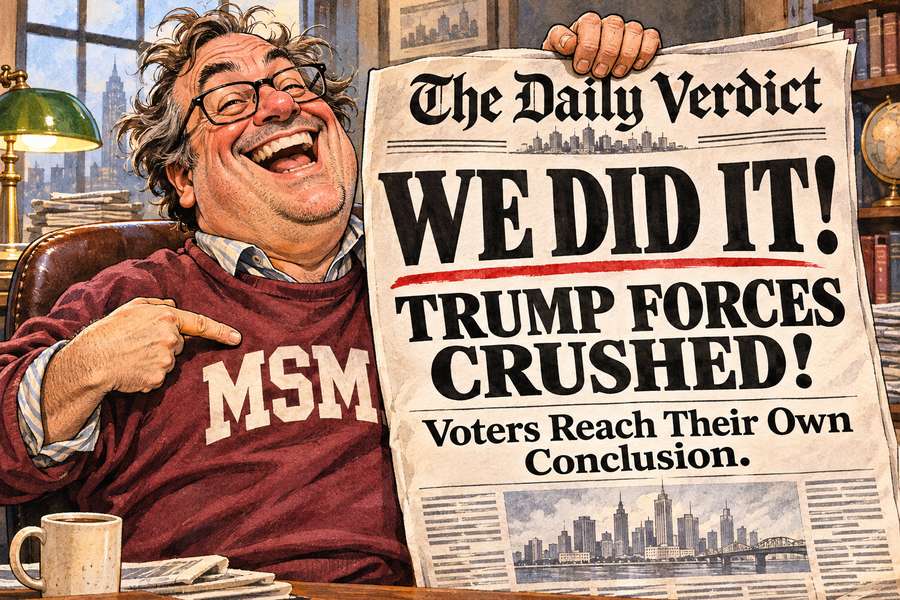
What role did the mainstream media (MSM), which is now explaining that verdict to us, play in producing it?
The American electorate has swept Democrats into control of the House and Senate. The verdict being offered is familiar: voters have rebuked Donald Trump and his party. He has disappointed their hopes; they have rejected his leadership. That is certainly one story of the election. But there is another: What role did the mainstream media (MSM), which is now explaining that verdict to us, play in producing it?
For years, the national press has subjected Trump, his administration, and his family to the most sustained, inventive, ferociously indignant condemnation ever directed at an American President. I cannot demonstrate that; I think it is self-evident. Reading the New York Times, one could imagine that the editors no longer need a daily news conference to decide the next day’s lead. The assignment, too, is self-evident: Find today’s variation on “Trump f–ked it up, again.” Investigate, dig, push: it is there!
Where is the examination of the media’s own contribution?
Now, when voters render the judgment that such coverage has invited, the press reports the result as a verdict on the president. But where is the examination of the media’s own contribution? If it claims the power to inform the electorate, it cannot become inconsequential the moment we ask how the electorate came to be informed.
It is highly suggestive that the hostility has a context broader than journalism. Conservative commentator David J. Harris Jr., in a Facebook post, expressed that context with admirable succinctness: “I watched…as the Mainstream Media…, the FBI, intelligence agencies, the CIA, Big Tech, and the entire Washington establishment joined forces in an unprecedented campaign to destroy a single man.
“The numerous lawsuits, the two impeachments, the endless hoaxes including the Russia one, the Mar-a-Lago raid, the gag orders, the efforts to remove him from the ballot, the attempts to bankrupt him and throw him in prison… all…at preventing him from returning to power. Two attempts on his life followed.”
Harris’s commentary thus characterizes the broader landscape of the campaign to defeat Trump; a campaign accompanied at every step by endless negative news stories and editorials. Election maven Karl Rove points out that before the voting 90% of those polled said government corruption was a ‘crucial’ or ‘major’ factor in their vote. No one following the media coverage of Trump could miss the thousands of headlines reporting, but more often insinuating, skullduggery. Voters went to the polls with that foremost in mind.
The answer from Trump’s critics? His words and actions merited the criticism. His administration provided the events. Journalists reported them. If the resulting portrait was ugly, the responsibility belongs to the sitter. Voila! an exemplification of the objectivity of contemporary media reporting.
That answer does not settle the question. Were the selection, emphasis, language, and repetition through which Americans encountered this presidency proportionate to the facts?
We can begin with something more useful than swapping impressions. In a 2022 national survey of 1,600 American journalists, reported by Lars Willnat, David Weaver, and Cleve Wilhoit, 35.4 percent identified as Democrats and 3.4 percent as Republicans. Most, 58 percent, identified as “independents” (I mean that is what you are supposed to be). Their outlook: 53.4 percent self-described liberals and 7.1 percent self-described conservatives.
Their outlook: 53.4 percent self-described liberals and 7.1 percent self-described conservatives.
No, we cannot assign a party label to every reporter’s work. But the ideological imbalance is substantial. When a profession avows allegiance to diversity, is it reasonable to ask whether differences in political ideology belong in the discussion?
Consider findings from Harvard’s Shorenstein Center on Trump’s first 100 days in 2017. Among reports assigned a positive or negative tone, 80 percent were negative; neutral reports, roughly a third of the total, were excluded from that calculation. CNN and NBC had more than 13 negative reports for every positive one. The New York Times registered 87 percent negative, and the Washington Post 83 percent.
Its author, Thomas Patterson, was quick to emphasize Trump’s self-inflicted difficulties. Trump supplied some two-thirds of the sound bites in his coverage. The extraordinary evidence of the negativity of Trump’s treatment does not, in itself, imply a verdict on its justification. And yet, sitting through the CNN nightly news month after month (one’s spouse may insist on watching it), it is surreal to watch the fashion model called a “news anchor” gravely gaze at the “guest” and say [I am creating a composite case here] “As the chairman of the Georgia State Democratic Party,” do you have a comment on the case against Rudy Giuliani for slandering a Black Democratic election worker and the prosecution’s demand for a settlement that would strip Giuliani of all his financial resources?”
“Yes, ma’am, I totally agree with the prosecutor.”
Retractions extracted from the media have been legion, but not widely publicized:
CNN issued a formal retraction and apology after publishing a story that wrongly linked Trump associate Anthony Scaramucci to a Russian investment fund, an error that led to the resignation of three journalists.
Politico published a report claiming that Trump owed money to the Bank of China, and later had to acknowledge and correct the error after it was revealed that the bank had sold its stake in the loan years earlier.
Critics and the administration have pointed to segments on networks like CNN—such as discussions questioning Trump’s daytime alertness or health—as examples of reliance on unverified or cherry-picked framing rather than official medical reports.
And so it goes. Reporters are driven to root out stories damaging to demon Trump—and they do—and editors greet them with gratifying praise. I experienced it myself early in my career as a reporter. I duly brought my story (my “takes”) to the city desk guy. This was a story about what was viewed as a commercial threat to the city. He brought my story back again and again, tossed it on my desk, and said: “Dig more.”
It was 11:00 p.m., and I could not go home until I finished the story. I began to make it up. Not to create new facts but to use language to put “spin” on the story that conveyed the required message: something is very wrong here.
It passed with the city editor. Done. In no sense am I comparing my position and importance to the universe of the Times. But human psychology, motives, and imperatives are generalizable, if not universal. Do you imagine the same thing cannot happen in the city room of what Allen Drury in Capable of Honor mockingly called “The Greatest Publication That Absolutely Ever Was”?
A later comparison by the Media Research Center examined 660 presidential campaign stories on the ABC, CBS, and NBC evening newscasts from July 21 through October 25, 2024. It found 78 percent positive coverage for Kamala Harris and 85 percent negative coverage for Trump.
The source should be identified: MRC is an advocacy organization committed to exposing liberal media bias. Describing the source does not invalidate its evidence. The familiar pairing of 92 percent negative for Trump with 78 percent positive for Harris, incidentally, mixes election cycles. In that report, the 92 percent figure referred to Trump’s coverage in 2020.
On October 27, MRC reported that campaign coverage on those same three evening newscasts from September 28 through October 26 totaled 56 minutes and 44 seconds of unfavorable news for Republicans, compared with 18 minutes and 53 seconds for Democrats. Its analysts timed statements from journalists, politicians, and voters. That’s approximately a three-to-one ratio. It is a measure of selected campaign coverage on three programs during a specified period, not a census of American journalism. Nevertheless, a substantial imbalance in the material audiences encountered is a legitimate subject of inquiry. The subsequent defeat does not tell us whether the coverage merely anticipated it, helped bring it about, or did some of both.
There is more to bias than misstating facts. A newspaper can print accurate sentences all week while still giving its readers a distorted impression of the relative importance of events. The question is what happened to the other accurate sentences that never made it to the page. Remember the nightly, prominently displayed images of a defective lining of the Lincoln Memorial Reflecting Pool, while Ukraine fought for its national survival and Israeli forces sought to free hostages in Gaza—both stories with critical consequences for America.
One candidate’s indiscretion may become a recurring test of fitness for office; another may be dismissed as an unfortunate phrase.
A policy’s costs may lead the broadcast, while its benefits receive a paragraph days later. One candidate’s indiscretion may become a recurring test of fitness for office; another may be dismissed as an unfortunate phrase. A panel can include several people who disagree vigorously about tactics while sharing every important political premise. An opinion page can offer a rich variety of arguments within boundaries that its editors never think to examine.
Language works more quietly. Which proposal is a reform, and which is a rollback? Who is an activist, and who is an extremist? Such descriptions can be justified, but they should be earned through explanation. Attached as routine labels, they deliver a judgment before the reader encounters the evidence. So can the photograph chosen from a hundred frames, or the video excerpt that preserves an angry sentence and omits the qualification that followed it. ICE agents enforcing legal entry into the United States under Trump, as they did under Bush, Clinton, and Obama (all of whom deported millions more individuals than did Trump), were portrayed as fiends, brutes, and storm troopers when responding to protesters incited to violence nightly, day after day, by the media. In the end coverage focused on “Trump”—the “racist,” “white nationalist,” the “xenophobic” president.
Needless to say (the press already has), throughout all of this, the president entirely unnecessarily made himself an easy target. Mr. Rove summarizes:
“Mr. Trump’s frequent rallies made him the center of attention. He dominated coverage with wild accusations, sloppy insults, and over-the-top bragging. He weirdly focused on the physiques of male candidates. No discipline, no forward-looking message, no substantive line of attack. Just whatever came to his mind as he meandered for more than an hour at each rally. He called it ‘the weave.’ It was really a mess.”
That might be called “the soundtrack.” But the substance is what most deeply distressed those who hoped Trump would champion market economics, constitutionally limited government, cultural individualism versus the warring neo-Marxist collectives, and America’s rational self-interest in a parlous world. Instead, Trump has convinced us that either he has no concept of principle or, like the typical American businessman, is a philosophical Pragmatist—opposed to principle on principle. A commitment to limited government power, for example, cannot depend on whether the official exercising unconstrained power happens to be our man.
Tariffs marked the start of the second Trump administration by defying economic theory. Adam Smith, who more than any other intellectual figure conceived “capitalism,” with all the astonishing prosperity that has followed, began with his opposition to the tariffs that were the core of the pre-capitalist order: mercantilism. If the president treats a barrier to trade as an accomplishment, defenders of free markets must part ways with him. Nor should scrutiny of military commitments or the use of federal law enforcement cease just because people who dislike the president are the ones asking the questions.
The media are no longer a single national lecturer addressing a captive classroom. Fox News, talk radio, podcasts, social platforms like Facebook and Instagram, and independent publications offer powerful competing accounts. Pew’s 2025 research documented extensive partisan differences in the sources Americans use and trust. The phrase “the media” can obscure the very divisions an explanation needs to describe. Trump’s 2024 victory demonstrates that hostile coverage does not determine an election.
On November 5, a Wall Street Journal editorial broke from the media pack, even mentioning the media:
…wouldn’t you know, President Trump didn’t steal the 2026 elections after all. Democrats and the press spent months publicly fantasizing on variations of that theme. Would Mr. Trump send ICE agents to the polls? Command the 82nd Airborne to seize the voting machines? Order the U.S. Postal Service to do, um, something or other?
Turns out, this was another partisan panic attack…sadly become par for the course, from both parties. The difference is that when Mr. Trump rambles about phantom mass fraud and the SAVE America Act, he gets constantly refuted, including in these pages. When top Democrats suggest that the GOP is plotting to hijack elections, the media indulges them.
Now watch as all of those stop the stealers react to the Democratic victory this week by forgetting they were superspreaders of bad information.
What, then, would constitute reporting the “story gone missing”? A comparison of the issues emphasized and neglected before the election; a distinction between news reporting and declared opinion; an examination of whether comparable claims received comparable scrutiny. It would require studying audiences and exposure, rather than assuming that everyone watched the same broadcasts. Above all, it would require distinguishing the demonstration of unequal treatment from the much harder demonstration of its effect on votes. What I object to is granting the press an exemption from the intense daily investigation and scrutiny it selectively applies to other people’s conduct.
I imply no government remedy. A free press includes the freedom to be partisan, irritating, selective, and wrong. The answer is criticism, competition, disclosure, and better reporting. An administration that responds by intimidating journalists expands the very power over public discussion that defenders of liberty should oppose.
Yesterday’s election was an exercise of the voters’ authority. Their verdict stands. But the institutions that helped supply its premises belong on the docket for how it came about. I am waiting for a major newsroom to put that assignment on its own desk—and to pursue it with the energy it has brought to Donald Trump.

-

When Will the Real Midterm Election Story Be Reported?
-

Under the Big Top—The Political Three Ring Circus
-

O Catalonia! O Gaza! Political Romanticism Rolls On
-

Book Review: Dictators and Disinformation by Jay Friedenberg
-

The New Humanoid Workforce: When Labor Becomes Capital
-

Muddling Through—Until We Don’t
-

Part II: Can We Exorcise the Ghost from the AI Machine?
-

Can We Exorcise the Ghost from the AI Machine?
-

The Intimacy Marketplace Part II: The New Johns
-

The Intimacy Marketplace Part I: From Playboy to OnlyFans