
For Mastery of an Age, Swinburne Turns to Form to “Say It All”
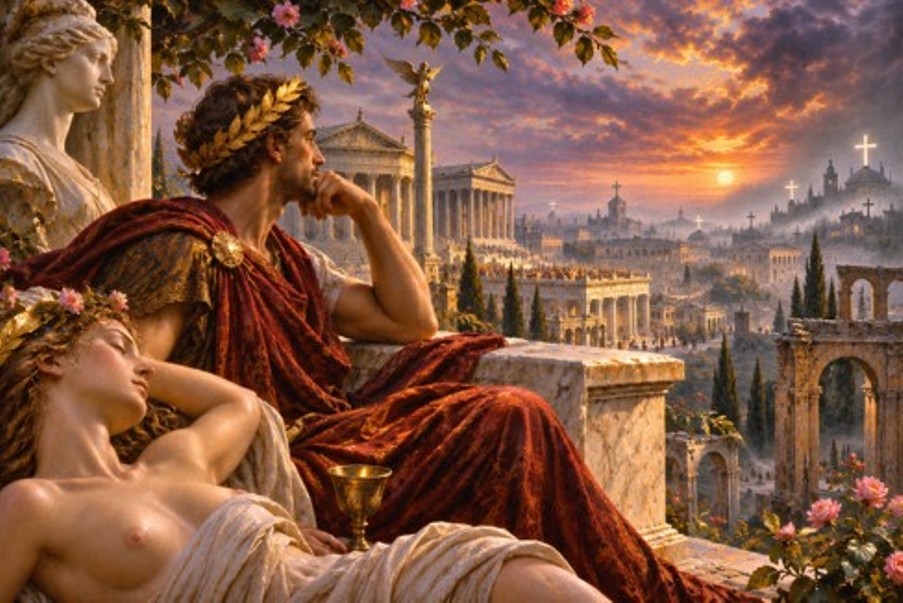
By Walter Donway
November 28, 2026
SUBSCRIBE TO SAVVY STREET (It's Free)
Wilt thou yet take all, Galilean? but these thou shalt not take,
The laurel, the palms and the pæan, the breasts of the nymphs in the brake;
Breasts more soft than a dove’s, that tremble with tenderer breath;
And all the wings of the Loves, and all the joy before death . . .
…Vicisti, Galilæe—“Hymn to Proserpine (After the Proclamation in Rome of the Christian Faith)”
By Algernon Charles Swinburne
The Victorian era, spanning the life of the great queen (1837–1901), was an age of seismic fractures: a past in which institutionalized religion had been challenged and shaken to its roots by the Age of Enlightenment’s philosophy of reason, science, and worldly happiness and a present striving anew for establishment, invigoration, and glorification of the age-old dominion of the Church of Rome. Culturally, this counter-reformation manifested as an anxious, hypermoralistic domesticity, where religious onformity functioned as social infrastructure. Philosophically, it was an era defined by a desperate, defensive dualism, fiercely attempting to partition sacred spiritual dogma away from the encroaching, secularizing touch of modern, material reality.
But a young intellectual growing up in the 1850s and 1860s confronted a world suddenly exploding the very concepts of time and history with the impact of the newly discovered, awe-inspiring geological “deep time” reckoned in billions of years and simultaneously new ages and epochs of Darwinian evolution. Religious orthodoxy itself was under direct attack from historical Biblical criticism.
Algernon Charles Swinburne (1837–1909) by natural endowment and by equipment came to internalize and then manifest these historical crosscurrents. Yet, his poetic triumph in his 1866 masterpiece, the 110-line dramatic monologue “Hymn to Proserpine,” is a kind of paradox: its elemental force is achieved not through the “liberating” abandonment of the art of poetry—later dubbed “free verse” (T.S. Eliot commented that “it is neither”)—but through the disciplined mastery of classical poetic form to express the strains, the fervid hopes and rueful anxieties, of a collapsing worldview. In an age struggling to make sense of science versus religion, reason versus faith, and the traditional versus the “radical,” Swinburne relied upon the most refined mechanics of versification to “say it all.”
The Architecture of Rebellion: Biography as Catalyst
To understand how and why “Hymn to Proserpine” works, we must first map the intense psycho-biographical contradictions of its creator. Swinburne’s boyhood was a crucible of religious orthodoxy in a devout High Anglican Church household—complete with aristocratic seaside manor and servants—in which the boy internalized the liturgical rhythms, scripts, and solemn gravity of Christian dogma.[1] Spending his boyhood mostly beside the ocean near Bonchurch on the southern coast of the Isle of Wight, and his father a navy admiral, Swinburne came to view the sea almost as a second church and spoke and wrote of swimming as a sacred ritual. He recalled of the waters of Monk’s Bay near East Dene: “Its salt must have been in my blood before I was born. I can remember no earlier enjoyment than being held up naked in my father’s arms and brandished between his hands, then shot like a stone from a sling through the air, shouting and laughing with delight, head foremost into the coming wave. . . . I remember being afraid of other things but never of the sea.”
To understand how and why “Hymn to Proserpine” works, we must first map the intense psycho-biographical contradictions of its creator.
When he writes about the sea, Swinburne’s language is mystical and metaphysical. It was his first passion. This can be seen throughout his work, including the “Hymn to Proserpine,” for he experienced immersion in the sea as a brief transcending of separateness and a recovery of unity with the All.[2]
Again, somewhat paradoxically, his traditional British schooling at Eton, then Balliol College, Oxford, exerted an intellectual centrifugal force on his view of the world. He famously pivoted from boyhood piety to a fierce, unapologetic and anti-Christian polemic. However, it was a revolt—and a life—complicated by a state of acute somatic tensions. Of unimpressive physical stature, he was plagued by nervous eccentricities, speech blockages, and physical frailties that sharply contrasted with his explosive, artistic ego. He constructed a self-image as a romantic rebel, an impassioned lover, and a transgressive artist—a vision all-too-often undercut by his own physical limitations.
His emotional reserves ran out in 1865, when his cousin and companion since literally the nursery, Mary Gordon, married another man.[3] Shattered, Swinburne retreated into the London bohemian scene, becoming heavily involved with Dante Gabriel and Christina Rossetti and the Pre-Raphaelite Brotherhood. For a time, he patronized the city’s flagellation (or “birching”) brothels that catered to wealthy clients seeking sadomasochistic experiences (famously dubbed “the English vice”). He had fixated lifelong on whippings he had endured, and now eroticized, while boarded at Eton.[4]
The Scourge of Notoriety: Art Beyond the Whipping Post
And so, we come face-to-face with the dark Swinburne legend. Nor can it be denied; he dramatized it in prose and verse, albeit sometimes anonymously. Thus, his legacy has been freighted with accusations of deviance, pathologized as a catalog of vices ranging from chronic masochism and alcoholism to the production of scalding, transgressive erotica (some like The Flogging Block under pseudonyms) in his poetry and novels. Critics of his atheism seize upon his patronage of Soho houses of ill repute and his flagrant flouting of domestic norms to argue that the speaker in “Hymn to Proserpine” is not an authentic philosophical voice. It is the voice of a grandiloquent rationalizer of shameless pagan indulgence. By this logic, Swinburne’s defense of the ancient Rome ethos is reduced to a self-serving attempt to elevate his human frailty into an aristocratic rebellion.
But that is to commit an all-too-common logical fallacy. The enduring authority of “Hymn to Proserpine” ultimately must be tested in aesthetic terms, apart from ad hominem inquisitions into the artist’s private behavior. And to commit the added fallacy of context dropping, for Swinburne’s thought and art are always serious: read his “Dedicatory Epistle” to Poems and Ballads[5] and see if you can disagree.
His life was fractured, but the intelligence of the verse is cohesive, deliberate, and structurally complete. The text does not read like the frantic justification of a libertine; it stands as a rigorous, historically informed meditation on civilizational decay, executed with a technical discipline that requires total intellectual sobriety. By looking past the tabloid notoriety of the man, the reader is forced to confront the absolute sovereignty of the page—proving that the metric architecture of a masterpiece remains true, regardless of the flaws within the crucible that forged it.
Yes, lesser minds would have dissolved entirely in the crucible that was Swinburne’s life, but his formidable intellect survived. He studied with the Oxford scholar Benjamin Jowett, advocate of historical criticism and a pioneer in bringing classical Greek philosophy into the modern Victorian consciousness. He discerned Swinburne’s rare genius and even shielded him from the consequences of his undergraduate high jinks, acting as an academic shield to prevent his permanent expulsion from the university.
Jowett’s curriculum immersed Swinburne in Aristotle, whose Nicomachean Ethics offered a thoroughly secular, rational framework for human fulfillment.
Jowett’s curriculum immersed Swinburne in Aristotle, whose Nicomachean Ethics offered a thoroughly secular, rational framework for human fulfillment—history’s most potent philosophical foil to the Augustinian obsession with original sin, mystical asceticism, and the systematic renunciation of worldly values.[6] Armed with Aristotelian rigor and a mind sharp enough to masticate the discoveries of contemporary geology and evolutionary science, Swinburne did not throw an emotional tantrum against his society. Instead, he reared an enduring monument of cultural criticism, using a dying Roman aristocrat as his persona to chronicle the cyclical death of empires and ideas—including Christianity.
The Journey Through the Poem
“Hymn to Proserpine”[7] is framed by an historical transition. Subtitled “After the Proclamation in Rome of the Christian Faith,” the dramatic monologue is set in the fourth century CE and keynoted by the apocryphal deathbed lament of Emperor Julian the Apostate in the epigraph: Vicisti, Galilæe— “Thou hast conquered, O Galilean.” From there, the reader is swept into a journey of deep psychological exhaustion and ultimate philosophical resignation:
“I have lived long enough, having seen one thing, that love hath an end;
Goddess and maiden and queen, be near me now and befriend.”
From this opening couplet, the narrative may mirror Swinburne’s own post-1865 desolation. The speaker bypasses the triumphant, newly institutionalized Christian god, turning instead to Proserpine, the ancient goddess of death, sleep, and seasonal cycles. He assesses the new Christian faith not as a divine revelation, but as an aesthetic and spiritual blight upon human civilization. The core of this civilizational indictment arrives in the poem’s most famous, stinging couplet:
“Thou hast conquered, O pale Galilean; the world has grown grey from thy breath;
We have drunken of things Lethean and fed on the fulness of death.”
By labeling Christ the “pale Galilean,” the poem characterizes the Christian apparatus as an engine of physical and cultural anemia. As an explicit rejection of the world’s vibrant, tactile surfaces in favor of a morbid obsession with mortification and the afterlife. To this gray, ascetic system, the speaker defiantly contrasts the rich, multi-textured legacy of pagan antiquity—a culture that celebrated civic beauty, natural philosophy, an ethos of human flourishing, and earthly existence. The journey through the poem becomes an argument between the joyful, sensory celebration of the material world and a theology that demands the systematic renunciation of worldly values.
The Climax of Worldly Culture: Reclaiming the Nymphs
The intellectual pivot is the speaker’s challenge to the dogmatic authority of the incoming faith, asserting that the visceral reality of human culture and natural beauty cannot be entirely wiped clean by dictate or decree:
“Wilt thou yet take all, Galilean? But these thou shalt not take,
The laurel, the palms and the pæan, the breasts of the nymphs in the brake;”
It is a brief for human vitality. Enduring elements of earthly joy—the triumphal laurel, the communal pæan, and the sensory realities of love—ultimately outlast the strictures of religious dogmatism and theological enforcement. Rejecting submission to the panic of a changing era, the speaker adopts instead an encompassing perspective. Influenced heavily by Victorian advancements in geology and evolutionary science, Swinburne views both the old pagan gods and the new Christian deities through a macro-historical lens. “Time and the Gods are at strife,” reducing all human religious systems to transient ripples within a vast, indifferent ocean of cosmic history. Addressing the gods, he writes:
“Will ye bridle the deep sea with reins, will ye chasten the high sea with rods?
Will ye take her to chain her with chains, who is older than all ye Gods?
All ye as a wind shall go by, as a fire shall ye pass and be past;
Ye are Gods, and behold, ye shall die, and the waves be upon you at last.”
The Crucible of Craft: Verse as the Preservation of Fury
Yet, to trace the narrative arc of the speaker’s displacement is to map only half of Swinburne’s achievement; the deeper mystery lies in how this transgressive point of view survived the century at all. In our contemporary literary landscape, dominated by a postmodern preference for free verse, there is a pervasive illusion that raw emotional rebellion requires an equally fractured, unstructured medium. Modern practice implies that to express chaos, the form must be chaotic. But Swinburne understood a secret that would later animate the mature work of William Butler Yeats: that profound cultural grief and radical political fury only achieve historical permanence when they are subjected to the crushing pressure of strict formal architecture.
Swinburne did not abandon the ancient tradition of English versification; he mastered it.
When Yeats in “September 1913” lamented that “Romantic Ireland’s dead and gone, / It’s with O’Leary in the grave,” he did not scatter his disillusionment across a loose, conversational page; he clad it in seamless iambic tetrameter and a relentless, interlocking rhyme scheme. The form became the sarcophagus that kept the emotion from evaporating into the historical ether. Swinburne operated on this identical aesthetic principle. He recognized that a sprawling, unstructured emotional outburst against Victorian orthodoxy would fade like the ephemeral rhetoric of a seasonal political campaign. If “Hymn to Proserpine” was to carry its controversial validation of worldly, pagan vitality across generations, it could not rely on the stylistic indulgence of prose or the liquid formlessness of unstructured lines. It required an acoustic engine that time itself could not stall. To immortalize a mutiny against the absolute authority of his age, Swinburne did not abandon the ancient tradition of English versification; he mastered it.
Why Free Verse Could Never “Say It All”
Indeed, that is a structural imperative because the defining characteristic, the very definition, of poetry is verse—metrics.
Thus, what makes “Hymn to Proserpine” immortal is not its viewpoint, or not just that, but its execution. Only mastery of “the great tradition” of verse metrics—along with structured rhyme, alliteration, and assonance/consonance—could raise his rebellion above the flood waters of literary anonymity. Indeed, that is a structural imperative because the defining characteristic, the very definition, of poetry is verse—metrics. What else distinguishes it essentially from prose? Prose maps information linearly; verse anchors experience rhythmically. Poets may dispense with punctuation, feature idiosyncratic line breaks, and avoid surface intelligibility to signal “this is poetry”—but they do not make it poetry. Without meter and the variations played upon it to achieve distinctively poetic effects, language loses its best tool for simulating the heartbeat, the tide, and the physical weight of time. Thus, Swinburne reached back to classical antiquity, constructing the poem in an accentual rhythm close to the dactylic hexameter of Homeric epic. By structuring his lines around six heavy, cascading stresses, he infuses the poem with a physical, rhythmic momentum. Readers do not merely comprehend the passage of time; they feel it physically through the wave-like, crashing cadence of the verse.[8]
To concretize this phenomenon, one need only analyze the metrical mechanics of his most famous declaration. Swinburne blends dactyls (/ ˘ ˘) and anapests (˘ ˘ /) into elongated, six-stress lines that roll forward with oceanic force. Consider the line:
˘ Thóu | hast cón | ˘ quered, O | pále | ˘ Gali | leán; | ˘ the | wórld | has grown | gréy | ˘ from thy | breáth.
Swinburne alternates unstressed breaths with hard, muscular stresses, culminating in insistent heavy accents (“grey from thy breath”) that simulate a literal closing off of cultural oxygen. When the speaker turns to challenge Christ directly, the metric architecture accelerates into pure, defiant driving anapests that carry a kinetic, confrontational momentum that plain prose exposition can never replicate:
˘ Wilt thou | yét | take | áll, | ˘ Gáli | leán? | ˘ But | thése | thou | shalt | nót | take,
Furthermore, Swinburne’s intricate weaving of alliteration and assonance/consonance functions as an acoustic binder, giving the lines an authoritative, inevitable texture. This disciplined adherence to classical boundaries enables him to resonate with the dense friction of his upbringing, the crushing weight of a dogma that refuses to let go, and the sheer intellectual force required to transcend it.
Poetic architecture becomes the vehicle for his vision of cosmic flux. And suggests that only by formal mastery of versification of the highest order could a single poem put into play for all time the conflicts, the soul-searing passions, and the stark contradictions of an entire age.
The Apotheosis of Language: Form as Immortality
The wedding of radical thought with superb metric discipline elevates “Hymn to Proserpine” above a mere historical curiosity of the 1860s. The poem endures as a validation of the magic inherent in formal poetry—a still arcane, generative technology that modern exponents of unstructured (“free”) verse have discarded. Swinburne thus ensured that his ideas would evade the standard censorship of history. The poem does not merely ask for agreement; it captures the reader’s nervous system, forcing subsequent generations to mentally rehearse the very rebellion his Victorian contemporaries sought to suppress. The architecture of the verse creates a permanent, resonant chamber where the voice of the dying Roman aristocrat retains its vital heat, defying the cultural freeze of any subsequent orthodoxy.
It is this transcendent quality of craftsmanship that reveals the deepest law of literary survival, a principle later summarized by W.H. Auden in his elegy for William Butler Yeats:
“Time that is intolerant / Of the brave and innocent . . .
Worships language and forgives / Everyone by whom it lives.”
History may judge Swinburne’s personal eccentricities harshly, and theological shifts may render his specific institutional battles obsolete, but time bows to the mastery of form. Time forgives the iconoclast because he gave his rebellion an immortal body. In “Hymn to Proserpine,” Swinburne turns to the oldest, most refined mechanics of verse for the power to “say it all”—and to ensure that the world never can forget what was said.
Endnotes
[1] For a comprehensive biographical exploration of Swinburne’s shifting relationship with High Anglican dogma and his eventual turn toward intellectual atheism, see the curated resources on the Poetry Foundation Overview (https://www.poetryfoundation.org/poems/45292/hymn-to-proserpine-after-the-proclamation-in-rome-of-the-christian-faith). [2] Rikky Rooksby, A. C. Swinburne: A Poet’s Life (Palgrave Macmillan, 1997). Verified via the Internet Archive Print Collection (https://archive.org/details/acswinburnepoets0000rook). [3] The deep emotional relationship with Mary Gordon and its profound impact on the melancholic, exhausted thematic openings of his 1866 verses is documented in the historical commentary featured on the Victorian Web Biography (https://victorianweb.org/authors/swinburne/hymn.html). [4] Historical contexts regarding late-Victorian domestic friction, institutional environment, and subcultural spaces are archived in the historical overviews at the London Telegraph Digital Edition (https://www.telegraph.co.uk/travel/destinations/europe/united-kingdom/england/london/articles/victorian-london-facts/). [5] Algernon Charles Swinburne, “Dedicatory Epistle,” Poems and Ballads. For a full breakdown of Swinburne’s defense of structural artistic seriousness, look to the historical commentary hosted on the Victorian Web Literary Criticism Archive (https://victorianweb.org/authors/swinburne/buron10.html). [6] For a detailed analysis of Benjamin Jowett’s controversial classicism at Oxford and how his translations of Plato and structural treatments of Aristotle provided a secular framework for Victorian intellectuals, consult the Victorian Web Jowett Collection (https://victorianweb.org/authors/swinburne/buron10.html). [7] Complete text formatting and lines of “Hymn to Proserpine (After the Proclamation in Rome of the Christian Faith)” can be cross-verified via the Poetry Foundation Database (https://www.poetryfoundation.org/poems/45292/hymn-to-proserpine-after-the-proclamation-in-rome-of-the-christian-faith). [8] The complete metrical text, including the iconic direct challenge to the “pale Galilean,” is preserved in the digital historical collections at Project Gutenberg’s Poems and Ballads edition (https://www.gutenberg.org/files/35402/35402-h/35402-h.htm).

-

For Mastery of an Age, Swinburne Turns to Form to “Say...
-
The GOP Midterm Debacle
-
The Science of Fiction
-

Free Will and The Brain
-

When Will the Real Midterm Election Story Be Reported?
-

Under the Big Top—The Political Three Ring Circus
-

O Catalonia! O Gaza! Political Romanticism Rolls On
-

Book Review: Dictators and Disinformation by Jay Friedenberg
-

The New Humanoid Workforce: When Labor Becomes Capital
-

Muddling Through—Until We Don’t